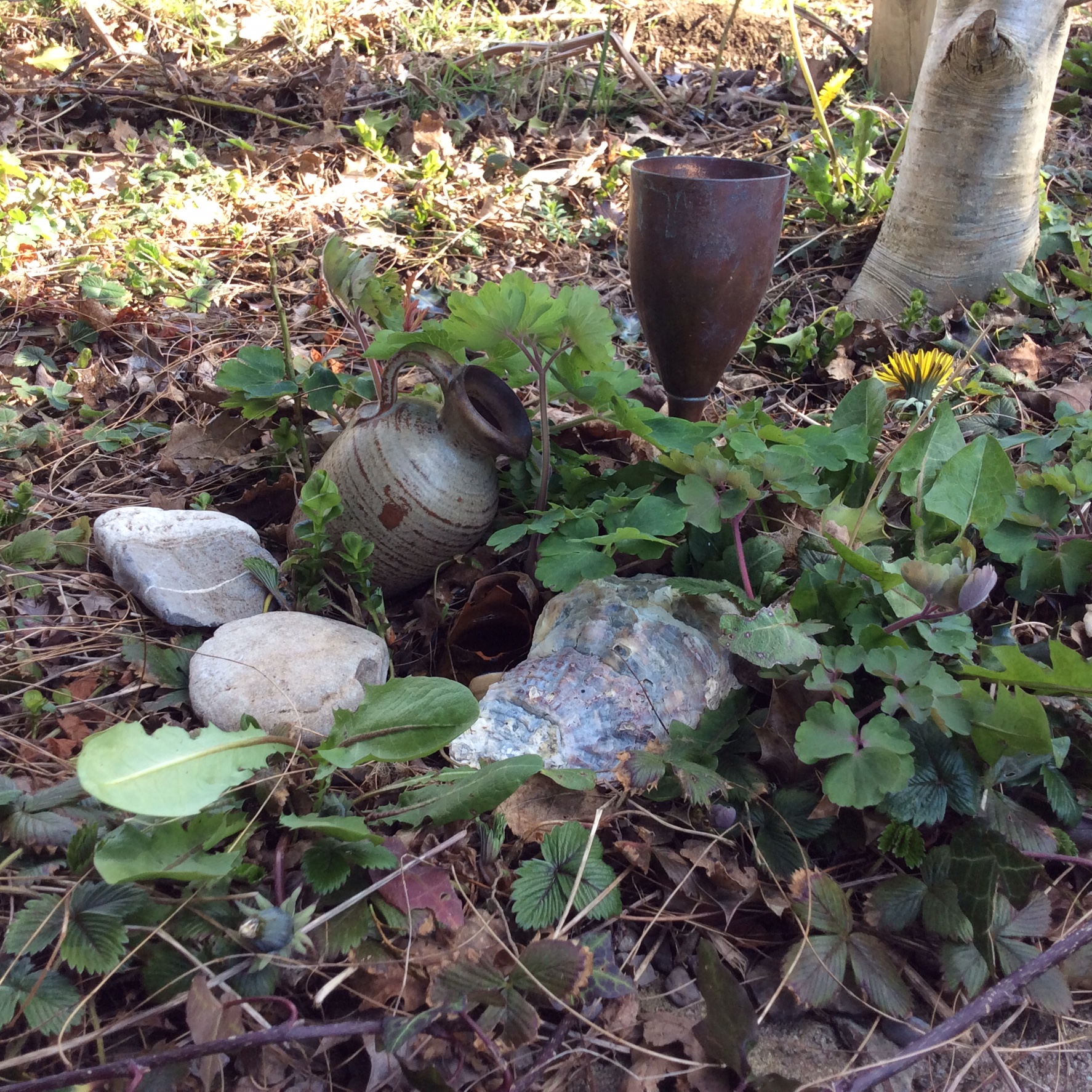
The stones for Belisama were collected by Lorna Smithers and shared with myself and Lee Davies as part of a meeting to discuss the BRYTHON project. A BRYTHON blog will ensue at Calan Mai.
Consider the stories from Greece about Hades and Persephone, which operate at the purely mythic level and Orpheus and Eurydice which enacts the same mythic pattern but sets it as a story about humans rather than gods. In the first Hades snatches Persephone away to his dark realm and her mother Demeter eventually manages to rescue her but only on the basis that she spends half the year in Hades and half in the world we know. This is a story about the gods and the turning of the seasons. Now consider the story of Orpheus and Eurydice. As with many Greek stories about interactions between the worlds, the human characters concerned have some divine ancestry but live as humans in our world. Eurydice is bitten by a snake and dies so her husband Orpheus, a musician with divine gifts, one might say inspired by the Awen and so godlike in his nature, goes to the Land of the Dead and plays his music charming Hades into releasing her, though the condition that he must not look back until they are both in the open air introduces a tragic dimension that is often a feature of the Greek stories. This feature often translates to an ironically comic view of human frailty as in the Roman Ovid’s re-telling of the tale.
So what we have here is a basic myth of a goddess being snatched away by a god into his realm and her return being allowed for part of the year and a parallel story of a woman being taken into this realm and her release negotiated, though not successfully achieved. The story is different but the mythic pattern is the same. In Ireland this pattern occurs in the story of Midhir and Etain. There are two versions of this story which echo the differences between the two Greek stories. In one they are both inhabitants of Tir na Nog (i.e. both gods) but in another version Etain is human and is carried off by Midhir, a king of the Tuatha de Danaan, after he tricks her husband and wins her in a game of chess. The cultural context here is very different and firmly embedded in the mythical history of Ireland. But, again, the mythic pattern is the same.
Celtic otherworlds may be in caves or under hills, beneath lakes or seas, or on far-away islands. The variety of location and context reveals a multi-layered inheritance in how these worlds are perceived and how they tend to fuse, in later literature, in a more generalised experience of Faery or, more trivially, Fairyland. In both these latter cases most often this is an inaccessible place that may be glimpsed but rarely visited though its inhabitants may well also inhabit our world. In an article about the Welsh name for the Otherworld, Bernard Mees and Nick Nicholas remark that ” the Welsh name Annwfn … suggests an etymological notion of an otherworld” [see below*]. Suggested Brythonic origins of the name are *an-dubnos (‘not-world’ or ‘not-deep'[deep-notness?]) or *ande-dubnos (‘underworld’ or ‘under-deep’). Also discussed is a Gaulish word antumnos, used in calling upon Dis or Prosperpine and therefore suggesting a nether world of darkness rather than a paradisal parallel realm.
The probable Greek origin of antumnos also suggests a dark, underworld location. The authors of the article find it unlikely that the supposed Brythonic term *an-dubnos was used without knowledge of its associations with the Greek Underworld. This may imply that its later associations with the ‘Hell’ of Christian tradition is not entirely a later overlay. Rather, as Mees and Nicholas suggest “… the entrance of the term to early Brythonic might even be plausibly connected with the development of the dual nature of the Insular Otherworld and Graeco-Roman influence: paradisaical and ageless on the one hand, sinister and Stygian on the other.”
In this view, it seems that the Brythonic Celts wanted it both ways, not wishing to abandon the idea of a blissful parallel dimension to their own world but also paradoxically seeing it as a dark Underworld where the souls of the dead reside. If the fabric of these alternatives appear to have little in common with each other this may be because, for us, ancestors and other-beings seem to require differently imagined locations. But do they?
In Britain the story exists in various folklore and literary versions including the Shetland ballad ‘King Orfeo’ and the Breton lay ‘Sir Orfeo’. Both conceive of the place into which Orfeo’s wife Heroudis is snatched as a domain of Faery. The confusion between this and the Land of the Dead is expressed ambiguously in these tales. ‘King Orfeo’ has the lines “The King of Faery with his dart/Has pierced your lady through the heart” possibly suggesting death but also, potentially, enchantment. ‘Sir Orfeo’ portrays the land that Orfeo enters as one where the folk who had been captured were “thoughte dede and nere nought” (seemed dead but were not) but a few lines further on “some dede and some awedde” (some dead and some mad). I wrote my own concise distillation of these British versions some time ago HERE. Lorna Smithers also discusses ‘Sir Orfeo’ and the nature of the Otherworld in her own inspired exploration linking with some different contextual matter HERE where the overlay between Annwn and the Land of the Dead is also discussed. The mythic pattern of capture and release from the Otherworld may also be seen in the story of Rhiannon in the Third Branch of the Mabinogi tales where it is Manawydan who rescues her. Again the cultural context changes but the pattern remains. The medieval Welsh poem of ‘The Girl in Ogyrfen’s Hall’, discussed recently on this blog, I think gains much of its power from its concentration on just one aspect of this mythic pattern. The gods live in an Otherworld which is parallel to and connected to our world. The seasons come and go as the gods move between the worlds, life leaving the land and returning in due season. So that land is also the Land of the Dead, where the ancestors dwell, just as they also dwell in the landscape that we know, their embedded actions in shaping and naming the landscape and the memories of their lives, their spirits, their being here with us which is also there in the Otherworld where the cauldron of re-birth gives them new identity.
So the mythic world of the gods is also our world, the legendary world of those semi-divine or heroic figures who have visited that world also inhabit our own world, and so it is there for us too if we would see it. Or it is ‘other’ if we choose it to be so.
[*]Bernard Mees and Nick Nicholas in Studia Celtica XLVI (2012) pp.23->
See also Gwilym Morus Baird’s discussion of ‘Dwfn’ in relation to Annwn HERE
Though you are absent, I feel your presence,
A space in the landscape where you would be,
An echo returning from this very place
In the Otherworld where you followed Pryderi.
Did he go there to claim his birthright
In the country you left to be with us here?
Did you follow to give him your blessing
Leaving only the wraith of a riderless mare
To haunt the borders between us and Annwn?
For now we live with your memories lingering
Like elusive scents from a summer that’s gone
Or the sounds of your birds so sweetly singing.
In the unwoven woods Manawydan awaits you
Keeping the keys for the expected day
To open the gates when you will come riding
On a shining white horse in bright array.
In the Third Branch of the Mabinogi tales Rhiannon follows Pryderi into an enchanted fort and they are carried off to the Otherworld. Manawydan eventually manages to bring them back. According to the plot of the medieval tale an enchantment has been cast over their land by an otherworld sorcerer and Manawydan also breaks that spell. But I have interpreted these plot mechanisms as a means to explain the comings and goings of Rhiannon – here and in an earlier tale – from the Otherworld, thereby emphasising the mythological aspects of the tales with devotional intent.
To leave a devotional message for Rhiannon visit her shrine HERE
As I am Merlin
And again Taliesin
Eternal my singing
My prophecies unending.
So runs the lines of part of the ‘conversation’ (Ymddiddan) between Merlin and Taliesin in The Black Book of Carmarthen. In what sense can two people speaking to each other be thought of as the same person? The lines have been translated as though they mean ‘I Merlin, and Taliesin before me’. There is, perhaps, room for ambiguity in ‘Can ys mi myrtin guydi taliessin’ and so expanding the lines to make sense of them could, indeed, yield that translation. A note to this line in Jarman’s edition of the Black Book indicates that the reading of ‘guydi’ (modern Welsh ‘wedi’ = ‘after’) is also construed as ‘before’, or ‘in the guise of’ in medieval Welsh. Consider too the words of Elis Gruffydd from his 16th century Chronicle of the Ages:
Some people hold the opinion and maintain firmly that Merlin was a spirit in human form, who was in that shape from the time of Vortigern until the beginning of King Athur’s time when he disappeared. After that, this spirit appeared again in the time of Maelgwn Gwynedd at which time he is called Taliesin, who is said to be alive yet in a place called Caer Sidia. Thence he appeared a third time in the days of Merfyn Frych son of Esyllt, whose son he was said to be, and in this period he was called Merlin the Mad. From that day to this, he said to be resting in Caer Sidia, whence certain people believe firmly he will rise up once again before doomsday.
(Trans Patrick K Ford. Viator 7)
The idea that Merlin and Taliesin were the same person in different guises was common enough for Elis Gruffydd to report it. Patrick Ford, discussing of the Taliesin legend in the Introduction to his Ystoria Taliesin, says that the two prophets are “aliases of a single poetic spirit” and hence the same figure appears in Irish texts such as the Senchan Torpeist bard identified as “the Spirit of Poetry“.
But can we identify that “spirit” as a god? Consider this from the discussion of the evolution of the Taliesin legend from Ifor Williams:
Stage 1
Taliesin was one of the old gods of the Welsh mythological tradition who developed a reputation as a bard or as an inspirer of the bardic arts.
Stage 2
Taliesin becomes a legendary bard (9th-10th c)
Stage 3
The poems, already becoming Christianised in Stage 2, become assimilated to the Christian tradition and lose much of their ‘druidic’ character though retaining an aura of this as part of the bardic ethos.
Chwedl Taliesin (O’Donnell Lecture 1955-6)
This legend developed separately from the poems written to Urien in the sixth century by the historical Taliesin, though they were later confused particularly when bards began to adopt the persona of Taliesin as an inspired awenydd.
So if he was (is) a god, which one? Perhaps the one who entered the shepherd boy in Henry Vaughan’s account of bardic possession in his letter to John Aubrey. If the shepherd lad is a type of the Divine Child and if the ‘ghillie’ of the Irish tale of Senchan Torpeist can also be so construed, is this an appearance, variously of Mabon (<Maponos) or Aengus Og (Mac ind Oc) both epithets of the Divine Child? Or is it, rather, that when the inspiration is breathed into them they become the god that breathes it. The source of the Awen, the divine breeze that blows through the world.
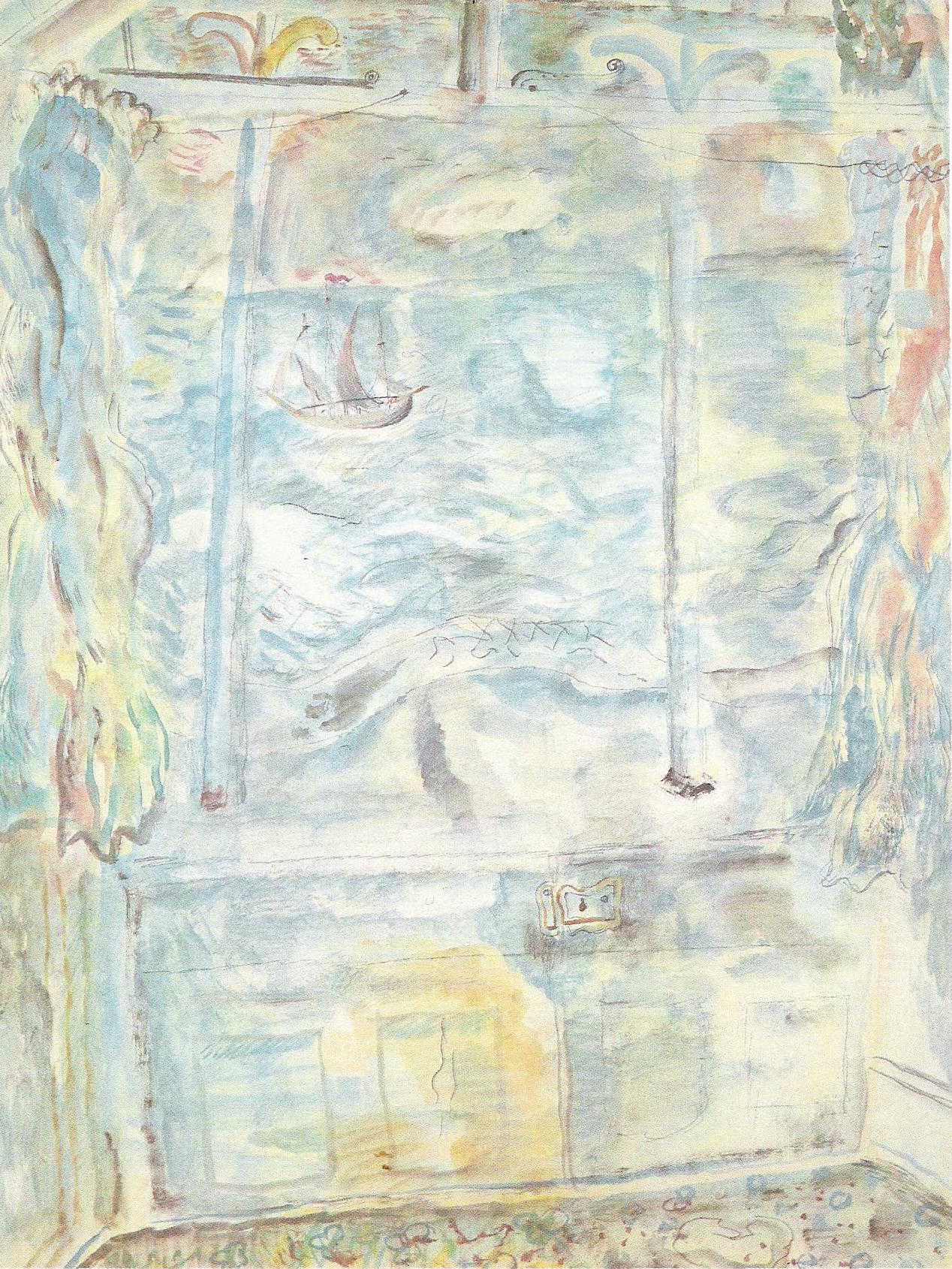
Manawydan’s Glass Door – Water Colour by David Jones
Weldy racco … y drws ny dylywn ni y agori –
Look there … the door we should not open
(Spoken by Manawydan as the Company arrive in Gwales with the head of Bran in the second branch of the medieval Welsh Mabinogi tales.)
Meditation
He has lingered at the doors of perception for so long I could not imagine him not being there. But never forthright, never an intrusive presence, sometimes barely a presence at all, as if he said:
“You wanted me for a god but I am not a god for you now … though I am here for you, for counsel should you want to listen – keeping the door that you might not open, but when you do open it telling you what I have to tell about the path that opens through it should you choose to listen, and take me for a companion, walking with you on that path. I am patient and will wait for days, weeks, months, years … longer if it is necessary, for the right time and until then I will be at the threshold watching from beneath my hood of shadow, like the shadow of trees in the corner of a field where the hidden path leads into the wood.
So you ask – or dare not ask – why I did not walk with Pryderi and Rhiannon when the door opened for them? When the Divine Son is snatched away and the Divine Mother follows as she did not follow before, then though I offer counsel which would be wise for you, for them, who are beyond counsel, I could only watch, and wait, and bide my time for action, to bring them back into the world, and bring the world back to its right shaping.
But for you … for you too I wait and will speak the words you need to hear when you need to hear them. The door is not locked; you have already seen through it. You know what is to be found there and that there is a task to fulfil when you walk that path.
But for now, learn patience. Do not call before the appointed time, do not bid me speak before I have something to tell you. But know that I am here for you, acknowledge me and I will hold my counsel and reveal to you its hidden depths: Standing aside from the busy-ness of the world to better see the way through and tell it in quiet words for those who listen.
This for you and for all of those.”
Reflection
When I was taught the art of focused meditation I always had a commentary, a reflection, on what I reported. So here I provide my own. Clearly this meditation results from many years of passive reflection on what it contains. Clearly too it contains things gained from study, from reading, from explorations of Brythonic lore, and so is not without some cultural influence. But it is not consciously shaped from these studies so much as emanating from having internalised them. Like the poet who has learned the verse forms and finds them providing a shape for the shapeless inspiration that is breathed through the breath of words.
So I knew that Manawydan was held to be ‘oet guis y cusil’ (profound of counsel). So I knew that he identified the door in Gwales that must remain shut for eighty years before the Company of the Head must leave their sojourn in that place and take the head of Bran to the White Mount and bury it there; … that he had refrained from claiming the lordship over Britain which had been usurped but retreated to Dyfed to marry the now widowed Rhiannon and ‘there was no woman more beautiful than she’; … that he lived simply but outwitted the Otherworld adversaries that had cast a spell over Dyfed and brought back Pryderi and Rhiannon from Annwn to live among us once again. All these things and more I ‘knew’ in the way that I knew how to breathe rather than as dry academic knowledge.
But more – I have perceived Manawydan on the edge of my meditations, my reflections, my perceptions of the Otherworld, the Gods, the deep presences of deity. And he has stayed there, biding his time quite apart from any cultural conception of him as a mythological figure, a cultural construct or a willed identity. So now as his hood is drawn back to reveal … what? I can only report his words as they came to me and, as he requests, acknowledge him as he has appeared to me.
*
A note on the painting by David Jones. The reproduction doesn’t do it justice. The original water colour paints have a luminosity that is almost transparent so that the outside and the inside of the room seem to flow into each other. The glass door is a boundary between the two, but one that allows the scene outside to be an extension of the space inside and the carpet similarly seems to flow out of the room. The two worlds are one. Yet they remain apart.
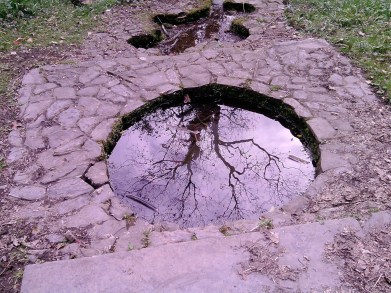
There is the story of a well in Ireland
that was abused so then could not be found
by any but the true seeker who would be led
to where it was by one who kept its secrets.
There is the story of a well in Wales
whose guardian was dishonoured so it flooded
and made a great lake, but she would come
from the waters to greet any with the right token.
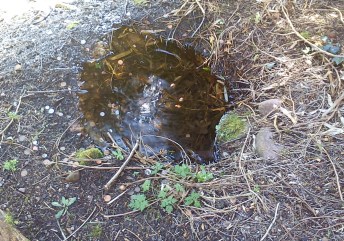
There are stories of The Well at the World’s End
that many seek for far away, but find
near to home where the Otherworld spring pulses
through in some hidden place in the world we know.
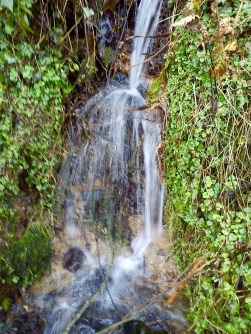
Seek out the source of the crystal waters,
the rising spring that runs into the gathering stream.
Speak out the spells that the well maid waits for
as a salve for her sorrows to wash away her pain.
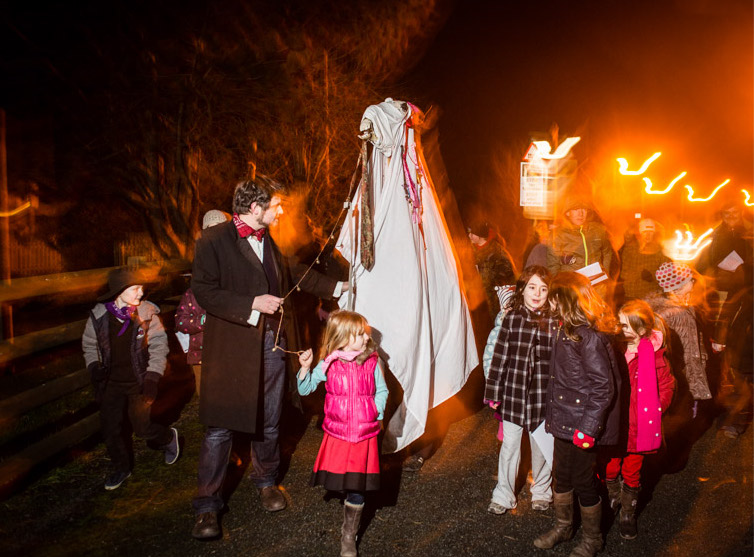
January 12 2013 People in Llandre village outside Aberystwyth Wales UK celebrate one of the strangest and oldest of Welsh customs as they take ‘The Mari Lwyd’ to visit homes in the community. The ‘Mari Lwyd’ (‘Grey Mare’ or ‘Gray Mary’ in English) is a Welsh midwinter tradition, possibly to celebrate New Year, although it formerly took place over a period stretching from Christmas to late January. It is a form of visiting wassail, a luck-bringing ritual in which a the participants accompany a person disguised as a horse from house to house including Public house pubs and sing at each door in the hope of gaining admittance and being rewarded with food and drink.
The custom of carrying a horse’s head around at New Year is a well established folk tradition in Wales. But how old is it? The example in the picture above from the village where I live is certainly a recent revival, seeking to maintain old customs and cultural survivals, and none the worse for that. Elsewhere in Wales, particularly in Glamorgan, the custom has a longer continuity. The name Mari Lwyd (Grey Mary) has been linked to ceremonies connected with the Virgin Mary, though the folklorist Iorwerth Peate, writing in the 1930s, thought that it should be construed as ‘Grey Mare’ and that it had its origins in pre-christian practices, possibly transferred to Mary in the Middle Ages. More recent folklorists have been reticent to make this connection and its continuity is doubted by Ronald Hutton. Nevertheless the custom has a deep resonance about it that connects with ancestral memories in a way that does not require proof of unbroken continuity.
The poet Vernon Watkins wrote of the custom in his ‘The Ballad of the Mari Lwyd’ in 1941. The whole poem covers more than twenty pages and alternates different voices, together with an ‘announcer’ to convey the New Year custom in Wales of carrying a horse’s head from house to house.
Here is an extract:
Mari Lwyd , Horse of the Frost, Star-horse and White Horse of the Sea, is carried to us.
[…..]
Midnight. Midnight. Midnight. Midnight.
Hark at the hands of the clock.
A knock of the sands on the glass of the grave,
A knock on the sands of the shore,
A knock of the horse’s head of the wave,
A beggar’s knock on the door.
A knock of a moth and the pane of light,
In the beat of the blood a knock.
Midnight. Midnight. Midnight. Midnight.
Hark at the hands of the clock.
The sands in the glass, the shrinking sands,
And the picklock, picklock, picklock, hands.
Midnight. Midnight. Midnight. Midnight.
Hark at the hands of the clock.
In the poet’s own note to the poem following its first publication he asserts that it was a well-established custom remembered from his childhood:
“Mari Lwyd – the Grey Mari, the Grey Mare – was a white or grey horse’s head modelled in wood, painted, and hung with ribbons, carried from house to house on the last night of the year.
The carriers were usually a party of singers, wits, and impromptu poets, who, on the pretext of blessing, boasting of the sanctity of what they carried, tried to gain entrance to a house for the sake of obtaining food and drink. The method they used was to challenge those within to a rhyming contest. The inmates would keep them out so long as they were not in want of a rhyme, but when they failed to reply to the challenger the right of entry was gained. The singers would then bring their horse’s head in, lay it on the table, and eat and drink with the losers of the contest.
The singers came every year to my father’s house; and listening to them at midnight, I found myself imagining a skull, a horse’s skull decked with ribbons, followed and surrounded by all kinds of drunken claims and holy deceptions. I have attempted to bring together those who are separated. The last breath of the year is their threshold, the moment of supreme forgiveness, confusion and understanding, the profane and sacred moment impossible to realize while the clock-hands divide the Living from the Dead.”
* *
*
Details of more recent practice of the custom can be found Here and there is You Tube footage with commentary Here. All of these recent enactments take place around New Year, but is this the right time for the practice? Iorwerth Peate thought that is properly belonged to Samhain and I have always thought of it in this way and many years ago wrote my own fictional setting for it in this context : Grey Mare of the Night. Its transference to New Year, however, may be significant of the movement from darkness to returning light. Vernon Watkins’ poem is seen from the perspective of those within the houses which are visited by the Mari. Many years later in the 1960s he wrote a sequel to the earlier ballad entitled Ballad of the Outer Dark. The later ballad in one sense picks up where the earlier one left off, the inmates of the house going out into the night bearing the horse’s head, taking the interpretation of the custom a stage further as if the Dark itself needed to be embraced as the voices move beyond the circle of Light.
Here the experience is not of being within the house but outside as one voice says:
The fire we loved, the hours we lived
Are snatched away by thieves.
and another voice responds:
We are ourselves the shafts of white
Those men of firelight mock.
And we must drift like flakes of snow
That know not where to rest,
So soft upon the night they go
Whom none will take for guest.
But the horse’s head is, in fact, brought in. The ancestors are met with on their own terms and go back to the land of the dead and the light returns for the living. So the later ballad in some ways completes the earlier one in transcending the rejection of the ‘Outer Dark’. This seems a plausible explanation of the custom of carrying the head of the Mari Lwyd from house to house at New Year though the custom itself seems to be resonant of the whole period from the coming of Winter at Samhain through to New Year Calends and the prospect of returning light at Imbolc.
According to the poem ‘Angar Kyfundawt’ in The Book of Taliesin the Awen is divided into “seven score ogyrven” with a further division of each of these twenty. Elsewhere in The Book of Taliesin, in the poem ‘Kadeir Teyrnon’ the Awen is simply asserted to be divided into three ogyrven, hence the three shafts of the Awen symbol as later interpreted. John Rhŷs asserted that
“three muses had emerged from Giant Ogyrven’s cauldron. But Ogyrven seems to be one of the names of the terrene god, so that Ogyrven’s cauldron should be no other probably than that which we have found ascribed to the Head of Hades”.
Celtic Heathendom pp 267-269
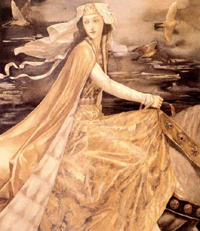
That Ogyrven is one of the names of the King of the Otherworld is also suggested in a poem by Hywel ab Owain Gwynedd (died 1170). Hywel was the son of Owain of Gwynedd by an Irish woman who lived in his court and was thus both within the privileged mainstream and to some extent marginalised and so was able to practise the art of poetry as the muse took him. At a time when the official court poets were mainly engaged in praise of military prowess or power he penned some delicate love lyrics, including one addressed to a girl “in Ogyrven’s Hall” who has captivated him though he cannot approach her as she stands – fair as the foam on the wave – watching seagulls glide around a hillside:
Unwilling to leave her (it would be my death)
My life-force is with her, my vitality ebbs
Like a legendary lover my desire undoes me
For a girl I can’t reach in Ogyrven’s Hall.
So here the Hall of Ogyrven is a place in the Otherworld (or the Otherworld itself) with a girl who has possessed the poet with unrealisable desire. Is she his muse? And if, as John Rhŷs asserts, Ogyrven is the God of the Otherworld or Netherworld, who is the girl and how could a poet dare to fall in love with her? Hywel says he would go to her on a white horse but “she would not have me” and also that her fairness flows out of her realm towards us.
Ogyrven, then, seems to be many-faceted not just in the variability of the number of divisions of the Awen, but in the identity of the figure from whom it originates or the number of cauldrons, seething without fire, from which it may emanate according to ‘Angar Kyfundawt’ a poem whose title refers to a malign alliance of uninspired poets. Hywel, clearly, was not one of these. The delicacy of his poem in its original Welsh with its patterning of sound and imagery defies adequate translation not so much of its meaning as of its quietly inspired intensity. Here is no boasting Taliesin but a poet shaping inspired words out of his inability to fully realise his aspiration to fulfil his desire in the Otherworld.
And Ogyrfen? Whether a god, a place, a flow of inspiration streaming out into many further streams, elusive as the girl that Hywel desires or as the words that will adequately describe her, we may, perhaps, catch in a glimpse in one of these streams, some sense of what it is to be inspired and the many aspects of Annwfn as experienced in our world.





 greghill.cymru