-
Awenau hear me
aid my song
As I write of the one
who is ever young:Maponos, the son
of Matrona – Mabon
Who from Modron was taken
out of the light of the WorldInto the darkness of unWorld
he was Maponos and not-Maponos
When the darkness held him
and he held the darkness about him.Matrona – who is Being – searched
but he was in not-Being;
She was in every place in the World
but he was in not-World,So she went there, and Being
was not, and light faded from World.. .
.Who was it held the key
to release them? Many storiesTell of heroes in the spring of World:
Manawydan breaking the spell
That lies on the land
for Rhiannon and Pryderi to return,Cei and Bedwyr riding the salmon
to find Mabon and bring Arthur
To release him from Caerloyw
out of the darkness into the light..
. .O Awenau, he is the one
who holds the harp, the lute, the lyre,
He is the one who contains your song,
He is the muse of Fire!.
-
The Greek poet Hesiod (c. 8th century b.c.e) prefaced his Theogony (Stories of the Gods) with an appeal to the Muses “Let us begin our singing”, and tells first of them. There were nine born to Memory: “Nine nights Zeus lay with her …. and she bore nine daughters”. They went then to Olympus “glorying in their beautiful voices and singing divinely”. Hesiod then tells how they inspire divine utterance in those they favour: Such is the Muse’s holy gift “and they told me to sing of the blessed ones who are forever, and first and last always to sing of themselves”. So Hesiod begins the work of writing his Theogony. Addresses to the Muse or muses also begin the Homeric Hymns to each of the gods from the same period, and Homer himself begins both his Iliad and his Odyssey with a similar appeal.
For the early Welsh bards the Muse was Ceridwen with her cauldron the source of Awen. So the nine maidens whose breath kindled the Cauldron of the Head of Annwn, as described in the Taliesinic poem Preiddeu Annwn, embody the sense of nine muses, daughters of a god, their breath inspiring awen in the bards they favour.
So their praises also should be sung.
O Muses / O Awenau
You whose breath kindled the cauldron
of awen in Ceridwen’s keeping,
breathe sweet music into my songsfor the gods, for the good life
they shape for us, to celebrate
their presence and their powerto move us and make for us
a world of meaning awakening
the kindled flame of the cauldronburning beneath the brew
of inspired speech in hearts
and minds with devotion that bindsour words in worship, our wish
to bring to all the gods a song
that will please, a gift of praise. -
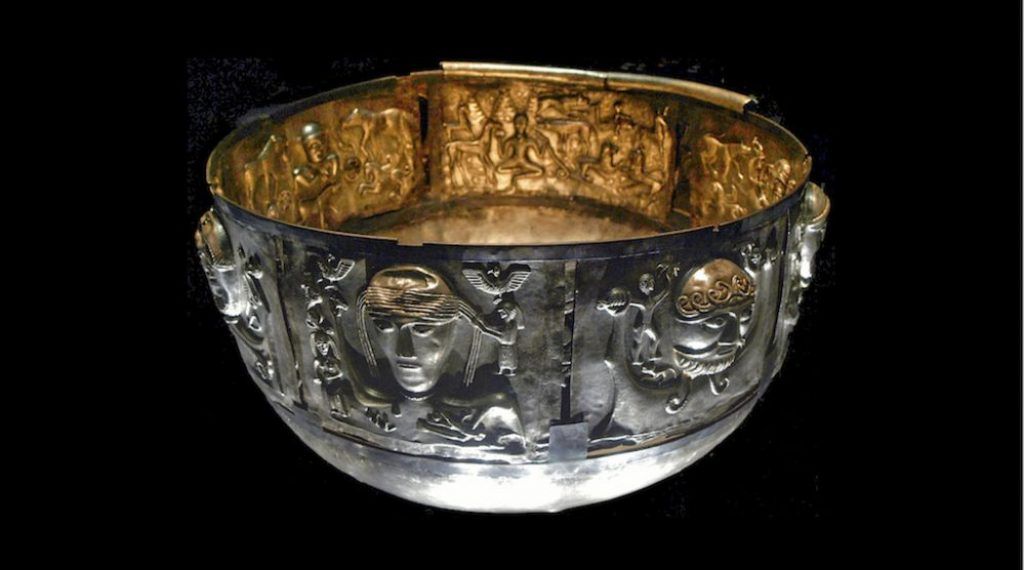
Gundestrup Cauldron The name CERIDWEN has had various forms and implications. Can we say which most clearly relates to its origin? The spelling with one ‘r’ given in this opening sentence is the most common in modern Welsh usage both as a given name and as a rendering of the name as used by the early Welsh bards. But CERRIDWEN is also often used by those referring to the character in the Tale of Taliesin and associated references in legendary texts. An attempt to unravel the uncertain origins of the name was made by Marged Haycock in 2003 where she also catalogued the various forms of the name in the early texts* . These mainly occur in manuscripts which have been dated to the Thirteenth Century, though they may, of course, be using earlier forms or 13th century adaptations of earlier forms. The Black Book of Carmarthen gives ‘Kyrridven’. Peniarth 3 gives ‘Kyrrytuen’, The Book of Taliesin variously gives ‘Cerituen’, ‘Kerrituen’ and ‘Kerritwen’, while the Red Book of Hergest gives ‘Kerituen’. So ‘-fen’ is the most common termination (a mutated form of archaic ‘ben’ : ‘woman’) and ‘rr’ is more common rather than the single ‘r’ of modern Welsh spelling. Whether the variations are due to different spelling patterns at different times and places, or by different scribes, or whether the different forms reflect developments in speech pronounciation is unclear. The difference between the ‘C’ and the ‘K’ initial consonant is clearly simply a matter of a different spelling convention to represent the hard ‘c’ sound. But the the following vowel, ‘y’ or ‘e’ could well represent a shift in actual pronounciation of the vowel sound.
Later examples include: ‘Cereidven’, ‘Cyridven’, ‘Caridwen’, ‘Cridwen’ and ‘Cridfen’.
Elis Gruffydd uses ‘K/Ceridwen’ in his 16th century version of the prose tale of how Gwion Bach became Taliesin, and K/Caridwen is also found in other sources of this tale. Hence Charlotte Guest’s popularisation of ‘Caridwen’ in the translation included in her Mabinogion.
What about possible meanings of the name? Ifor Williams ** asserted that ‘Cyrridfen’ is the most likely original form from ‘cwrr’ (bent, angled..?): ‘cwrr-rhid-ben’ (= woman with an angled joint, or ‘crooked back’) so fitting the stereotype of a witch; but later scholars since have thrown some doubt on this interpretation.
Marged Haycock also discusses:
-the first syllable as ‘cyr’ which could relate to ‘crynu’ so Cyridfen could be like the Gwrach Cors Fochno that makes people shake or shiver
-the first syllable as ‘crid’, judged to be “difficult” but ‘craid’ ( for ‘graid’) (passionate, fierce, powerful) is possible
-the second syllable as ‘ŷd’ (corn, relating her to a corn goddess like Ceres as some earlier antiquarians had supposed)
– her daughter Creirwy, with the first syllable a form of ‘credu’ (belief’) and so, by analogy, her mother’s name as Credidfen would mean ‘woman to be believed in’, making the mother’s and daughter’s name stems a pair.None of this is conclusive. Nor is there any surviving early evidence of divine origin as no references to her before the 13th century manuscripts exist and all references since seem to be based either on those manuscripts or the later prose tale which itself stems from them, or is an elaboration of more detailed earlier sources which have not survived. Many have, nonetheless, experienced her as divine or chosen to characterise her a witch or powerful enchantress on the basis of interpretation of the prose tale and the reference to her later in that tale by Taliesin when he says, “I was nine months in the womb of the witch Ceridwen”.
What the earlier poems emphasise is, rather, her keeping of the cauldron of awen and so a source of poetic inspiration. In the prose tale, she gives birth to Taliesin and then ceases to be part of the tale. In the bardic tradition this giving birth to Taliesin may be seen as inspiring his presence and inspiring bards to sing in his name. Certainly, many of them asserted this. Cuhelyn Fardd (1100-1130) spoke off being inspired by “awddl Cyridfen”, while Cynddelw Prydydd Mawr (1155-1200) acknowledged “Cyridfen” as the source of his art and Prydydd y Moch at the beginning of the 13th century specifically mentions the cauldron of “Cyridfen” as the source of the gift of awen. These and other references by identified bards are of course in addition to the many references by unidentified bards in The Book of Taliesin.
References
*Marged Haycock ‘Cadair Ceridwen’ yn Cyfoeth y Testun 148-> (Gwasg Prifysgol Cymru, 2003)
**Ifor Williams Chwedl Taliesin (Gwasg Prifysgol Cymru, 1957) -
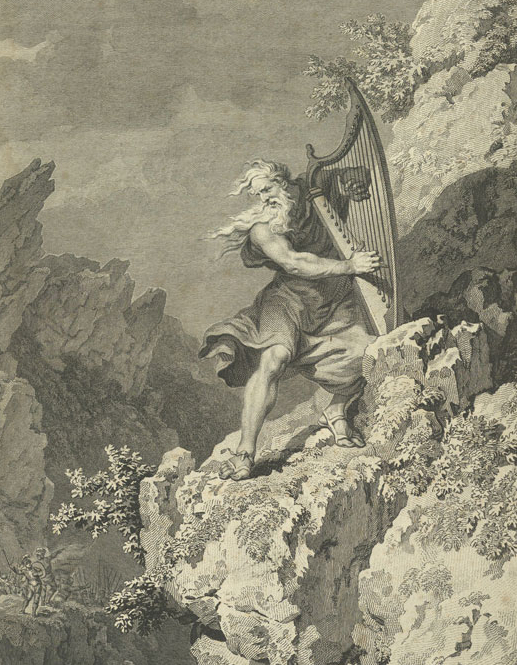
‘The Last Bard’
Frontispiece to Musical and Poetical Reliques of the Welsh Bards by Edward Jones (1784)The traditional view of the inspired bard or divine singer is of one holding a harp. This image goes back to the Greek Orpheus whose words and music could charm the gods. He was given a golden lyre – a type of small hand-held harp – by Apollo who taught him how to make music with it. In the Brythonic tradition we might think in terms of Maponos and Taliesin, although Taliesin’s most often identified source of inspiration is the Cauldron of Ceridwen and although he says “I was the string in a harp” in one of his many metamorphoses in Cad Goddeu, references to him playing a harp are few. One such is the ‘Elegy for Uthr Pendragon’ where he tells us:
I’m a bard,
I’m a harpist,
I make music
On a pipe
On a crwth;Seven score, or more
Could not match my skill,
My craft, my art …Surviving references to musical intruments used by the early Welsh bards are not common, though Gerallt Cymro in his twelfth century Description of Wales said “the Welsh use three instruments: the harp, the pipe and the crwth”; but the professional court bards tended to be contemptuous of the ‘lesser’ bards and entertainers who played such intruments. Here, though, in spite of singing his own praises as the greatest of poets, in typical boasting style, the Taliesin figure is happy to sing his praises as a musician too. As for other bards, at least one text relates the issuing of “a harp, a crwth and pipes” by a king to his poets*, and Llywarch ap Llywelyn (Prydydd y Moch) praises his prince “ â thafod a thant” (with both tongue and [harp]string).
Earlier practices in the Ancient World and in pre-medieval heroic society in different parts of Europe highlight the harp, and the lyre, and sometimes an instrument like the crwth, as an accompaniment to recitation. A 15th century Latin text on the history of the viol and similar stringed instruments comments that, before the development of a raised bridge holding the strings separately away from the body of the instrument, the flat-bridged arrangement would have produced a drone sound rather than individual notes and was used “for the recitation of epics” adding that this was common “over the greater part of the world”.** Such instruments might be played with a bow on the reciters lap or held out in front, rather than on the shoulder as with a modern violin. This suggests that bards and cyfarwyddwyr (story-tellers) had a choice of a steady drone or the sounds of single plucked strings on the lyre or the small harp when reciting, in addition to any music they might also make in the intervals to recitations or to accompany songs. In Welsh, the modern word ‘telyn’ for harp had a wider earlier usage to include the lyre and similar instruments, so the distinction may not always be clear. Similarly the crwth, often seen as an earlier form of the violin, may have overlapped in form with the lyra and the lyre before distinct forms of these intruments and the terminology used to decribe them became fixed.
Of particular interest here is the terminology used between Wales and Ireland. In Ireland one word for a small ‘harp’ was ‘croth’ which seems to indicate a crwth rather than what we would think of as a harp. But the word ‘teillin’ was also used, although it is not the current usage, which, as well as sounding like Welsh ‘telyn’ apparently, according to the Irish scholar Eugene O’Curry, could also indicate the sound of a buzzing bee***. We need to distinguish here between the small harps, or other instruments, which a bard might hold while reciting, and the larger harps used for musical recitals. The fluidity of terminology between harp, lyre and crwth probably reflected the fluidity of form of instruments so described.
Then there is the matter of strings. Traditionally the strings were made from woven horse hair. But in the later medieval period gut strings began to be used and, especially with the larger harps, strings of metal. Such strings made it easier to play individual notes, as with the strings of the viol with an arched bridge noted above, and so to perform polyphonic music. They gave a clearer sound for each note but the horse-hair strings produced a softer sound which seems to have been more to the taste of the bards. The distinction between ‘telyn lledr’ (gut strings) and the ‘telyn rhawn’ (horse-hair strings) was made in one 15th century poem by Iolo Goch, complaining that the new-fangled strings of gut (or “dead sheep”!) are inferior to those of horse-hair and make a harsher sound:
Un delyn , ddiddan angerdd
Onid o rawn, gyfiawn gerdd(‘a harp’s innate quality, its sweet tone/best from horse-hair, a well-made tune’ – ‘cerdd’ here can refer to either poetry or music).
In the same poem he reminisces about a past when there was time to ‘clera’ before the coming of the gut-stringed harp. To ‘clera’ was to go about as a minstrel, presumably singing and playing as well as reciting poetry. But as the professional bards were above such things, the clêr, or minstrels were a lesser grade of bard. But this strict grading does not seem to have survived the times of the independent Welsh princes and poetry in the later Middle Ages is more often associated with music and song as the bards travelled around the houses of the gentry to ply their craft and the difference between grades of bard disappears.
So Iolo Goch is not remembering back that far, but clearly the soft sweetness of a humming bee was more to the his taste than the sharp ringing of single notes. We might also think here of the drone sound of the flat-bridged viol used for recitation of epics noted above. Should we think also of the crwth, or croth/crotta related to the early Irish instrument so denoted? It seems anyway that there was a reversal of terminology between Wales and Ireland. What’s in a name if things so named are different? The crwth and the harp may well have developed separately from the lyre, as might the viol. Overlapping forms and names across Europe as new instruments were developed can make it difficult to pin down references to them in historical texts. But one scholar was prepared to declare that the crwth (‘crotta’) was certainly a Brythonic instrument***.
In addition to these considerations, the nature of bardic recitation and its relation to ‘song’ should be considered. The point of traditional bardic measures and verse forms is that they should be musical, and the bards were said to ‘sing’ rather than recite their verse. It is noteworthy that still today the modern Welsh word ‘canu’ can mean both ‘singing’ and ‘versifying’ and the related words ‘ynganu’ (‘recitation’) and ‘llafarganu’ (‘chant’, or literally ‘songspeech’) contain both the sense of speaking and of singing. So the voice made the music and was supported by the background sound of the strings. There could be music too, of course, as part of an evening’s entertainment. The chief bards at the courts of the Welsh princes may have thought themselves above such lighter forms of entertainment. But for Taliesin, even when his name was taken by one of these chief bards, though he thought himself seven score times their equal, the awen came through him in a multiplicity of forms in words, music and inspired song.
§
A poem containing conceits interacting with these deliberations appears on my Web Portal weblog HERE~>
§Notes:
*in The Black Book of Chirk (c.1200)** J Tinctoris , quoted in Ian Woodfield The Early History of the Viol (Cambridge, 1984)
*** A O H Jarman ‘Telyn a Chrwth’ Llên Cymru 6 (1962) Discusses O’Curry’s remarks.
Jarman’s comment on the crwth:
“Nid rhaid amau nad oedd y crotta yn offeryn ‘Cymreig’ neu Frytanaidd” -

Opening the door from the otherworld island of Gwales
Margaret Jones
Although is was said there was a gatekeper at Arthur’s court, there was not. But Glewlwyd Gafaelfawr was there ….”
Owein : The Lady of the Well
A gatekeeper is an elusive character. He may not be a gatekeeper. He may only keep that gate on certain days of the year, or only on 1st January, the gateway to the year. He may deny entry to those for whom, elsewhere, he keeps their gate. Like Glewlwyd Gafaelfawr (‘Brave-grey Mighty-grip’), who is the keeper of the gate (though not the keeper of the gate) of Arthur’s hall in different tales, as when Culhwch comes calling in the tale of How Culhwch Won Olwen* and the keeper of the gate in quite another hall where he refuses admittance to Arthur in the poem ‘Pa Gur yw y Porthaur?’(Who is the Gatekeper?) unless he can prove the worth of his men. He may also be the keeper of the gate for Wrnach the giant when Cei and Bedwyr come calling seeking the things Culhwch needs to wed Olwen, a detail which may be referenced in the poem ‘Pa Gur yw y Porthaur?’ where Cei’s exploits “in Awarnach’s hall” are alluded to when Arthur tells Glewlwyd of his heroic deeds.** This would, of course, be an elaborate and circuitous joke, but it also embodies the double-sided nature of portals.
If we are puzzled, who should we ask? Manawydan fab Llyr is said to be deep in understanding and counsel when Arthur tells Glewlwyd of the qualities of his men. He, too, is a gatekeeper, remarking the door out of the otherworld fortress of Gwales which should not be opened until the occupants are ready to leave. He also watches the Portal through which both Rhiannon and Pryderi pass in the enchanted fortress which appears on Gorsedd Arberth, and keeps watch until he is able to bring them back into the world again. His representation in the Mabinogi as one who patiently bides his time and in Triad 8 as “lledyv” (humble, subdued) suggests one who waits to act at the appropriate time. Consider, too, the Irish tale of Mananaan mac Lir who meets Bran out on the sea as he is passing to the otherworld islands. Manannan says the sea is for him like a grassy plain as Bran passes in his boat through the rolling waves and Manannan sends him on his way.
*This is one if the many ‘doublets’ in the tale How Culhwch Won Olwen, mirroring a similar incident in a parallel episode elsewhere in the tale as if on the other side of a gate in another tale.
** Rachel Bromwich commented “it seems likely that the two gatekeepers have been interchanged, and that Glewlwyd Gafaelfawr originally figured as the guardian of the fortress of Wrnach” and, a little further on, suggests that the poem would therefore represent an earlier version of the episode of Cei and Wrnach. (Trioedd Ynys Prydein, revised 2006 edition, p.362)
The question is posed HERE~> in a different way, and when you have returned from THERE~>, consider these links as a mirror of a window between two worlds. Who, then, is a gatekeeper?
-
The Awen in Welsh Tradition
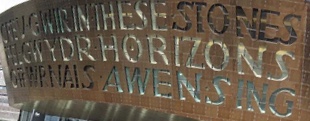
Words from Gwyneth Lewis on the Wales Millenium Centre, Cardiff Although ‘awen’is usually translated literally from Welsh to English as ‘poetic inspiration’ or ‘muse’, its resonance in Welsh is both broader and much deeper. In his poem ‘Mewn Dau Gae’ , the twentieth century Welsh poet Waldo Williams uses the phrase “awen yn codi o’r cudd …” (awen arising from the deep, or from what is hidden). In a commentary on his translation of this poem (1), Rowan Williams says that he didn’t feel able to translate the word ‘awen’ literally here because it would not adequately convey the sense in context, as it is “not just a matter of one poet’s imagination at work”. I would endorse that comment and add that it is just as much a matter of communal inspiration and a shared sense of something arising from the landscape and the ‘Deep’ from which the spirit of the landscape arises.
Rowan Williams further develops his discussion of awen in the Introduction to the translation from The Book of Taliesin which he has published together with Gwyneth Lewis(2). There it is linked both to bardic craft and to “the shamanistic gift of inhabiting a life other than the poet’s own”. Noting that the concept of awen is central to the Taliesin poems, the assertion is again made that simply translating the word as ‘inspiration’ or ‘muse’ would be misguided. Reference to the awenyddion as described by Gerald of Wales in the twelfth century is also made to reinforce the sense of “spirit possession” that the term also implies in these poems, and that this is the mark of a true poet rather than the lesser practitioners Taliesin often denigrates alongside monks and other clerics whose knowledge is seen as inferior to that of the bard.
Taliesin is seen, therefore, as a poet of “ecstatic utterance” and compared to the Greek Orpheus, defining part of the way of ‘being’ a poet. Many of the poems in The Book of Taliesin – both the so-called ‘Legendary’ poems and the ‘Prophetic’ poems – refer to the awen as the source not only of inspiration but of deep knowledge. The source of awen is also often located, both in these poems and in the poetry of other Welsh bards of the period, as coming from the Cauldron of Ceridwen. There is a sense, then, of awen as having a spiritual origin so that, in the more orthodox christian theology of the later Middle Ages, it is seen as coming from the Virgin Mary, or directly from God.
So how has that usage survived into modern Welsh where the dictionaries seem satisfied with ‘poetic inspiration’ or ‘muse’, but the example from Waldo Williams’s poem and Rowan Williams’s commentary on it suggest deeper meanings? ‘Awenydd’, in modern Welsh is often used simply as a synonym for ‘poet’, functioning in a similar way to the word ‘bard’ in English. So ‘inspired poet’ might be a good way of translating it, though it doesn’t usually imply shamanistic possession. Similarly ‘awen’ is what inspires a poet or anyone with a creative gift. It can be used simply in these terms, but the linguistic archive of Welsh still makes that deeper meaning available and the sense of it arising from the ‘Deep’ haunts its usage and implies a deeper mystery to the practice of an awenydd’s craft than simply having a way with words. So Taliesin’s strictures about the necessary qualities of a bard still stand!
1. ‘Translating Waldo Williams’ by Rowan Williams chapter in Cof ac Arwydd , Golygwyd gan Damian Walford Davies & Jason Walford Davies (Barddas, 2006)
2. The Book of Taliesin :Poems of Warfare and Praise in and Enchanted Britain, Translated by Gwyneth Lewis and Rowan Williams (Penguin Classics, 2019) * (Discussed separately HERE~>)
-

Rivers (with nymphs!) flowing across Cors Fochno, map by Wm Hole from Michael Drayton’s Poly-Olbion (1612) Many rivers and streams run into the drowned lands of Gwyddno Garanhir where Mererid’s~> cry can be heard in the sigh of the turning tides, the cries of the wading birds and the winds gusting over the waves. This is a mythic world in a place that I inhabit. To the north the wide estuary of the River Dyfi washes the salt marsh and the mire of Cors Fochno shadowed by mountains to the east. These lowland acres stretch out to meet the sea, crossed by a web of streams flowing into rivers such as the Clettwr which rushes from the high ground through a rocky cleft and down through a wooded gorge to level out across the bog and into the estuary. And Ceulan, which flows from the same high ground where the cauldron lake of Moel y Llyn, fed by a perpetual spring, drains into the capillaries, veins and arteries around Cae’r Arglwyddes, flooding into the rivers below. Ceulan meets Eleri, running down from even higher ground, and as the land begins to level out they run together through another wooded gorge towards Cors Fochno, once flowing directly into Cardigan Bay but now diverted into the estuary to drain the land between the bog and the sea(*see note). Was it here that Gwion Bach was found in the fish weir of Gwyddno Garanhir and re-born as Taliesin? And so, was the flood that drowned Gwyddno’s realm the same flood that flowed from Ceridwen’s cauldron and poisoned his horses?(Discussion on this and the lake of Moel y Llyn HERE~> )
The geography of the tale of Gwion and Taliesin is diverse. In the most well-known account Ceridwen set Gwion to tend the fire under her cauldron above the waters of Llyn Tegid. But this is too far north of Maes Gwyddno for the watersheds to bring the flood from there, though Llyn Tegid is itself said to have been formed by an inundation. Other parts of the tale of Gwion and Taliesin take it even further north to the Conwy estuary on the northern coast of Wales, where yet another inundation legend is set. Gwyddno himself may have originated in the ‘Old North’, that is the borderlands between England and Scotland.
So these ‘legendary’ events have geographical fluidity! But what of their source myth? Here, at the crucial meeting place of legend and mythic narrative – and the liminal ground of folklore through which the stories are diffused – is where historical memory, geology, and cultural ancestry come together in inherited mythos, and so cultural identity. It tells us where we belong, and who our gods are. When Gwyddno Garanhir leaves his lands to dwell with the ancestors accompanied by Gwyn ap Nudd ~> it is a mythic event represented in legend as located in a specific place, though his land could be any of many where historical inundations took place or where geological events re-shaped landscapes and seascapes as the narratives of these events themselves become ‘folklore’ and are written down as ‘literature’. They are our events when they are located in familiar landscapes or narrated in culturally specific ways. But the mythos is universal and this universality is reflected in the apparent universality of international folklore motifs, though mythic universality runs deeper; this is why Annwn is the ‘Deep’ from which our shallow world is manifest.
But it is never ‘shallow’ to us. because it is given depth by legends and mythic narratives which enliven the lands we inhabit, just as the empty winter woods take on a depth when sunlight shimmers through trees in full leaf to shadowy hollows and glades. Already, then, when Taliesin is re-born in Gwyddno’s lands, they are places of legendary history where mythic events have occurred. So when Gwyddno’ son Elffin adopts Taliesin as his bard at the court of Maelgwn Gwynedd, characters from the historical record become the stuff of legend and the carriers of mythic narrative: here the bard re-born from the waters to sing of the Deep from which he came. Here too is Mabon, freed from the dungeon below the waters of the Severn, who himself shares a story with Pryderi, stolen from his mother, Rhiannon, soon after his birth. The stories are told with many variations and inter-leavings as myth becomes legend and lore: the Harp of Maponos ~> playing to inspire multiple narratives.
And Taliesin? His historical, legendary and folkloric dispersal weaves a mythic identity as the archetypal bard. But when Gwyn ap Nudd invites him into The Deep~> he seems reluctant to leave the legendary territory of his shaping for the mythic realm he claimed to know. Such is the ambiguous fate of heroes and demi-gods of ancient story, living between worlds. It is so for us too, when The Deep reveals itself and its darkness illuminates our world.

-
Subscribe
Subscribed
Already have a WordPress.com account? Log in now.
 greghill.cymru