AWENYDD PAGES
  • Maes Gwyddno and the Waters of the Otherworld

    February 21st, 2015

    DSC00375
    The semi-fossilised remains of trees on the beach near Borth.

    Maes Gwyddno lies under the sea, west of the Cambrian Mountains and around the estuary of the River Dyfi. Some of it is still open to the air: sand dunes, salt marsh, peat bog and water meadows reclaimed from the bog and the marsh. Gwyddno Garanhir (‘Longshanks’) whose land it was, spoke with Gwyn ap Nudd, and was the father of Elffin who found the infant Taliesin in a salmon weir on the land called Maes Gwyddno , better known as Cantre’r Gwaelod, the lost land under the waves. So much myth, legend and Brythonic lore implicate him in the unfolding of their stories. The intersections of legend, geology and history are enmeshed here too as this is a factually drowned land as the semi-fossilised trees uncovered on the beach at low tide confirm. Most of these can be seen near the village of Borth, originally surmised to be Porth Gwyddno. To the south and to the north of this area causeways run out into the sea and they too are uncovered at low tide like roads running into an undersea domain. At the end of one of these, known as Sarn Cynfelyn, is a rocky outcrop marked on the maps as Caer Wyddno (“Gwyddno’s Fort’). According to the Taliesin story the salmon weir in which he was found by Elffin was in sight of Gwyddno’s fortress and so, knowing the stretch of coast as intimately as I do, I wonder which of the rivers running into the sea across the level land between the cliffs either side is the one on which the weir was placed. Was it Eleri, as at least one re-telling in Welsh claims? Was it Clarach? – though this seems too far south. Or was it one of the other streams that run into these rivers, or like Clettwr into the Dyfi estuary, but which might once have run directly to the sea?

    It is difficult to know as the land is submerged and the coastline is not now where it was. The well-known story is that a character called Seithennin did not close the sluice gates when the tide came in because he was drunk. But this story is a recent one. The older story, recorded in verses in The Black Book of Carmarthen which are thought once to have been part of a prose saga, tells of a woman called Mererid who has caused the flood. She is referred to by the title ‘Machteith’ which means ‘maiden’ but was also an official title indicating an office at court, often the attendant of the Queen. As she is also called a “fountain cup bearer” she clearly had some responsibility for a well or spring. John Rhŷs identifies a number of legends from Wales according to which lakes have their origins in the overflowing of sacred wells when they have been neglected or because the well guardian is offended in some way. This is part of Rhŷs’s general survey of the importance of water as a portal to the Otherworld[*].

    So the drowned land was submerged because Mererid allowed the well to overflow. But who was she? We might suppose she had the office of guardian or priestess of the well. As such her story can be re-imagined as it is HERE. Her name is the equivalent of Margaret or ‘Pearl’. John Rhŷs felt that this could hardly have been her original name and other, more recent, scholars have agreed. One analysis of the structure of the verses finds the lines containing her name to be metrically too long.[**] So a shorter name would be a better fit. Elsewhere John Rhŷs suggests that the name Morgan or Morgen (‘sea-born’) would have been attached to female water spirits who inhabited wells or springs as well as to mermaids. So was Gwyddno’s land flooded in the same way that lakes like Llyn Llech Owen were created by the overflowing of a spring, and did a Morgan, a nereid or water deity, cause the land to be engulfed by water from the Otherworld?

    If we retreat from the flat land and climb to higher ground, to where the old Roman road called Sarn Elen runs along a ridge, we will find a Bronze Age chambered tomb known as Bedd Taliesin (‘Taliesin’s Grave’) just above the ridge and below a track running off from Sarn Elen, to an area of higher ground called Cae’r Arglwyddes (‘The Lady’s Field’) which is scattered with the remains of what look like many broken cairns. Even higher, sitting in its own rocky bowl above this, is a lake called Moel Y Llyn. From one side of the lake streams run off to form the River Clettwr which runs directly down the wooded slopes to join the estuary of the River Dyfi, and on the other side streams run off to form the River Ceulan which flows on into the River Eleri. But none of these streams run directly from the lake as the following piece of local folklore, translated here directly from Welsh, indicates:


    “There are a number of unexplained mysteries linked with the lake. No crystal shines brighter than its waters though they are heavy with peat. No drop of water runs into it nor from it. The lake is self-sufficient and unchanging. I saw it in the Winter of 1936 and it was full, but a friend who accompanied me said he had seen it in the middle of the dry summer and it was no different and was equally full then. Summer and Winter – wet or dry – the lake is the same.

    According to tradition the lake is guarded by a supernatural power. The following story was told by Mr Richard Griffiths [… references to the reliability and family connections of the source …]. One summer when there had been no rain for several weeks the River Ceulan dried up and the owner of the water mill decided to release the waters of the lake into the river to get the mill working again. He went with others up to the lake on a clear summer’s day and began digging a ditch towards the lake. As they were working heavy clouds formed and began to descend and a gloom came over the mountain above them. Thunder and lightning followed as a violent storm developed. The men fled in fear for their lives. The ditch can still be seen at the lakeside. Mr Griffiths estimated that this had happened about 120 years before.” [***]


    Imagine then if the ‘supernatural power’ of this lake was unleashed. Something worse than the digging of a ditch by the miller must have been involved to offend such a spirit and cause the lake to overflow. But if it did then the waters rushing down the hill would fill the narrow rivers running down to the sea and overflow onto the steep slopes to drown the flat land of Gwyddno’s domain below allowing the sea to wash over them. Might this have been the original story that is reflected in the verses about Mererid? She is said to cry out from the ramparts of the fortress and from the back of a bay horse. The refrain “after presumption there is loss .. after presumption there is repentance .. after excess is want” seems to indicate regret. Seithennin here is addressed in the first verse and in the final verse he is referred to as “Seithennin the presumptuous” in his grave. We can only guess at what story was told in a lost saga relating the events leading to the flood. Flood legends are common. But Rachel Bromwich observed that the story was “not to be sought in the Bible tale; here we have an ancient story-theme common to the Celtic nations” [****].

    What links, if any, can be made to the other stories about Maes Gwyddno? ‘Taliesin’s Grave’ some way below the lake has been dated to the Bronze Age. There is a ‘Gwion’s Hill’ (Bronwion) just over the ridge above the Einon Valley. It is said in the tale of Taliesin that the contents of Cerridwen’s cauldron spilt into the river and poisoned Gwyddno’s horse so its estuary was afterwards referred to ‘’Gwenwynfeirch Gwyddno’ (Gwyddno’s Horse-poison). Gwilym Morus has outlined his own theories about links between this landscape and the Taliesin story HERE. But any attempt to link it with the inundation would place the origins of the legend a lot further back in time than the sixth century. The common denominator in all this is Gwyddno Garanhir. Rachel Bromwich says of him that “It would seem that the historical Gwyddno of the North either took over some of the attributes of an earlier mythological character , or that there were two persons of the same name known to tradition.” [****] Either way he seems to be a key figure in the mythological, the legendary and the imaginative life of the Brythonic cultural ethos so it is hardly surprising that we also have a record of him conversing with Gwyn ap Nudd.

    [*] John Rhŷs Celtic Folklore (1901)
    [**] Jenny Rowland Early Welsh Saga Poetry (1990)
    [***] Evan Isaac Coelion Cymru (1938)
    [****] Rachel Bromwich ‘Cantref y Gwaelod and Ker Is’ chapter in The Early Cultures of North-West Europe eds. C Fox & B Dickens (1950)

  • Gwyn ap Nudd and Gwyddno Garanhir

    February 8th, 2015

    IMG_0109
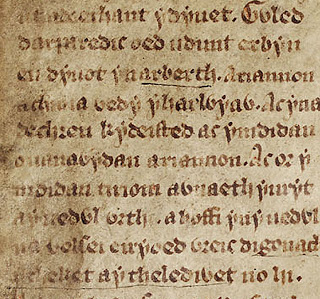
    The beginning of the Exchange Between Gwyn ap Nudd and Gwyddno Garanhir in the manuscript of The Black Book of Carmarthen

    An interpretation of the conversation between 
    Gwyn ap Nudd and Gwyddno Garanhir.

     This conversation appears in a manuscript collection known as The Black Book of Carmarthen which is a collection of copies from earlier manuscripts made by a monk in Carmarthen in the Thirteenth Century, some of which are verses which may have originally been embedded in lost prose sagas. As with much early Welsh verse some parts of it are difficult to interpret and the only easily available version in English is that contained in Skene’s Four Ancient Books of Wales, a pioneering translation which is now regarded as flawed. I’ll provide my own attempt to translate it during the course of the ensuing discussion based on consulting modern editions and commentaries in Welsh. There are some uncertainties expressed by careful modern scholars and I have taken note of these while also venturing to suggest interpretations which they do not explicitly give but which are implied by their commentaries.

    The conversation takes the form of series of englynion, each three-line englyn conforming to the syllabic and metrical requirements for the type of englyn used with apparent exceptions usually ascribed to faulty manuscript copying. The requirements of the englyn form would have determined the precise choice of words and expression and it’s necessary to be sensitive to that process when deciding on possible meanings of uncertain phrases. The exchange follows a conventional format to begin with of a defeated warrior asking for protection from his attacker. But as, in this case, the conversation is between an historical character and a mythological character it soon develops into an enquiry  into the nature of Gwyn ap Nudd which implies his coming from the Otherworld as a harvester of the dead. It is likely that it was not necessary to be explicit about this for readers or hearers of the poem and the nature of these poems is anyway that they are usually elliptical rather than explicit.


    A typical feature of one of these conversation poems is that there would be a balanced exchange between the two parties and this is how this poem begins. But it then develops into a monologue from Gwyn with the occasional interjection from Gwyddno.  A problem here is that the manuscript does not indicate who is speaking and although this is often obvious there are one or two places where it is not. The final section of the poem as published by Skene is often detached by modern scholars who profess themselves uncertain if it belongs to the exchange although there is no indication in the manuscript of a new poem beginning and as this is usually indicated by a larger coloured capital or ornamented letter. I’ll discuss below another reason why I think it should be regarded as a continuation of Gwyn’s monologue.

    The first two englyns set up the exchange with Gwyddno speaking first and Gwyn replying


    Fierce bull of battle, awesome
    Leader of many , slow to anger,
    Of trust unfailing, who will protect me?


    From the man who leads the conquest
    Invincible lord,  strong in anger,
    You who ask shall have protection.


    Having established his safety Gwyddno begins to ask his questions:


    Since you give me such protection
    I will ask you, Lord of Hosts
    Where is the land from which you come?


    The answer is characteristically oblique, not so much identifying a place of origin as a function:


    I come from many battles, many deaths
    With shields held aloft,
    Many heads pierced by spears.


    Unperturbed by the indirectness of the answer, Gwyddno tries again:


    I greet you great warrior
    Your shield ready,
    Tell me, great one, of your descent.


    At this point it begins to be clear that Gwyn is more than a victorious opponent who is being placated but a powerful figure with special attributes. Gwyn answers and Gwyddno replies politely also identifying himself:


    My horse is Carngrwn from battle throng
    So I am called Gwyn ap Nudd
    The lover of Creiddylad, daughter of Lludd.


    Since you, Gwyn, are so forthright
    I will not hide from you
    I am Gwyddno Garanhir.


    At this point the contemporary audience may have been reminded of the story of Gwyn’s love for Creiddylad related as an aside in the story of Culhwch and Olwen. It is clear, anyway, by now that he is a mythological figure and from this point on he begins a monologue making his Otherworld nature more apparent rather than responding to questions from Gwyddno. The next four verses are therefore from Gwyn:


    The white horse calls this talk to an end
    His bridle leads us away
    Hurrying to battles in Tawe and Nedd.


    Not the Tawe here in this land
    But the one far away in a distant land
    Where the tide ebbs fiercely on the shore.


    I have a carved ring, a white horse gold-adorned
    And to my sorrow
    I saw battle at Caer Fanddwy.


    At Caer Fanddwy I saw a host
    Shields shattered, spears broken,
    Violence inflicted by the honoured and fair.


    His horse is clearly a kindred spirit, calling him away to battles elsewhere. So we begin to get the sense of Gwyn as one who is called to wherever battles are raging, his function as Lord of the Dead, harvester of souls, becoming apparent. ‘Tawe’ and ‘Nedd’ are both rivers in South Wales. But he says it is not to the Tawe nearby he is called but to one far away. Where this might be is made clearer in the next two verses where he refers to Caer Fanddwy a place in the Otherworld mentioned by Taliesin in the poem Preiddeu Annwn, one of the forts in Annwn raided by Arthur (‘Save seven none returned from Caer Fanddwy’).   So not only is Gwyn clearly an Otherworld character but he performs the task of Lord of the Dead, attending battles in that world too. But while he was previously portrayed as being victorious in this role, in the Otherworld he is sorrowful.


    Here Gwyddno makes a brief interjection endorsing this view of Gwyn:


    Gwyn ap Nudd, helper of hosts,
    Armies fall before the hooves of your horse
    As swiftly as cut reeds to the ground.


    This seems to enable a change of direction for Gwyn:


    My hound is sleek and fair,
    The best of hounds;
    Dormach he is, who was with Maelgwn.


    There is some uncertainty about the name Dormach. The scribe had originally written Dormarch but the second ‘r’ has been removed and a space left in the manuscript. It is, however interesting that he belonged to Maelgwn as he had a legendary pack of hounds referred to by later Welsh bards. Gwyddno, of course, was father of Elffin who discovered Taliesin in a weir. He was lord of the land drowned in the legend of Cantre’r Gwaelod. More of this in a later post but it is interesting to note here their connection in legendary history.


    There is some confusion about who speaks the next verse, partly caused by an uncertainty about the meaning of part of the wording. It could be argued that Gwyn continues to speak but in my interpretation I suggest that Gwyddno speaks:


    Dormach rednose – why stare you so?
    Because I cannot comprehend
    Your wanderings in the firmament.


    The reading of the final line is difficult, but interpreting it in the way I have allows for a reference to the Wild Hunt, and an indirect reference to Gwyn’s role as its leader.


    Following this verse there is a complete change of tone and direction so that some scholars have doubted if it is a continuation of the same poem although there is no indication in the manuscript that it isn’t. Some uncertainty has also been expressed as to who speaks the remaining verses if they are to be regarded as part of the same poem. But if we regard the reference in the verse above as being to the Wild Hunt, it does not seem to me problematic to regard them as being spoken by Gwyn and relating to his activities as a harvester of souls:


    I was there when Gwenddolau was slain,
    Ceidio’s son, a pillar of poetry,
    When ravens croaked on gore.


    I was there when Bran was slain,
    Ywerydd’s son of wide fame,
    When battle-ravens croaked.


    I was there when Llachau was slain
    Arthur’s son, wondrous in wordcraft,
    When ravens croaked on gore.


    I was* there when Meurig was slain,
    Careian’s son, honoured in praise,
    When ravens croaked on flesh.


    I was there when Gwallog was slain,
    From a line of princes,
    Grief of the Saxons, son of Lleynog


    I was there when the warriors of Britain were slain
    From the east to the north;
    I live on; they are in the grave.


    I was there when the warriors of Britain were slain
    From the east to the south;
    I live on; they are dead.


    *Here the manuscript reads ‘I was not there’ (‘Ny buum’ instead of ‘Mi awum’) but it is likely that this is a scribe’s mistake.


    And so finally we may note the characterisation of Gwyn in folklore as the leader of the Cwn Annwn and so the Wild Hunt and another of the references to him in Culhwch and Olwen where the giant Ysbadadden tells Culhwch that he can never hunt the Boar Twrch Trwyth without Gwyn ap Nudd who “contains the nature of the devils of Annwn”. This is the burden he takes upon himself. In the medieval Life of St Collen, this Welsh saint is said to be lured by Gwyn – described as King of Annwn – into his fortress, but the saint throws holy water over him. In a medieval Latin text advising the clergy how to deal with superstitions an addition was copied in by a Welsh monk referring to Gwyn ap Nudd and his “concubine” in the context of love trysts in the woods, a not uncommon theme of medieval Welsh poetry. There are various passing references to him by the medieval Welsh bards, usually in the context of being lost in the mist and encountering Gwyn or the Cwn Annwn. In the view of Idris Foster[*] his original character was lost in some of these later references to him which simply see him as a leader of the Tylwyth Teg. He describes a number of “fluctuating descriptions” ranging from fairy to devil, but concludes that underlying these “there was one basic conception which was decidedly old – that of Gwyn as the magic huntsman”[*].

    Sources:
    J Gwenogvryn Evans (ed) The Black Book of Carmarthen (Pwllheli, 1907)
    A O H Jarman (ed) Llyfr Du Caerfyrddin   (Cardiff, 1982)
    B F Roberts ‘Ymddiddan Gwyn ap Nudd a Gwyddno Garanhir’  in Astudiaethau ar y Hengerdd ed. Rachel Bromwich & R Brinley Jones (Cardiff, 1978).
    [*]Idris Foster in Duanaire Finn quoted by Brinley Roberts in Gwyn ap Nudd Llên Cymru XIII pp 283-289.

  • Enchanting the Shadowlands

    February 4th, 2015

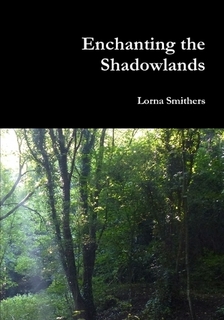
    enchanting Review of Enchanting the Shadowlands by Lorna Smithers


    This is a substantial collection of poems and prose by Lorna Smithers written in response to an imperative from Gwyn ap Nudd who gave her the task of ‘enchanting the shadowlands’, of bringing back enchantment to the land through her writings. As a task carried out for the god she follows it is an exemplary illustration of one way of following the path of the awenydd and , indeed, of showing dedication to the gods.


    The Prelude sets the scene for the collection with a reference to the ‘Bull of Conflict’, the words addressing Gwyn ap Nudd at the beginning of the dialogue between him and Gwyddno Garanhir contained in an early Welsh poem in the manuscript of The Black Book of Carmarthen. Following this the collection is divided into a number of sections, each of which are aspects of a journey in the sense that they chronicle a development through time both in the imaginative life of the poet and in the landscape she celebrates while at the same time culminating in a union with Gwyn.

    The first section recalls the early history of what is called ‘the ‘water country’ before the land was drained and when people lived close to the wetlands. There is then a section for Nodens, Gwyn’s father in the mythological record. Sections follow which look at the growth of community around Castle Hill, the life of the meadows, the re-imagining of the town of Preston in its original designation of Priest Town, the river Ribble and its Goddess Belisama and, finally, sections focussing on Gwyn himself and his Hall. There is a rhythmic movement between these sections, each changing the perspective but also keeping a clear focus on different aspects of the project of imaginative recall.
    As the reader moves through each section the landscape is explored, relationship affirmed and the purpose of the developing narrative kept firmly in the author’s gaze:


    I write this prayer for the souls
    of the long forgotten dead
    who greet us in the fields,
    wandering roads and haunted farmsteads.


    This is an assured voice, balancing the free expression of her message with a control of the rhythmic development of the verse so that the emphasised words also carry subtle echoes of each other, so ‘souls … fields’ assonate together and interrelate with the harder ‘d’ sounds of ‘roads’, ‘fields’ and ‘farmsteads’.
    The “stories must be told”, as a verse in the same poem has it, and the task of discovering a place to live that is ‘enchanted’ is fulfilled by this telling so that gramarye may once again be infused with our experience of living in the landscape. This is not simply an antiquarian exercise in recovery but clearly, as well as being divinely inspired, also undertaken out of love for the landscape itself.


    There is, of course, a particular focus on her own locality of Penwortham, or Peneverdant as it is called in he sources back to the Domesday Survey of 1086 that have been researched as part of the project. Understanding history and the felt particularities of the lives of the people who have lived on the land is a strong feature of the poems, and with more detail and a little more definitively in the prose pieces which intersperse them. These also relate some of the legends and myths of the area as in the moving story and subsequent poem about the drying up of a local well. In this way the recognised history of the area known as Castle Hill is brought to life with imaginative insights into events and the people who experienced them. The spirit life, which is inseparable from the physical life for those who would really know it, and the perception of Gwyn ap Nudd, the King of Annwn as he is described in another early Welsh text, infuses the stories told and shapes the collection.


    ‘The Meadows’ section evokes the life of the fields and ends with a powerfully resonant poem with the refrain “ …Horse of my dreams …” and the charged final line “And we plunge into darkness to the kingdom of our bond” which as well as re-iterating the pact also begins to anticipate the concluding sections. We get there via ‘Priest Town’ and the songs to Belisama and the Ribble. The Gwyn ap Nudd section returns to the early Welsh sources of his mythology, from Culhwch and Olwen and the legends of the Wild Hunt. And so to his Hall in the final section. This might be regarded as the hall of the dead but this is no place of gloomy sojourn. Though it is “Summer here and winter there” and the celebrated life of the earlier poems is a “brief home”, the arrival there is a consummation :


    When my task is complete
    will you take me, make me whole?


    This is addressed to the Hounds of Annwn at the end of the previous section. Once in the Hall


    When you are truly swallowed
    the universe will spit you out saying
    break every boundary.


    We are part, that is, of an enduring eternity. Nothing is set in stone. There is “no theodicy” as another poem has it, but there are “truth and promises” binding us to “the boundless infinite”. By such apparent paradoxes truth is found, promises made and the imperative of the god fulfilled.


    The Coda poem that completes the collection is addressed to the Ancestors who are “… presence … stories on our lips.” In this collection those stories are told and the Ancestors are made present. It is a remarkable testament to a promise made as well as being a skilfully wrought work by a committed awenydd.

  • The Star-Strewn Pathway

    January 30th, 2015


    Who walks the Path of the Awenydd? One such is Lorna Smithers. Her dedication to the Path in seeking to fulfil her pact with Gwyn ap Nudd has resulted in her producing a newly-published collection of poems –Enchanting the Shadowlands – in response to his prompting. This will be reviewed here in a future post. Her formal dedication of the collection took place at Glastonbury and is recorded on her blog which can be accessed via the feed in the sidebar of this blog. It is fitting that she should be given space to present her personal interpretation of the nature of the path . Each of us must walk it as the call of the gods determine. Her voice deserves a place here as one who walks it with honour and exemplifies how the role of the Awenydd can be adopted today. This is what she has to say:

    -*-

    The Star-Strewn Pathway
    ‘Thence rolled down upon him the storm-clouds from the home of the tempest;
    thence streamed up the winter sky the flaming banners of the Northern lights;
    thence rose through the illimitable darkness on high
    the star-strewn pathway of the fairy king.’
    Wirt Sikes

    I write this post as a newcomer to the path of the Awenydd, having walked it in earnest little longer than a year and a day. The terms Awen and Awenydd have been familiar since coming to Druidry. In the Awen I found a name for the all-consuming force of inspiration that has burnt forever in my veins with the fire of stars in the iciest reaches of a dark universe. Its furious purpose was revealed by a god after many years of searching.

    Restless years. Wilder years. Seeking Blake’s infinite. Throwing my soul into the furthermost abysses of Western European philosophy where reason bites its own tail, curls up and dies and the only way to survive the white hot sun of truth is to burn with and express its creativity.

    Trying to find a framework to decipher visions of our native spirit world without knowing if my experiences were ‘real’. Searching Christian mysticism, Graeco-Roman, Saxon and Norse mythologies and finding only analogies. Discovering Britain has its own mythology in The Mabinogion, The Triads of the Island of Britain, The Four Ancient Books of Wales and regional folk and faerie lore.

    Finally, Gwyn ap Nudd, my Fairy King finding me and teaching me to walk the Star-Strewn Pathway.

    ***

    The Star-Strewn Pathway begins in one’s local area with the recognition the whole landscape is inspirited. Awen sings from the earth-sun at this world’s core through its molten mantle, sandstone bedrock, layers of clay and harrowed loam. Wonder can be found in backyards of composting earthworms and hatching spiders.

    Pathways lead to suburban edgelands. Narrow valleys of trees impossible to build on, brooks shrunken by drainage systems tripping down wooden platforms. Algae-covered stagnant ponds beloved of ducks. Decaying mills pink with Herb Robert housing volleys of pigeons circling above.

    These places are inspirited and there are spirits: huge boggarts who once stretched gurgling through mosslands grey and whiskery; undines clasping their last waters; newly planted woodlands arising into forms of consciousness with inherent knowledge of tree, bird and mycelia of mushrooms to the tread of deer.

    Inevitably pathways lead abroad. It is necessary to trace local brooks to the river’s crashing heart, find its trickling source and greet rolling tides with the sea at its shining estuary. To meet its Great Goddess who washes her hair by moonlight and stretches watery arms throughout the watershed.

    To travel ancient woodlands of oak men, snow-topped mountains of icy blasting and cities of tower blocks, steeples and malls which guard a heritage locked in catacombs and glassy vaults. Every facet of woe and joy, awe and strife, adds to the alchemy of our own sun.

    ***

    In rain or mist, at twilight to the touch of thunder, it is possible to step from known to unknown pathways. Wandering lost in a storm-cloud of emotion I have often found myself on unfamiliar tracks with strange figures, no longer myself. Sometimes it is those dusky shadows who beckon me, footsteps leading into the wildwood’s tangled heart.

    In the wildwood all the fay lights are lit by stars. They dance and glimmer, throwing bright shapes and longer shadows across paths which intertwine like roots. These paths have their own lives, untwining and uprooting to walk their own way through the wood. Where the fay strew their lanterns on the ground one might find the Star-Strewn pathway.

    There is a long tradition of caves and holes leading to the underworld. Their entryways are utter darkness. Timeless. Illimitable as despair. They lead into a womb of tunnels, the edge of an abyss, to where that age-old creatrix Old Mother Universe gives birth to stars. From thence the Star-Strewn Pathway unfurls through underground heavens.

    When the moon is full she lays out her bridge of vibrant stars in the river. The ripples become stepping stones. From the river-moon the Star-Strewn Pathway leads through the catastrophic beauty of falling stars to the star-decked parapets of the Fairy King’s hall.

    At his banquet stars burn and freeze. The order of things is undone. In the crux of fairy arts, the Fairy King’s Star Cauldron, the wonder of the universe is reflected and re-made anew.

    ***

    There are other ways to reach Gwyn’s Hall. As many ways as there are souls. Some fly with coveys of hounds or wild geese. Others do not need to fly at all.

    This is not the path for everyone. There are many gods, stars and cauldrons.

    Any soul flight requires a return to and grounding in the body of this world; dragging backward through hedgerows, screaming and echoing from slanting rock-faces to kiss the earth with bloodied and muddy lips.

    Apostasies need voicing in cafes and bars, chain-stores and museums. Launching into the internet’s mirror-void where the dust-mote of a spark of Awen can be multiplied into a million blazing simulacra fading as quickly into black holes.

    Following the Star-Strewn Pathway does not lead to catasterism ‘placing amongst the stars,’ but living a full life upon this earth, returning to and from the halls of our deities, knowing only our bones and star-songs will survive for future generations. Until, with our land and gods, we are swallowed by the sun. Perhaps in this manner we will receive our final catasterism.

  • MYRDDIN becomes MERLIN

    January 18th, 2015


    Everyone knows who Merlin is – or do they?

    For many the stories about a wizard who aids King Arthur are an integral part of the Arthurian Romance tradition. But trace that tradition back far enough and both Arthur and Merlin have separate existences unrelated to each other. The two were brought together by Geoffrey of Monmouth in his History of the Kings of Britain (c. 1136). Geoffrey had previously published a series of Prophecies of Merlin and included these in his ‘History’. Some years later he wrote a long verse ‘Life of Merlin’ which draws upon pre-existing Welsh legendary material about a character called Myrddin who lived as a wild man in the Caledonian Forest. Gerald of Wales, writing later in the twelfth century, speaks explicitly of two Merlins: Merlin Ambrosius and Merlin Silvestris. While he is likely to have drawn these from the work of Geoffrey he may also have seen other material and claimed he had his own ancient book of the prophecies of Merlin, though he never published these.

    Geoffrey based the Merlin of his ‘History’ on a character called Ambrosius mentioned by Nennius in the ninth century and attached him to the stories about King Arthur. He may not have become fully familiar with the earlier Welsh legendary material about ‘Myrddin Wyllt’ until after writing his ‘History’, his later ‘Life of Merlin’ is based on earlier material in Welsh, some of which has survived. This Merlin, like Taliesin, was regarded as a prophet and had a number of verses attached to his name over an extended period of time. The earliest ones, probably from the ninth or tenth centuries rather than the sixth century when he was supposed to have lived, are contained in a series called the ‘Afallenau’ because they are addressed to an apple tree which seems to afford him some sort of protection and prevent others finding him:

    In this glade a sweet apple tree

    From Rhydderch’s men hides me

    Though many are there to see.

    (Awallen peren atif in llanerch/y hanger tae hargel rac riev Ryderch/amsaethir in y bon. maon yn y chilch.)

    He was living in the woods as a wild man following the Battle of Arfderydd where Gwenddolau was defeated by Rhydderch Hael. This battle is an historically attested event and is thought to have taken place at Arthuret near to the border between England and Scotland in the year 573. It is likely that the legendary ‘wild man’ stories (which have parallels in the Scottish tale of Lailoken and the Irish tale of Suibhne Geilt) became attached to the story about a survivor from the Battle of Arfderydd. There are references in the ‘Afallenau’ to Merlin having the company of a “fair, wanton maiden” ( bun wen warius) in his early days in the forest but she has left him by the time the verses are written. There is also a dialogue between Merlin and his sister Gwendydd whose son Merlin has slain in the battle and this is given as a reason for the madness that made him flee to the forest.

    Armes Prydein (‘Prophecies of Britain’) in The Book of Taliesin contains the phrase “Merlin predicts …” which appears as a parallel to “Awen predicts …” elsewhere in the poem. Also attributed to Merlin is a ‘conversation poem’ (Ymdiddan) between himself and Taliesin. And so he becomes one of the ‘Cynfeirdd’ (earliest poets writing in Welsh) located in the area known later in Wales as ‘The Old North’, and like Taliesin a bard with prophetic powers. Once his legend was established in Wales it also became associated with Carmarthen because his name seems to be contained in the Welsh form ‘Caerfyrddin’, though this actually originates in Moridunon which would naturally have developed into ‘Mer-ddin’ (Sea Fort) and the tautology ‘Caer’ would have been added when it was thought of as ‘Merlin’s Town’. This is compounded by the fact that the verses of Myrddin are recorded in the manuscript of The Black Book of Carmarthen and therefore seeming to record a local tradition. At the same time, Geoffrey’s composite Merlin was gaining fame across Europe as the wizard behind the throne of King Arthur and gaining further accretions as it did so. He has been reinterpreted in our own day among other things as, e.g., Gandalf in Lord of the Rings, and reconstructed by the writer Nikolai Tolstoy, as a remnant druid and priest of Lugh surviving in the Celtic kingdoms of the North. He still has the power to conjure such images as a figure who answers the call to something embedded deep in psychic space: the magician, the wise man, the hermit removed from but integral to our cultural life.

    *


    History of the Kings of Britain by Geoffrey of Monmouth (translated by Lewis Thorpe, Penguin Books, various editions)

    Life of Merlin (Vita Merlini) by Geoffrey of Monmouth (translated by Richard Barber in Myths and Legends of the British Isles, Folio Society 1998) ; also JJ Perry (Forgotten Books, 2008)

    Journey Through Wales and Description of Wales by Gerald of Wales (translated by Lewis Thorpe, Penguin Books, various editions)

    ‘Early Stages in the Development of the Merlin Legend’ by A.O.H. Jarman in Astudiaethau ar yr Hengerdd (ed. Rachel Bromwich a Brinley Jones, Gwasg Prifysgol Cymru, 1978)

    Trioedd Ynys Prydain ed Rachel Bromwich (University of Wales Press, various editions) also contains useful discussion and quotations.

    The poems attributed to Myrddin are contained in the manuscripts of The Black Book of Carmarthen and some are anthologised though these are hard to find in translation (the translation above is mine). A good source of extracts is the edition with translations by Meirion Pennar (Llanerch, 1989)

  • Faërie Gold

    January 14th, 2015

    250px-Doleburyhillfort

    Dolbury Camp


    In one of her County Folklore (Somerset) volumes, Ruth Tongue records a comment collected in 1907 about the legend of buried treasure on Dolbury Camp:


    “ but but nobody hasn’t found the treasure yet. And for why? Well, to start up with it don’t belong to they, and so they won’t ever meet up with it. Twill go on sinking down below never mind how deep they do dig. I tell ee tis the gold of they Redshanks as used to be seed on Dolbury Top. To be sure there’s clever book-read gentlemen as tell as they was Danes, and another say twere all on account of their bare legs being red with the wind, but don’t mind they.


    My granny she did tell me they was fairies, ah, and all dressed in red, and so if the treasure med be theirs. If they was Danes how do ee explain all those little clay pipes as ee can find on Dolbury? They did call em ‘fairy pipes’, old miners did. An if there be fairy pipes then there was fairies, and nobody need doubt they was the Redshanks.”


    It’s interesting that these faeries wear red. Green is a more usual colour, though red caps are often worn. Sometimes they are naked, or wear old brown-coloured rags. So there is no consistency. Faerie treasure can never be found and even if bestowed may become worthless if misused. Here it is said that it can only be found by those it belongs to.


    These faeries have departed, as often with stories about them. Often they leave a place because they don’t like the bell installed in the church or because some human development gets too close. As there is less wild land the faeries shrink into smaller spaces and become less visible. There are many stories of the last of them on their way to somewhere else. But there are always traces. They do not leave entirely, or at least have not done so yet.


    Their gold still gleams in hidden caverns out of sight. Its story brightly seams the lands we love; we cannot own it but it is ours to cherish with delight.

  • Rhiannon, Thisworld and the Otherworld

    January 5th, 2015

    rhydderch So the manuscript breaks off as we hear that Manawydan has never met a more beautiful woman than Rhiannon. In the First Branch of Y Mabinogi she arrives with a magical aura about her but soon makes her presence felt as a real enough woman letting Pwyll know what she wants from him. In the Third Branch, the beginning of which the above illustrates, she is even more practically present as Manawydan’s wife at least until she passes into an enchanted fort. She has, as any ordinary woman, grown older from the First to the Third Branch, re-married and plays her part in the domestic events of the tale. But between these, in the Second Branch, her birds sing over the sea to those that returned from Ireland, “and all the songs they had ever heard were harsh by comparison”. In Culhwch and Olwen these same birds of Rhiannon are said to “wake the dead and lull the living to sleep”. We might wonder how two tales that lead one into the other, regard the same character at once as a person in the story and an other-world enchantress with magical birds?

    One answer is to say that elements came into the tale from different stages of an earlier mythological tradition, but this suggests a tale-teller that wasn’t in full control of the material. Whatever we think of Culhwch which is full of what might be regarded as loosely integrated folk-tale material, the author of the Four Branches does seem to be writing stories in which the elements are consistently integrated. But the two identities of Rhiannon do not seem consistent even in the context of interactions between Thisworld and the Otherworld. The final pages of Branwen eerily evoke an otherwordly atmosphere in contrast to the matter-of-fact way characters move between the two worlds in the other tales. 

    How can the ghostly and scarcely human Rhiannon of the birds suddenly become Manawydan’s wife? Could the author engage in a sort of double-think? We could propose that the sensibility of medieval authors was different from ours so that they could know what they were dealing with in terms of earlier mythical material while at the same time get on and present a story set in the world they inhabited. Sometimes with medieval literature it seems so, but at others medieval writers appear prone to an intense literalism attached to material objects like obviously fake holy relics. It might be that they knew full well that they were fakes but nevertheless were able to believe in their efficacy. The art of thinking mythically and literally at the same time is one that is more difficult for modern readers. One way to open the borders between the worlds is to cultivate that art, which does not imply either a naive credibility or a cunning sophistry, but a creative openness to the life of the soul-world as well as the life of the physical-world, bringing together what should never be parted.

  • Tolkien on Faërie

    December 29th, 2014

    tree&leaf
    “Faërie contains many things besides elves and fays, and besides dwarfs, witches, trolls, giants, or dragons: it holds the seas, the Sun, the Moon, the sky; and the Earth, and all things that are in it: tree and bird, water and stone, wine and bread, and ourselves … when we are enchanted.”
    J. R. R. Tolkien from his essay on Fairy Stories : Tree and Leaf


    This seems to have something in common with the view of James Stephens that “we do not go to but become Faery”. Does this mean that is simply a state of mind? Stephens does not appear to believe this and Tolkien clearly indicates that he doesn’t either when he also defines it as “the realm or state in which fairies have their being”. His preferred name for the inhabitants of this realm was ‘elves’ as is clear from his other writings. Here he declares “if elves are true and really exist independently of our tales about them, then this is certainly true: elves are not primarily concerned with us, nor we with them.” The implication of this, and of other statements Tolkien made about what he called “the Perilous Realm”, is that it is an ‘Otherworld’, one which is indescribable in scientific or historical terms though, for all that, not imperceptible. To enter that realm one needs not magic in the sense of a will to power over its guardians or to see through the veils of its borders, but enchantment which derives not from power but from art. Enchantment is the craft of elves while magic is the craft of humans. So Tolkien implies.

    The sense, then, in which we do not ‘go’ to Faery but ‘become Faery’, as James Stephens has it, is the same sense in which Faërie contains all the things to be found in this world, as the quotation from Tolkien asserts. The Well of Enchantment is not, after all, so difficult to find. The art of looking not so much with a direct gaze as out of the corner of an eye as we look into its waters may be more difficult to acquire. But to get there it’s only necessary to step off the path which does not lead to it.

  • Brownies and Wildness

    December 27th, 2014


    A good example of how changes in the way the faërie folk have been regarded over time is provided in the accounts of brownies. These faeries have been represented as domesticated and happy to do household chores or farm work, but as such became idealised over time. Originally mainly restricted to the North of England and Scotland they were regarded as easily offended and likely to turn into less beneficial faeries or bogles. An extreme example of this development is that of the Scottish brownie called Aiken Drum or The Brownie of Blednoch who is described in earlier accounts as being naked except for a kilt of green rushes but appears in a later ‘traditional’ nursery rhyme as having “a hat of cream cheese, a coat of roast beef with buttons of penny loaves”. Although genuine faërie lore does not go that far in transforming brownies, many later accounts do show a development in describing the way they should be treated and whether or not gifts should be offered.


    The earliest accounts stress their independence from humans and suggest that any attempt to offer them anything for the work they do would result at best in no more work being done and at worst by some sort of reprisal such as the undoing of work or the destruction of crops or farm implements. Then, perhaps, a bowl of cream might be left where they might find it, not as a direct gift but so that they are free to help themselves. Their independence is particularly stressed in the matter of their lack of clothes. One account tells how a brownie was offended when some clothing was left out for him to wear and was not seen again after this. In later accounts this changes to brownies being offended by offers of old or poor quality clothes with the suggestion that only best new linen is good enough for them. Such developments seem to ‘humanize’ the brownies away from their wild and independent nature and so attempt to domesticate them. Once this happens they are lost to us as we, rather than they, become further away from wildness.

  • Imbolc

    December 23rd, 2014

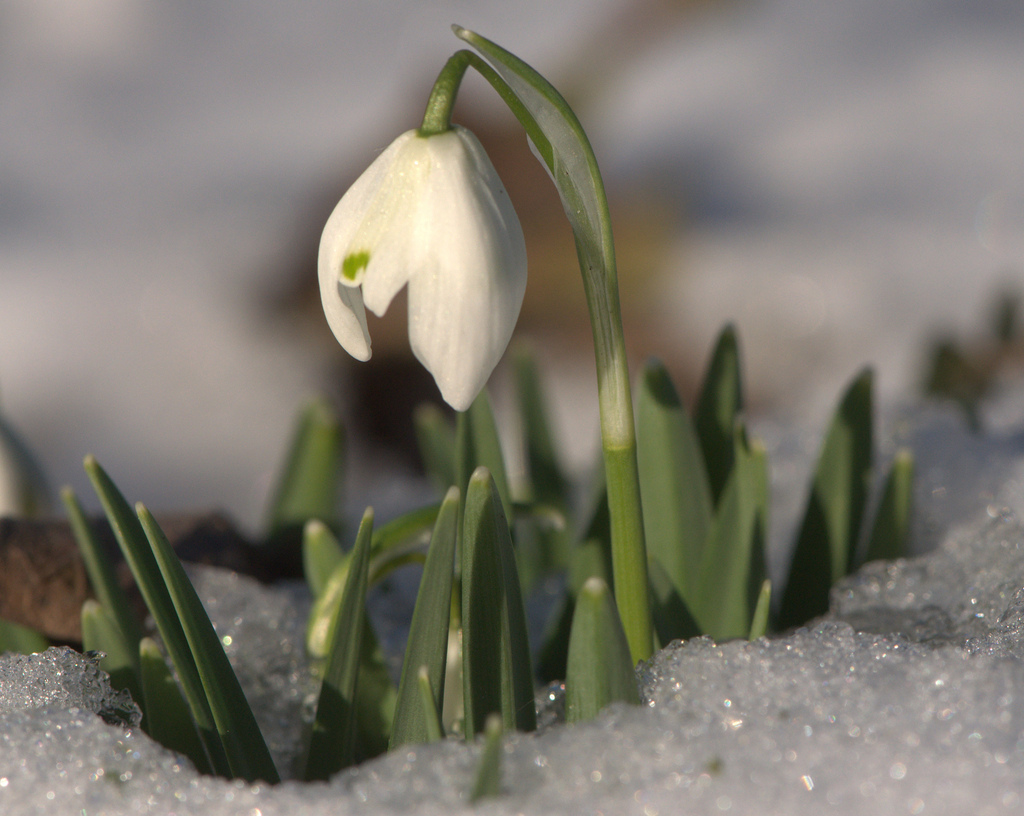
    snowdrop-frost
    Snowdrops break the seal of spring
    As light laps at the gloaming;
    Ffraid – or Bride – your blessings come
    Bright candles wish you welcome.

    White-Burning-Candles

←Previous Page
1 … 10 11 12 13
Next Page→

Create a website or blog at WordPress.com


Loading Comments...
 

    • Subscribe Subscribed
      • greghill.cymru
      • Join 74 other subscribers
      • Already have a WordPress.com account? Log in now.
      • greghill.cymru
      • Subscribe Subscribed
      • Sign up
      • Log in
      • Report this content
      • View site in Reader
      • Manage subscriptions
      • Collapse this bar