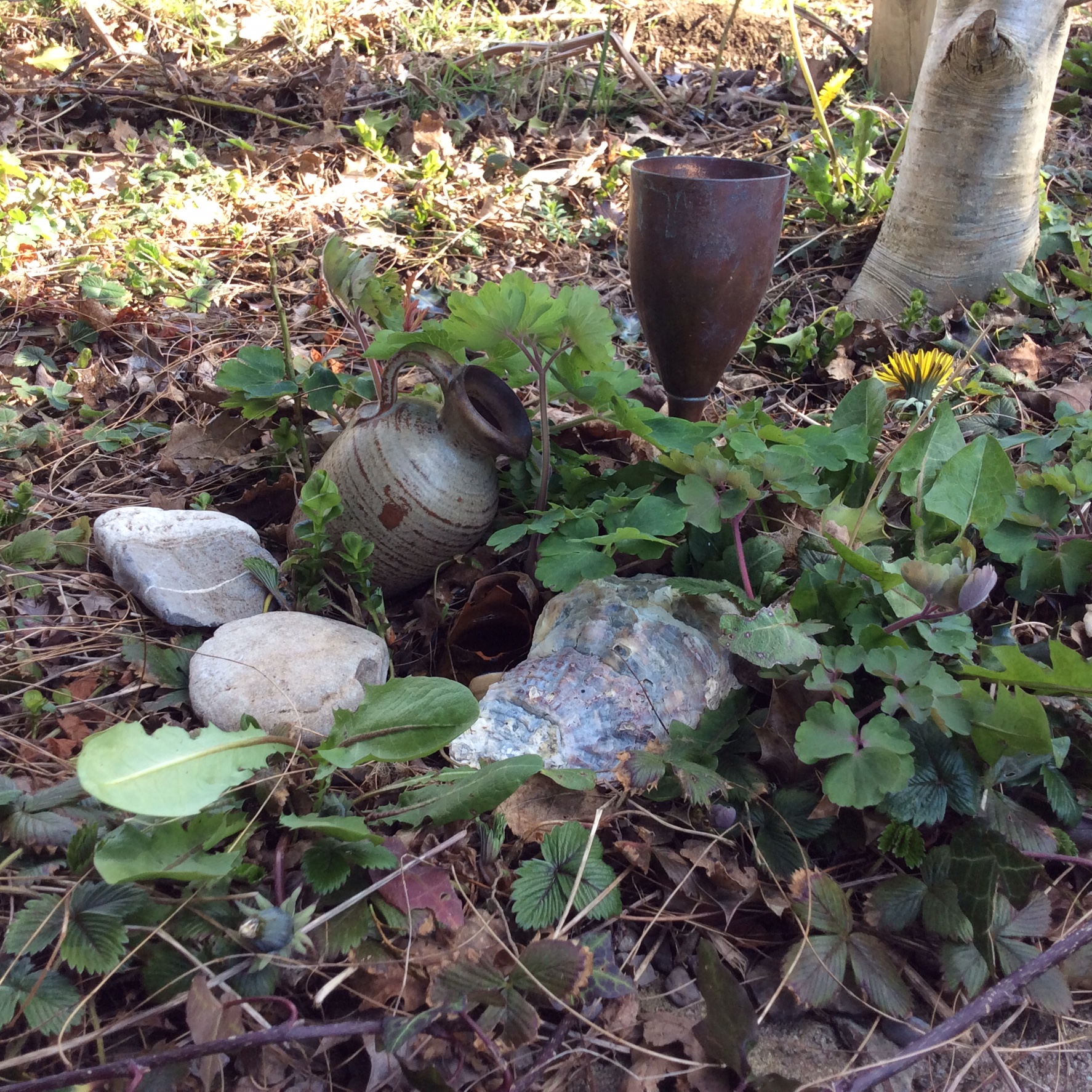
The stones for Belisama were collected by Lorna Smithers and shared with myself and Lee Davies as part of a meeting to discuss the BRYTHON project. A BRYTHON blog will ensue at Calan Mai.
There is the story of a well in Ireland
that was abused so then could not be found
by any but the true seeker who would be led
to where it was by one who kept its secrets.
There is the story of a well in Wales
whose guardian was dishonoured so it flooded
and made a great lake, but she would come
from the waters to greet any with the right token.
There are stories of The Well at the World’s End
that many seek for far away, but find
near to home where the Otherworld spring pulses
through in some hidden place in the world we know.
Seek out the source of the crystal waters,
the rising spring that runs into the gathering stream.
Speak out the spells that the well maid waits for
as a salve for her sorrows to wash away her pain.
John Rhys, in his study Celtic Foklore (1901), discussing a poem in The Black Book of Carmarthen , dealing with the inundation of Cantre’r Gwaelod on the shores of Cardigan Bay, says this:
“The name … Mererid, Margarita, ‘a pearl’ … but what does it here mean? …. the name given to some negligent guardian of a fairy well. It cannot very well be, however, the name belonging to the original form of the legend.”
My own meditation on this question follows, based on my experience of this landscape and its resonant features.
What is the name of the well maiden?
– the one who wept
tears of grief when the seal was broken
so the engulfing waters swept
over the land , drowning the forest that watched the sea?
Was it ‘Pearl’
– a hidden bud
of moisture in the enclosing earth
and stone, its pulse swelling to a flood
rushing down the cairn-strewn hill?
If not Mererid,
then to what hidden name will she answer
to those who seek the source?
Is she kin to Sulis or Coventina,
or to some sea nymph, say Morgana
Dwelling now in Gwyddno’s fort out under
the crashing waves
where the old road runs into the sea
her hair laved by the ebb and flow of the tides,
her wail echoed in the seabird’s plaintive cries.
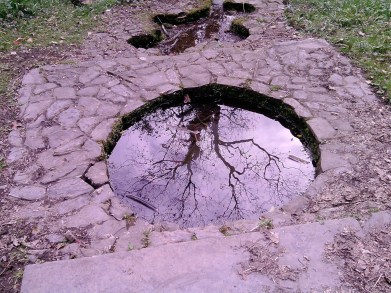
There is a well in my village, simply know as the “Ffynnon Sanctaidd” (Sacred Well). Though just outside the bounds of a church dedicated to Mihangel (Michael), the well itself does not have a particular dedicatee and would, of course, have been here, like the nearby ancient yew tree, before the church was built. There are some springs a mile or so along the valley in an area associated with Ffraid (Bride or Brigit) and a story that the church was originally to have been built there and dedicated to her. This, I know, is a story told of other churches: that attempts to build in one place are thwarted by the structure falling down each night until a voice from the heavens tells the builders to build elsewhere and/or to a different saint. These stories clearly reflect conflict in the past as much about who would be honoured rather, I suspect, than where the church should be built.
Wells are older than churches, their springs of water carrying the blessings of saints or deities variously named back to prehistory when the Earth last shifted to the shape she has now in each particular place. So when I sat by this well, as I often do to contemplate the changing seasons and dwell upon the pulse of water beneath me, I did not feel that I had to be bound by a name to embody the sacred space I inhabited – and yet the identity of she who brings sacred water into our world could not be denied for this season, this time, this point of correlation between myself and a goddess.
How does this work? The gods reveal themselves to us at different times, in different places and at different stages of our lives. It’s as if their identity can shine through a dedicated space or one in which we find ourselves ready to receive them, or shine through, even, the identity of another god’s dedicated space or persona. Or is it the same god? People may assert that their god is the only god, that their saint is the one to whom the church should be dedicated, or argue that one space is special not for others but only for them (consider Jerusalem). The god who calls to us is one identity at that moment of experience; the goddess who whispers her secrets is the only voice that matters in that moment which is forever.
Here the pronoun breaks down. It needs to change from plural to singular. I’ve spoken of ‘we’ and ‘us’ because I’ve tried to communicate a common experience. But, for each of us, it is ‘I’ that finds the god and ‘me’ that the goddess finds with words whispered on the winds. Although we may seek communal affirmation and desire to share our experiences, although we may congregate to honour the gods, the experience is not congregational but individual. Dedications to the gods in the ancient world were usually from individuals rather than social expressions of devotion. I can think of a few examples of community dedications such as the one to Epona by the burgesses of Trier, but these seem to be political or commercial rather than purely devotional inscriptions.
So now, as I sit by the well savouring the last of summer before autumn, watching bees go from flower to flower in the fuchsia bush, my experience of grace from the water of the well is a personal one, though by no means regarded by me as exclusive. I think of Odysseus and his personal devotion to, and relationship with, Athene, a goddess who was also acknowledged across the world that Odysseus inhabited. His covenant with her was intensely personal; her concern for him unquestioned. So my own relationship with the water of the well here where the church was built, and the springs there, further down the valley, where it wasn’t built, can centre on my developing relationship with Coventina whom I honoured with a visit to her well by Hadrian’s Wall over two hundred miles away. Nor does this detract from my acknowledgement of Bride of the Springs, or of any other deity which this well by the church of Michael may have embodied, or whose nature it may have expressed, or of other devotees with whom I share a love of this land and the springs that flow into and across it from the abode of the gods.

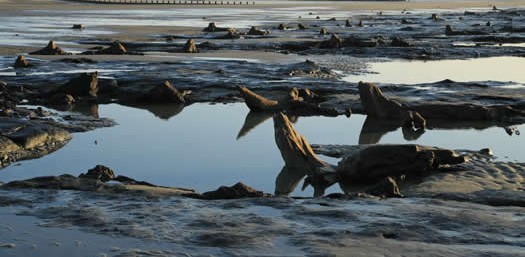 The remains of trees on the beach at Borth, Cardigan Bay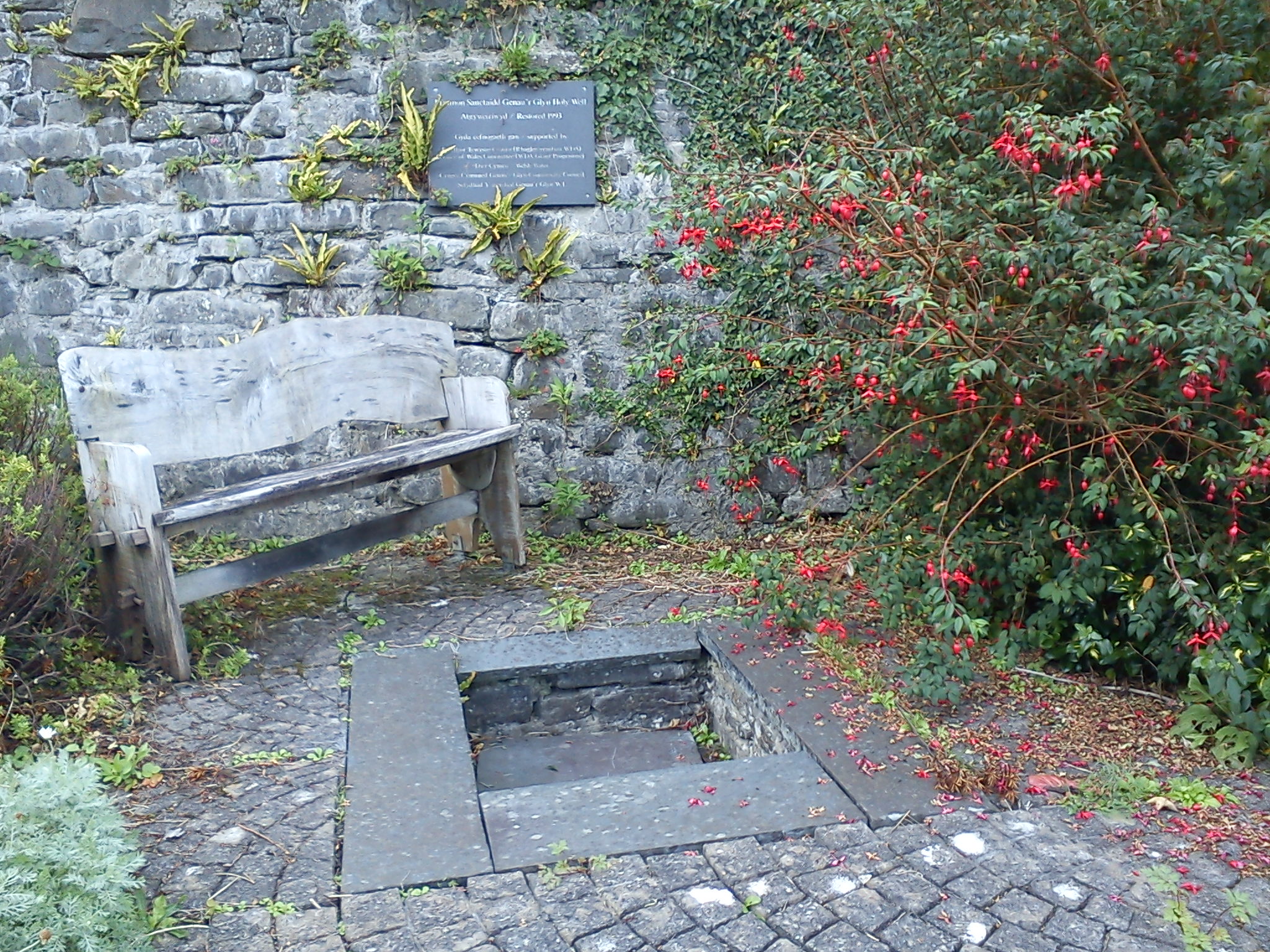
 greghill.cymru