The stones for Belisama were collected by Lorna Smithers and shared with myself and Lee Davies as part of a meeting to discuss the BRYTHON project. A BRYTHON blog will ensue at Calan Mai.
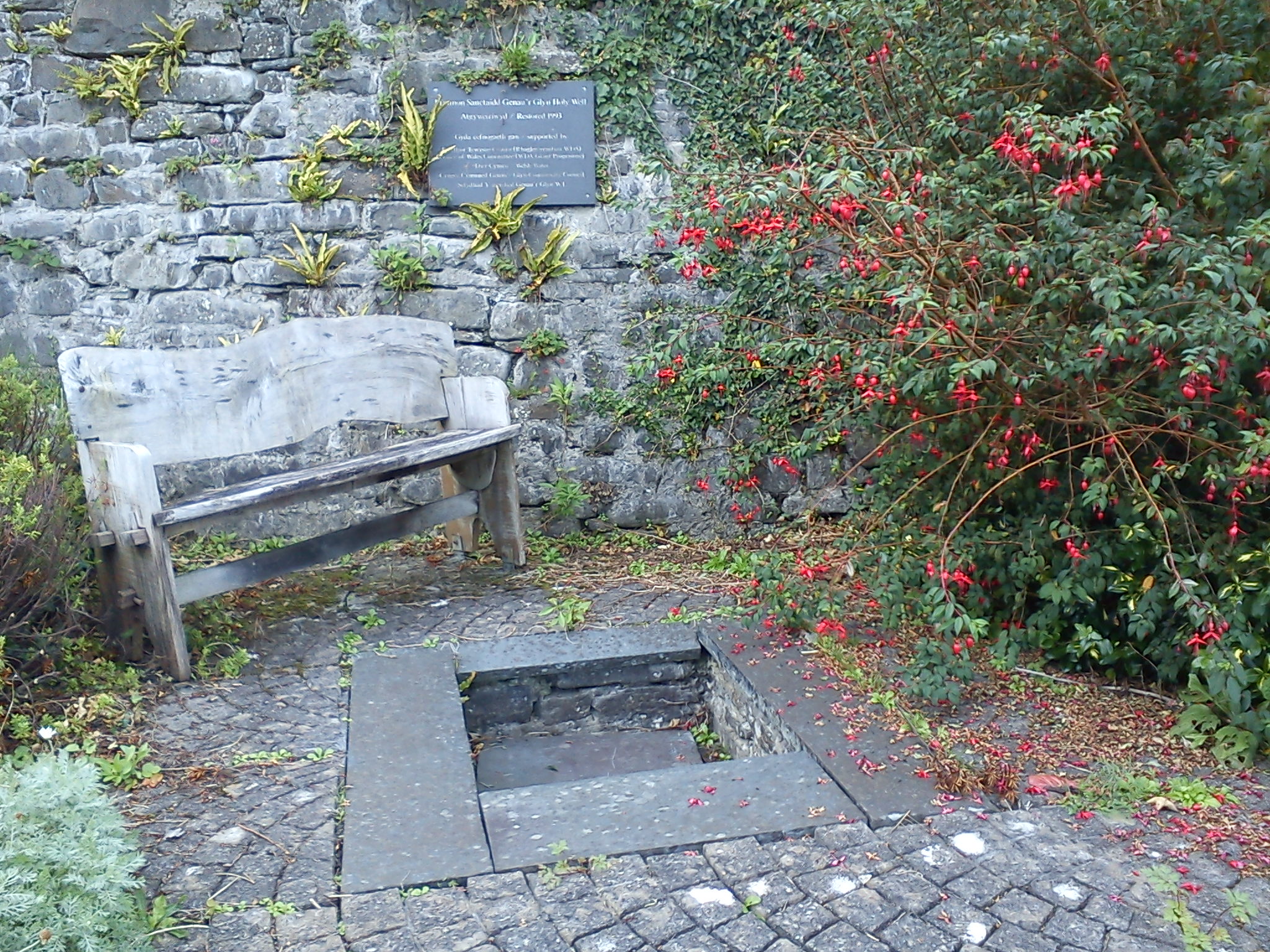
There is a well in my village, simply know as the “Ffynnon Sanctaidd” (Sacred Well). Though just outside the bounds of a church dedicated to Mihangel (Michael), the well itself does not have a particular dedicatee and would, of course, have been here, like the nearby ancient yew tree, before the church was built. There are some springs a mile or so along the valley in an area associated with Ffraid (Bride or Brigit) and a story that the church was originally to have been built there and dedicated to her. This, I know, is a story told of other churches: that attempts to build in one place are thwarted by the structure falling down each night until a voice from the heavens tells the builders to build elsewhere and/or to a different saint. These stories clearly reflect conflict in the past as much about who would be honoured rather, I suspect, than where the church should be built.
Wells are older than churches, their springs of water carrying the blessings of saints or deities variously named back to prehistory when the Earth last shifted to the shape she has now in each particular place. So when I sat by this well, as I often do to contemplate the changing seasons and dwell upon the pulse of water beneath me, I did not feel that I had to be bound by a name to embody the sacred space I inhabited – and yet the identity of she who brings sacred water into our world could not be denied for this season, this time, this point of correlation between myself and a goddess.
How does this work? The gods reveal themselves to us at different times, in different places and at different stages of our lives. It’s as if their identity can shine through a dedicated space or one in which we find ourselves ready to receive them, or shine through, even, the identity of another god’s dedicated space or persona. Or is it the same god? People may assert that their god is the only god, that their saint is the one to whom the church should be dedicated, or argue that one space is special not for others but only for them (consider Jerusalem). The god who calls to us is one identity at that moment of experience; the goddess who whispers her secrets is the only voice that matters in that moment which is forever.
Here the pronoun breaks down. It needs to change from plural to singular. I’ve spoken of ‘we’ and ‘us’ because I’ve tried to communicate a common experience. But, for each of us, it is ‘I’ that finds the god and ‘me’ that the goddess finds with words whispered on the winds. Although we may seek communal affirmation and desire to share our experiences, although we may congregate to honour the gods, the experience is not congregational but individual. Dedications to the gods in the ancient world were usually from individuals rather than social expressions of devotion. I can think of a few examples of community dedications such as the one to Epona by the burgesses of Trier, but these seem to be political or commercial rather than purely devotional inscriptions.
So now, as I sit by the well savouring the last of summer before autumn, watching bees go from flower to flower in the fuchsia bush, my experience of grace from the water of the well is a personal one, though by no means regarded by me as exclusive. I think of Odysseus and his personal devotion to, and relationship with, Athene, a goddess who was also acknowledged across the world that Odysseus inhabited. His covenant with her was intensely personal; her concern for him unquestioned. So my own relationship with the water of the well here where the church was built, and the springs there, further down the valley, where it wasn’t built, can centre on my developing relationship with Coventina whom I honoured with a visit to her well by Hadrian’s Wall over two hundred miles away. Nor does this detract from my acknowledgement of Bride of the Springs, or of any other deity which this well by the church of Michael may have embodied, or whose nature it may have expressed, or of other devotees with whom I share a love of this land and the springs that flow into and across it from the abode of the gods.
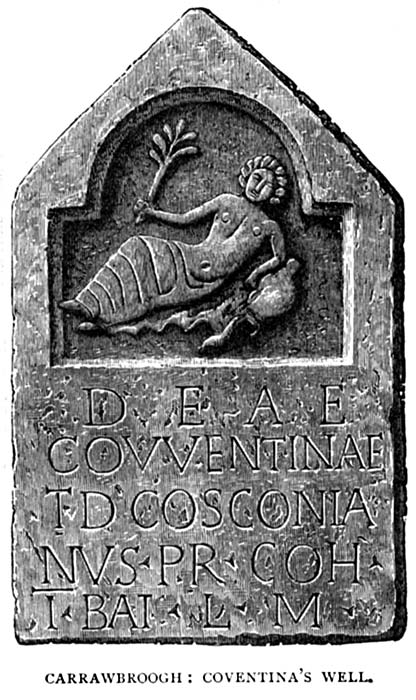
Beside the minor road that runs beneath Hadrian’s Wall at Carrawburgh is the site of a fort. The only visible excavated feature is the remains of a Mithraeum or temple of Mithras used by soldiers stationed on the Wall. There is also an area designated the Nymphaeum, or place where devotions were made to the spirits of the place. On the edge of the fort is the site of a well. This was dug out in the nineteenth century by the land owner in a search for deposits of lead ore. But large numbers of coins were found in the well along with incense burners and votive stones with inscriptions which are now housed in the nearby museum at Chester’s Fort. The inscriptions make it clear that the well was sacred to Coventina and her depiction holding the leaf of a water lily, and others where she pours water from a container makes it clear that she is a water goddess. Two of these featuring carved depictions are well-known and have been much reproduced. They appear at the head and foot of this post and are often cited as the chief evidence of the worship of Coventina. But there are other stones with inscriptions also dedicated to her and made especially for placing by the well in her honour. Here is a selection from the nearby museum.
*
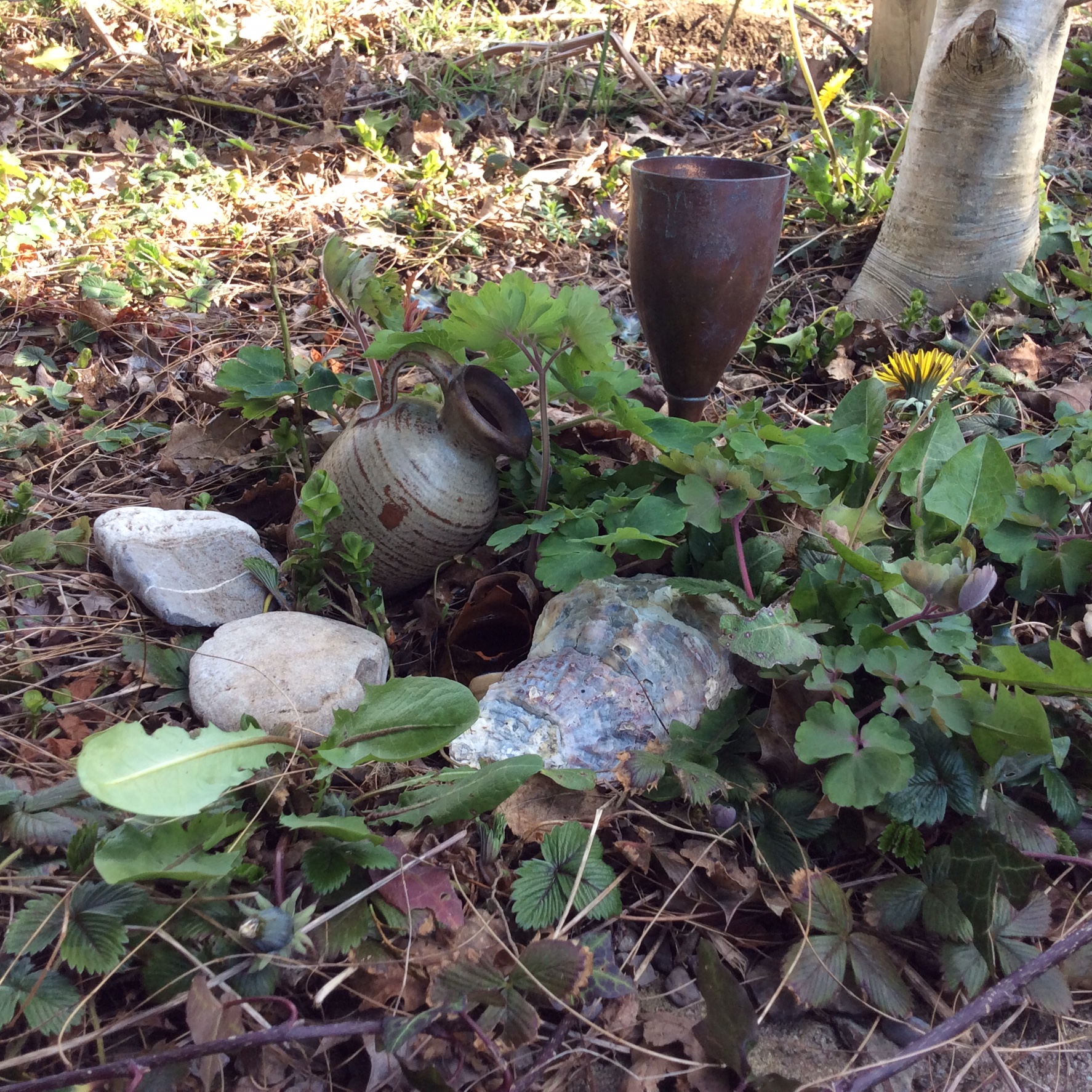
What now of her spring of sacred water? When I visited the site I knew that the well had been neglected and uncared for by comparison with the carefully excavated and preserved Mithraeum that most visitors stop here to view. But I did not expect there to be no visible trace of it. I have an area in my garden at home dedicated to her and visited her well to bring her a gift and possibly to bring back a stone or small token from the well site for my altar. My own personal devotions apart, I wonder what can be done to bring such neglected deities to wider attention? They live in their own parallel world of course, and if we have no need of them they may never trouble us. But we are poorer without them and their presence in the land is never quite gone, especially as there are those of us who remember them. The site at Carrawburgh (once known as Bricolita) is the only identified site for Coventina in Britain and there are only two other possible sites in Gaul. Her neglected well, then, seems symptomatic of her liminal status. Stories of the ill-treatment of wells or their guardians, often with dire consequences, are common enough in myth and folklore to suggest that such neglect serves as an icon for the abandonment of the world of the gods and of a life lived alongside them.
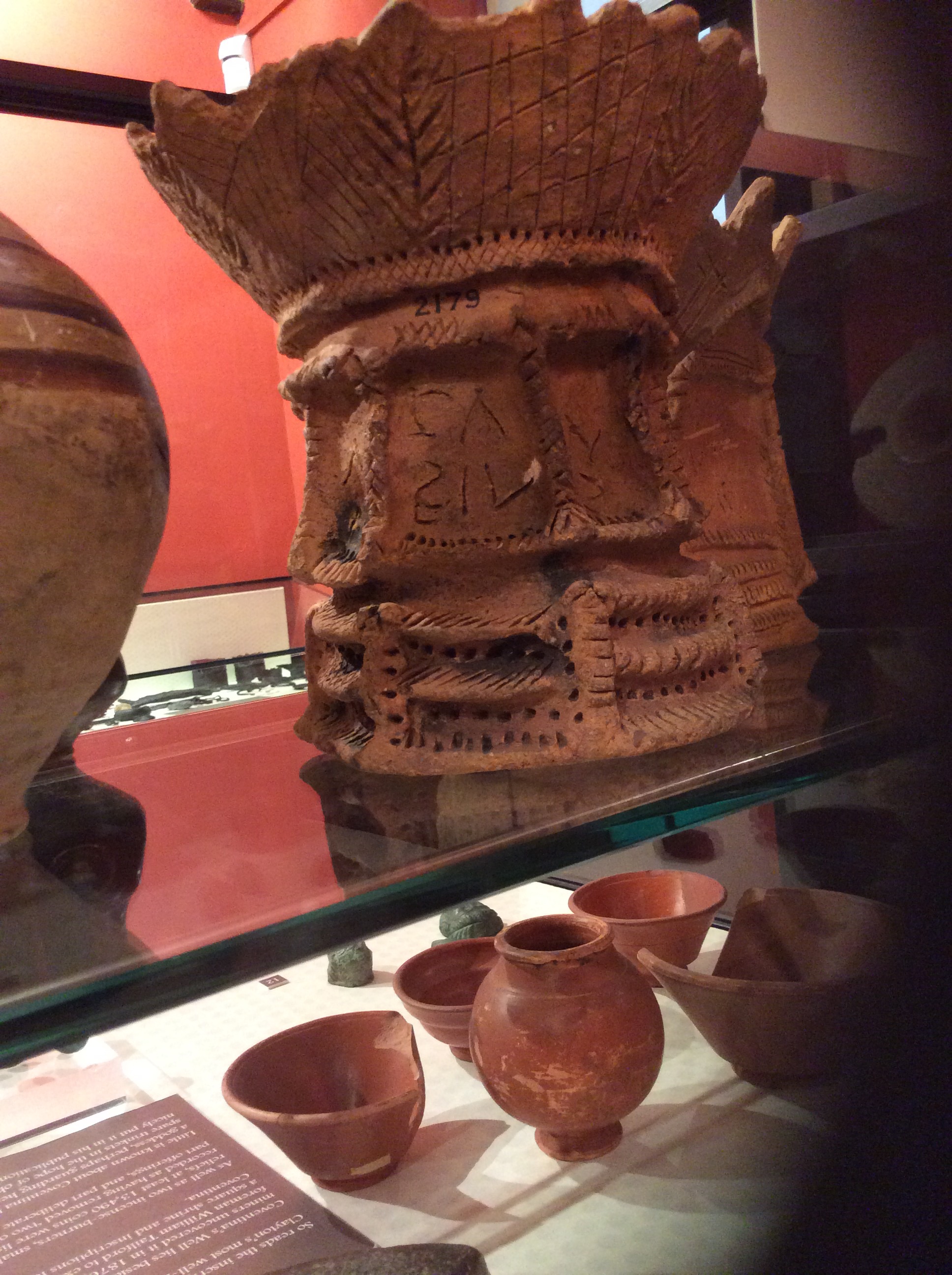
I walked around the site for a couple of hours looking for the well. Eventually I decided to go to the fully excavated Chester’s Fort a few miles away to view the items that had been removed from the well and to ask for the precise location. There is a case full of objects in the small museum there in addition to the stone inscriptions. These include clay incense burners especially made with inscription for placing by the well:
And these small bronze horse figures.
Many of the coins that were found in the well were later stolen.
An English Heritage official there explained to me that the well site was not on land administered by them so no signs indicating its position could be displayed and there was anyway nothing left to see as the original excavation of the site had destroyed it. But he did indicate to me more or less where it was. So I went back to the site, my gift still ungiven, to look for it again. The ground in the area area indicated between the fort and the open moor beyond is fenced off and very boggy. Bright yellow king cups, a flower of very wet ground, adorned the miry place where I guessed the well must have been. But in spite of their beauty I could not feel the presence of Coventina there. A narrow brook seems to emerge from or mix with these waters and flows away from the site. In one place this piece of fenced-off bog is traversed by the long distance footpath which follows Hadrian’s Wall. I climbed the stile to walk across using the large stone slabs that make this possible. Beside one of them I found this pool
In spite of appearing to be part of the sequence of wet places fed by the waters of the brook it has the feel of a well-spring about it. The water is clear to the bottom where a number of small creatures including some fresh-water shrimps scurried around in the soft sediment. Here was Coventina! This was the place to leave my gift and the small geode with a precious stone in it sank through the water and into the sediment out of sight.
For Coventina
Who brings us otherworld water
Budding through earth and stone
Into our world of dry words:
Liquid whispers of something deeper.
I went on a quest to discover a particular place. Did I discover it? Or did I discover that it is not the one site that is important so much as the journey to find it. But she is there wherever water flows. So each time I stop at a well, a spring or a stream of rushing water I think of Coventina and the water world and the deep well of memory of the gods and the world they inhabit. When I touch a drop of water from a spring to my skin I make a dedication to that world of sacred water as I did at that pool at Brocolita where Coventina was once acknowledged as I acknowledge her now and bring the memory of that place to my own dedicated space for her.





 greghill.cymru