(Amended version of an earlier translation, with extended commentary).
I love a fair fort on the side of a hill
where seagulls glide : there stands a shy girl.
I yearn to be with her but she would not have me
Though I came on a white horse for her sweet mirth
To tell of the love that has overcome me
To lighten my darkness out of the gloom,
To see her whiteness like the foam on the wave
Flowing towards us out of her realm,
Gleaming like snow on the highest hill.
To cool my vexation in Ogrvan’s Hall
Unwilling to leave her (it would be my death)
My life-force is with her, my vitality ebbs
Like Garwy Hir* my desire undoes me
For a girl I can’t reach in Ogrvan’s Hall.
After the Welsh of Hywel ab Owain Gwynedd (died 1170).
Ogrvan’s Hall was identified by Sir John Rhŷs as a place in the Otherworld, occupied by the god that ruled over it. But there is also legend of a giant called Gogvran who was said to be the father of Gwenhywyfar who may, in turn, have been confused with [G]Ogyvran who occupied a fortress in Powys in the sixth century.
*Garwy Hir was a legendary lover in Welsh tradition. His love affair with Creirwy is alluded to by other early poets though the details of their story is lost beyond the idea that she was ‘the fairest maiden in the world’ and, in one version of the Taliesin story, the daughter of Ceridwen. Garwy was enchanted by her and made helpless by the thought of her, as Hywel in the poem seems also to be by the unattainable girl in the otherworld fortress.
An ogyrven is also one of the divisions of the Awen (poetic inspiration) according to a poem in The Book of Taliesin. There may be no etymological connection between these names, but that Hywel (and others) should be inspired by a woman in Ogyrvan’s Hall is surely a correspondence no poet could ignore!
Multi-culturalism is sometimes seen as a melting pot: cultures all mix together and the result is a universal, globally similar, amalgam which encompasses all. But people also value diversity. Visiting a place and finding it is the same as where you came from seems to defeat the object of travel. I am reflecting on these things after attending an evening of Welsh and Indian poetry interactions. Poets from Wales and from India have been involved in a project to see how each can learn from, and benefit from, the other while also acknowledging the value and distinctiveness of each of their traditions. The poets visited each other’s countries and held sessions to explore the particularities of their artistic practices and how they could compare and contrast them, and of course translate each other’s work.
The latest instalment for two of these poets culminated in an evening of activities including a traditional Indian dancer who had been working with them. The dancer, Vikram Lyengar, spoke of his use of music as a base rhythm over which the steps of his dance were made. This was compared to the rhythmic pulse of a line of verse, arranging the syllables of each line around the accents of the main stresses, shortening or lengthening them for emphasis. The poets, one writing in Bangla (Bengali) and the other in Welsh cynghanedd metres, sought to emulate this in their verse and the dancer separately sought to to dance the rhythms of their verse.
It was difficult for me to evaluate the way Sampurna Chattarji wrote the rhythms of the dance in her verse in Bangla, or how Vikram Lyengar danced the work of either poet, though his performance was both impressive and enjoyable in its own right. But I was fascinated by the way that Eurig Salisbury transformed the dance steps into a series of cynghanedd lines across some englyn forms chosen because of the correspendence between the required syllable count and the number of steps he had to ‘translate’ in each case. It couldn’t be said that the englynion produced said anything significant in terms of their meaning. But they did seem charged as forms with the energy of the exercise and the cross-cultural frisson by which the Welsh verse patterns were enlivened without in any way diluting their distinct character and mode of expression. Reflecting on the evening, it seems to me that something very deep was achieved. But, as often with such things, its significance remains elusive, even mysterious. As it should be.
Brigid, Bríg, Bride, Brigantia; Birch, beith, bedw, betula – Bright boles break the dark of winter Buds swell on branches of pubescens and pendula.
Deep wells springing with rising waters, Sunlight growing as snowlight falters, Swift streams tumbling over mountain boulders Swelling through valleys to meet wide rivers.
So fills the cup that she will bear To the feast of the brightening of the year As across these islands by each name we call her: Brigid, Bríg, Bride, Brigantia.
Allan o dywyllwch caf fy ngeni
Allan o waed caf fy ngeni
Allan o ysbryd caf fy ngeni
Yn canu o Annwn
Tri phelydryn golau
Tri phelydryn llais
Tri phelydryn wirionedd
I oleuo â rhyfeddod
Ac yn torri’r galon wytnaf
Yn canu o Annwn
~
Out of darkness I am born
Out of blood I am born
Out of spirit I am born
Singing from Annwn
Three rays of light
Three rays of voice
Three rays of truth
To illuminate with wonder
And break the hardest heart
Singing from Annwn
~
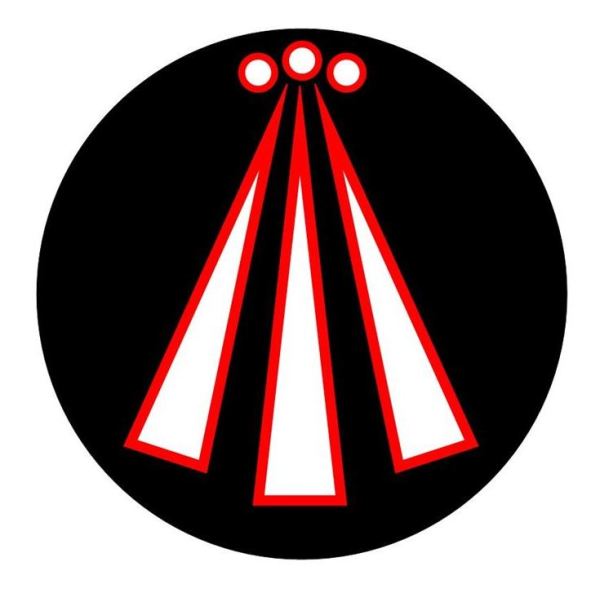
About a month ago I awoke with the symbol above in my mind with the name ‘Annuvian Awen’. Awen derives from the Indo-European *-uel ‘to blow’ and has the same root as the Welsh awel ‘breeze’. It is the primordial breath that binds all things, as Kristoffer Hughes says, ‘the voice of the universe speaking to itself’.
Gogyfarch Vabon o arall vro -*- Call upon Mabon from the Other Realm
(Book of Taliesin : 38)
Matrona with Child Divine Son of Divine Mother, taken at three nights old into the Otherworld but brought back out of the darkness into the light of this world. Playing the Harp of Time ~> he brings the music of the world out of silence into the sights and sounds of Summer. His is the bright step into the eternal present of Now, the act of Being, the vitality of youth grown to manhood. He may come as a hunter decked in leaves with a sheaf of arrows to inspire a bard, as the Welsh poet Henry Vaughan relates (~>).
In the tale of Culhwch and Olwen he is Mabon, released from the dungeon of Caer Loyw to join Arthur and his men to hunt Twrch Trwyth. He is simultaneously…
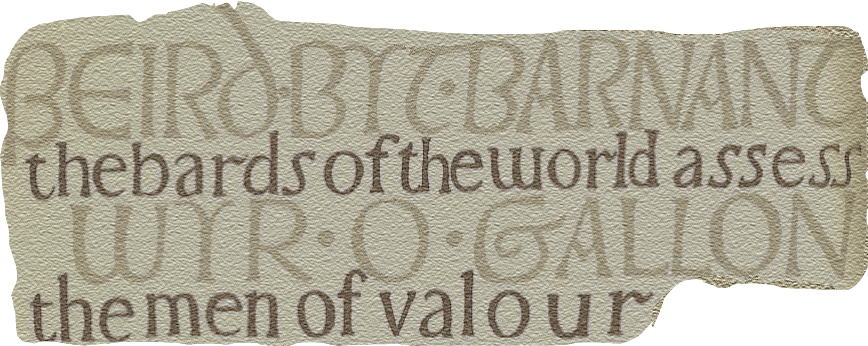
‘It is the bards of the world who judge men of valour’ – Gododdin
So says Aneirin in the oldest surviving text in the Welsh language. Aneirin was one of the bards mentioned in the 9th century Historia Brittonum (1) as having been active in the 6th century:
Talhaern Tat Aguen was then renowned in poetry, and Aneirin and Taliesin and Bluchbard and Cian who was called Gwenith Guaut, were all renowned at this time.
Of these, only Aneirin and Taliesin have surviving poems attributed to them and, in the case of Taliesin, poems continued to be written in his name by bards using him as the mouthpiece of the awen up until the end of the thirteenth century. The language of the Historia is Latin, but the epithets for Talhaearn and Cian are in early Welsh. Talhaearn is described as ‘the father of the Awen’, which…
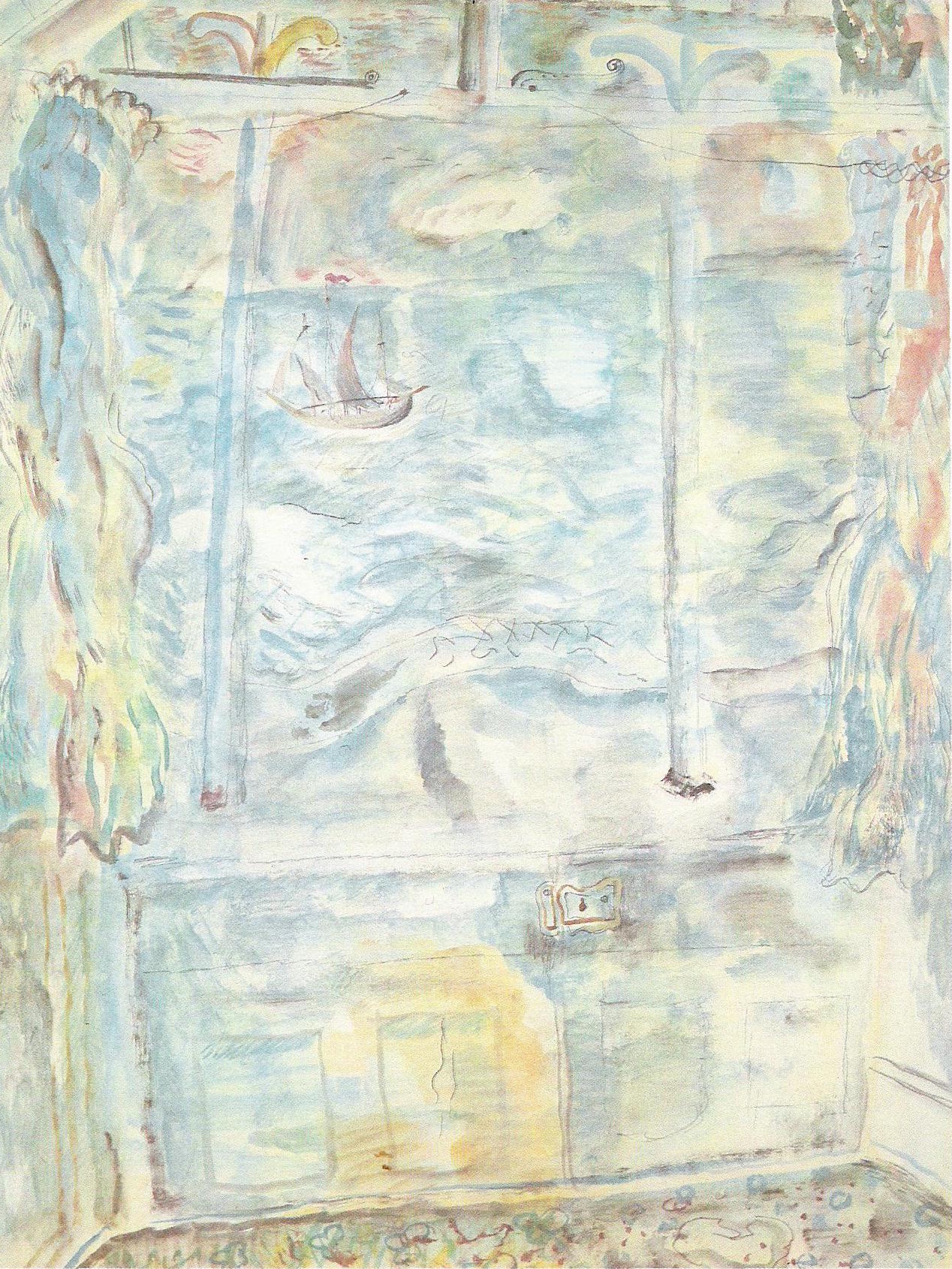
Manawydan’s Glass Door – Water Colour by David Jones
Weldy racco … y drws ny dylywn ni y agori –
Look there … the door we should not open
(Spoken by Manawydan as the Company arrive in Gwales with the head of Bran in the second branch of the medieval Welsh Mabinogi tales.)
Meditation
He has lingered at the doors of perception for so long I could not imagine him not being there. But never forthright, never an intrusive presence, sometimes barely a presence at all, as if he said:
“You wanted me for a god but I am not a god for you now … though I am here for you, for counsel should you want to listen – keeping the door that you might not open, but when you do open it telling you what I have to tell about the path that opens through it should you choose to listen, and take me for a companion, walking with you on that path. I am patient and will wait for days, weeks, months, years … longer if it is necessary, for the right time and until then I will be at the threshold watching from beneath my hood of shadow, like the shadow of trees in the corner of a field where the hidden path leads into the wood.
So you ask – or dare not ask – why I did not walk with Pryderi and Rhiannon when the door opened for them? When the Divine Son is snatched away and the Divine Mother follows as she did not follow before, then though I offer counsel which would be wise for you, for them, who are beyond counsel, I could only watch, and wait, and bide my time for action, to bring them back into the world, and bring the world back to its right shaping.
But for you … for you too I wait and will speak the words you need to hear when you need to hear them. The door is not locked; you have already seen through it. You know what is to be found there and that there is a task to fulfil when you walk that path.
But for now, learn patience. Do not call before the appointed time, do not bid me speak before I have something to tell you. But know that I am here for you, acknowledge me and I will hold my counsel and reveal to you its hidden depths: Standing aside from the busy-ness of the world to better see the way through and tell it in quiet words for those who listen.
This for you and for all of those.”
Reflection
When I was taught the art of focused meditation I always had a commentary, a reflection, on what I reported. So here I provide my own. Clearly this meditation results from many years of passive reflection on what it contains. Clearly too it contains things gained from study, from reading, from explorations of Brythonic lore, and so is not without some cultural influence. But it is not consciously shaped from these studies so much as emanating from having internalised them. Like the poet who has learned the verse forms and finds them providing a shape for the shapeless inspiration that is breathed through the breath of words.
So I knew that Manawydan was held to be ‘oet guis y cusil’ (profound of counsel). So I knew that he identified the door in Gwales that must remain shut for eighty years before the Company of the Head must leave their sojourn in that place and take the head of Bran to the White Mount and bury it there; … that he had refrained from claiming the lordship over Britain which had been usurped but retreated to Dyfed to marry the now widowed Rhiannon and ‘there was no woman more beautiful than she’; … that he lived simply but outwitted the Otherworld adversaries that had cast a spell over Dyfed and brought back Pryderi and Rhiannon from Annwn to live among us once again. All these things and more I ‘knew’ in the way that I knew how to breathe rather than as dry academic knowledge.
But more – I have perceived Manawydan on the edge of my meditations, my reflections, my perceptions of the Otherworld, the Gods, the deep presences of deity. And he has stayed there, biding his time quite apart from any cultural conception of him as a mythological figure, a cultural construct or a willed identity. So now as his hood is drawn back to reveal … what? I can only report his words as they came to me and, as he requests, acknowledge him as he has appeared to me.
*
A note on the painting by David Jones. The reproduction doesn’t do it justice. The original water colour paints have a luminosity that is almost transparent so that the outside and the inside of the room seem to flow into each other. The glass door is a boundary between the two, but one that allows the scene outside to be an extension of the space inside and the carpet similarly seems to flow out of the room. The two worlds are one. Yet they remain apart.
According to the poem ‘Angar Kyfundawt’ in The Book of Taliesin the Awen is divided into “seven score ogyrven” with a further division of each of these twenty. Elsewhere in The Book of Taliesin, in the poem ‘Kadeir Teyrnon’ the Awen is simply asserted to be divided into three ogyrven, hence the three shafts of the Awen symbol as later interpreted. John Rhŷs asserted that
“three muses had emerged from Giant Ogyrven’s cauldron. But Ogyrven seems to be one of the names of the terrene god, so that Ogyrven’s cauldron should be no other probably than that which we have found ascribed to the Head of Hades”.
Celtic Heathendom pp 267-269
That Ogyrven is one of the names of the King of the Otherworld is also suggested in a poem by Hywel ab Owain Gwynedd (died 1170). Hywel was the son of Owain of Gwynedd by an Irish woman who lived in his court and was thus both within the privileged mainstream and to some extent marginalised and so was able to practise the art of poetry as the muse took him. At a time when the official court poets were mainly engaged in praise of military prowess or power he penned some delicate love lyrics, including one addressed to a girl “in Ogyrven’s Hall” who has captivated him though he cannot approach her as she stands – fair as the foam on the wave – watching seagulls glide around a hillside:
Unwilling to leave her (it would be my death)
My life-force is with her, my vitality ebbs
Like a legendary lover my desire undoes me
For a girl I can’t reach in Ogyrven’s Hall.
So here the Hall of Ogyrven is a place in the Otherworld (or the Otherworld itself) with a girl who has possessed the poet with unrealisable desire. Is she his muse? And if, as John Rhŷs asserts, Ogyrven is the God of the Otherworld or Netherworld, who is the girl and how could a poet dare to fall in love with her? Hywel says he would go to her on a white horse but “she would not have me” and also that her fairness flows out of her realm towards us.
Ogyrven, then, seems to be many-faceted not just in the variability of the number of divisions of the Awen, but in the identity of the figure from whom it originates or the number of cauldrons, seething without fire, from which it may emanate according to ‘Angar Kyfundawt’ a poem whose title refers to a malign alliance of uninspired poets. Hywel, clearly, was not one of these. The delicacy of his poem in its original Welsh with its patterning of sound and imagery defies adequate translation not so much of its meaning as of its quietly inspired intensity. Here is no boasting Taliesin but a poet shaping inspired words out of his inability to fully realise his aspiration to fulfil his desire in the Otherworld.
And Ogyrfen? Whether a god, a place, a flow of inspiration streaming out into many further streams, elusive as the girl that Hywel desires or as the words that will adequately describe her, we may, perhaps, catch in a glimpse in one of these streams, some sense of what it is to be inspired and the many aspects of Annwfn as experienced in our world.
The Sun sits low in the sky and dips even lower as his year draws to an end. The pale light of day soon passes to night. The tide ebbs. Each flower, each tree, each head of grass and grain, has shrunk to back to kernel: to hard seed, to nut, to reserved essence, biding the time until the light grows again and roots find a way through nurturing soil.
Epona on a funeral stele from Gaul
For now, Epona traverses the paths of the dead, riding through the dark, through earth and sea, each life that has passed moving with her, finding the way that she opens for them, losing the memories she closes behind them. The Sun will return and a new year begin, but now is the time of repose.
Epona, we are with you in the time of waiting, we pause with you now in the dark of the year. We mark the time until the longest night when you stir the deepest well of the darkness like a river rising from the caverns of gloom.


 Brigid, Bríg, Bride, Brigantia;



 greghill.cymru