A Collection of Poems

Available HERE
Looking to put together a compilation of writings from here and elsewhere, it seemed that something on Nodens was also needed. So here is a draft of some thoughts which might make it into such a compilation. It relies less on historical attestations and academic investigation than other pieces. But there are a number of ways that data from historical sources, folklore and archaeology link into my personal insights.
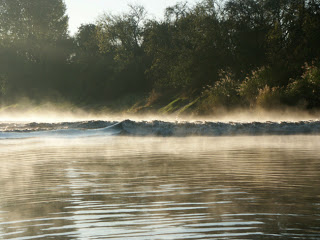
There is a temple of Nodens above the River Severn at Lydney, facing across the river from the western side and the eastern edge of the Forest of Dean. The temple was constructed quite late in the Roman occupation of Britain and so would have been thoroughly Romanised in its practice though dedicated to a Brythonic god Nodens who has survived in the folklore record variously as Nudd, Lludd and Lud. There are a number of landscape features in the forest containing the element ‘Lyd-’ which I once spent some time pursuing on foot [Described HERE]. This area between the rivers Severn and Wye, and westwards into the old forest of Wentwood, was known as ‘Gwent Is-Coed’ (‘Gwent below the Forest’) and, according to the first Mabinogi story featuring Rhiannon and Pryderi, Gwent Is-Coed was the domain of Teyrnon who rescues Pryderi after he had been snatched as a baby from Rhiannon by a creature who is also intent on stealing a foal from his stable every May Eve. Teyrnon eventually returns Pryderi to Rhiannon, ending her penance at the horse block for allegedly murdering her son. He is one of four fathers for Pryderi alongside his other foster-father Pendaran Dyfed, his biological father Pwyll Pen Annwn and, when he is an adult, his virtual step-father Manawydan. Pryderi is, of course, an analogue of Mabon Son of Modron, the Divine Son Maponos of the Divine Mother Matrona, so it is appropriate for a character who is based on a god whose identified descent is matrilineal that his fatherhood should be more diversely identified. Whether we are to regard each of these fathers as aspects of one divine figure, or different expressions of male partners for the Divine Mother, it is instructive to note that the name Teyrnon as been derived from Brythonic Tigernonos (‘Divine King’), an appropriate partner for Rhiannon whose Brythonic origin in Rigantona (‘Divine Queen’) suggests that they should be placed together. Consider, too, that an early version of a triad(*) which predates the Mabinogi story claims that Pendaran Dyfed was the original owner of the Otherworld pigs that Pryderi loses to Gwydion in the fourth Mabinogi and so might be conflated with Pwyll Pen Annwn who was in later versions said to be the recipient of the pigs from Annwn. Finally consider that Manawydan has been associated with the Irish sea god Manannan, in spite of himself having no apparent maritime characteristics in the Welsh sources, but may also be conflated with Pendaran as he also becomes a lord of Dyfed when he marries Rhiannon.
It is my intuition that we can we regard each of these characters as expressions of Nodens and that he is a sea god whose temple at Lydney overlooks the lower reaches of the River Severn where it broadens to the sea and where the phenomenon known as as the ‘Severn Bore’ causes the river to reverse its downwards flow and rush back upon itself with the incoming tide. This, it has been suggested, is an explanation for the epithet ‘Twrf Lliant’ which may mean ‘thundering waters’ and is attached to Teyrnon’s name. That is, the wooded domain of Teyrnon by the tidal Severn, where the temple of Nodens is located, the land of Dyfed much further west — the domain variously of both Pendaran and Pwyll and later of Manawydan — might all be earthly locations for characters who carry the mythology of Nodens, though not explicitly of the sea. If all of these have their origins in earlier folklore based on even earlier mythology, there is also a much later folktale in Welsh which tells of a character called ‘Nodon’ who was lord of the vast plain which now lies under the sea between Wales and Ireland. The tale tells that a healing well was kept for him by a well maiden called Merid, whose violation caused the land to be flooded. This is clearly a variant on the story of Mererid and the drowning of Cantre’r Gwaelod recorded in The Black Book of Carmarthen. But this story refers to a much larger area than the lands of Gwyddno Garanhir and is ruled by a character who is clearly Nodens.
Consider that flooded plain in the context of the words in the second Mabinogi where Bran crosses to Ireland: “… the sea was not wide then and Bran waded across the two rivers Lli and Archan. It was later that the sea flooded across the realms between.” Legends reflecting the historical raising of the sea levels in earlier times also carry mythological significance. Bran is Manawydan’s brother and is portrayed as a giant because of his characteristics in the Mabinogi, though he is never specifically referred to as a giant. The two brothers are clearly beings from the mythos as well as characters in the story, and if we can associate them with the sea, as we can their Irish counterparts, and the sea as a primordial place of origins, and Nodens as the Sea God, then those who are related to him as brother, sister, child or alter-ego — god relationships are fluid — can also be seen as having their identity not as ‘equivalents’ or syncretised deities but as springing from a source in the primordial deep, manifesting now perhaps as Annwn, or the deep place of origins, in the keeping of Gwyn ‘son’ of Nudd or Nodens; or the legendary dimensions of Gwent Is-Coed or Dyfed. When there is an enchantment on Dyfed in the third Mabinogi, and both Rhiannon and Pryderi are taken back to the Otherworld, that land becomes wild and uncultivated as it would have been before people lived in it. When Manawydan brings them back the land returns to its cultivated state and the people who live on the land have also returned. Just as the gods move between the worlds, and bring their world into our world, so they also make our world what it is, a place we can inhabit when the gods as cultural beings are with us, but we are also reminded of their primordial origins and that other place which the sea washing over the land also represents. What is given may also be taken away. A salutary reminder for our times.
* “And Pryderi son of Pwyll Pen Annwfn, who tended the pigs of Pendaran Dyfed in Glyn Cuch in Emlyn.” (TYP 26)
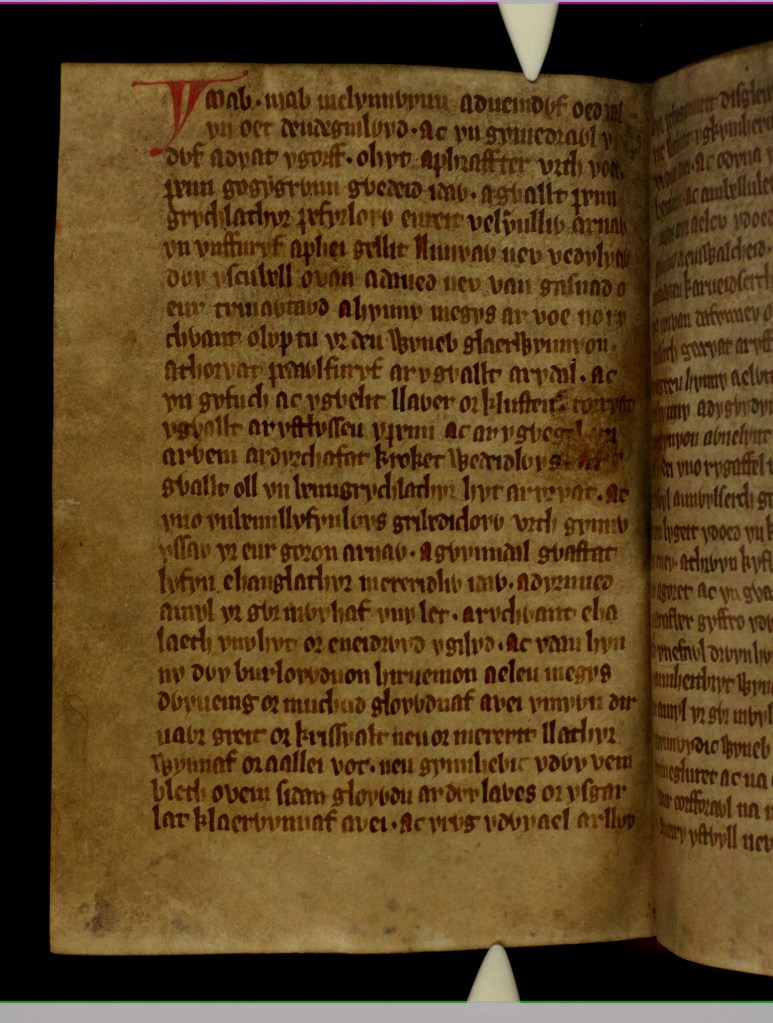
A page from a medieval mss copy of Ymborth yr Enaid
Ymborth yr Enaid (Sustenance of the Soul) is a text written in the 13th century by a member of the Dominican order of friars in Wales. It sets out a guide to mystical experience and suggests a number of practices to enable such experience for members of the order. As such it is comparably rare in the literature of medieval Europe in that the orthodox view of the Church at the time discouraged attempts to experience divinity directly rather than through the established rituals of the Church, and held that such experience, if it did come, should come unbidden and then only to special individuals whose experiences, if recognised by the Church, might well lead either to sainthood, or, particularly in the later Middle Ages, to accusations of heresy for the individuals concerned.
The fact that Ymborth yr Enaid was written in Welsh rather than Latin suggests that it was intended as a guide for ordinary members of the Dominican order rather than as a contribution to theological debate, and also meant that it would have escaped the attention of a wider audience outside Wales. One scholarly monograph on the text* suggests that a context for the production of the work in Wales might be the native tradition of the awenyddion as described by Giraldus Cambrensis in the 12th century. Although this tradition is more likely to have arisen from remnant druidry, and is described in terms of inspired prophetic ability, it is suggested that the existence of such a tradition would have provided the author of Ymborth yr Enaid with a context for a guide to mystical experience, or, as the opening section puts it, to “the ecstasies” and ”visions” whch may come “from the Holy Spirit” and “the nine orders of angels”. The fact that some parts of the work are in verse, and others in what might be termed ‘heightened prose’ indicate that the author was also relating personal inspirations alongside the more mundane passages of discursive argument.
The starting point for those seeking mystical experience is the conventional advice which would be given to all members of medieval monastic orders: avoid sinful thoughts and practise virtuous acts. This would attract the love of God which should be reflected to others around the practitioner. Having achieved this ideal state, the specific practices to achieve mystical experience can then begin. The author’s own experiences, as related here, concern a vision of the young Jesus and advice given by him to the poets that he should be the object of their praise. Clearly, the author was considered to be one of these poets and the instructions for achieving mystical visions follow the advice often given to poets who might compose intially by lying down in a darkened room shaping the verse in their minds. So the seeker of mystical experience is likewise directed to do so at quiet times of day or at night in bed “after midnight until daytime”. The aim here is to induce trance-like states, variously defined as “twofold”, “threefold” and “victorious” trance, each stage taking the practioner further from the physical flesh until a total union with the divine is acheived. Also significant is that the trances are to be experienced by individuals quietly in private spaces rather than as part of community worship or ritual, although part of the preparatory instructions include chanting a Latin hymn which the author has translated into Welsh metrical form. This should be done until “the heart dances and sings with devoted love”. While they are clearly distinct, and operate within different contexts, the similarities between the instructions to poets and to the Dominican friars, and between the trance states of the awenyddion and those which might be achieved by the friars, suggest a persistence within Welsh culture in the early medieval period of the notion of spiritual, poetic and prophetic activity arising from mystical experience, and spilling over from the bardic tradition of the divine origin of the awen to the Christianity which had become the approved mode of spiritual experience .
If the medieval Church, in general, tended to be suspicious of the bards and of poetry as a medium for individual expression, what we find here is a work in which poetry is integrated into both descriptive and imaginative prose detailing practices which may be undertaken by individual members of a religious order which was part of the medieval christian establishment. It is likely, that the anonymous author was also a bard as the verses included in the text display knowledge of techniques that are likely to be the result of bardic training. Analysis of the style also shows it to be comparable to works of imaginative prose tales of the period, even leading to suggestions of possible common authorship.* Be that as it may, the author was certainly gifted with the awen and able to accomodate older ascriptions of its divine origin to contemporary religious orthodoxy. The stories that shape divine inspiration change over time. The mythologies that give it form and make it accessible to expression vary across cultures with different emphases, aspirations and political priorities that may seek to channel it to orthodox interpretations or even suppress it entirely. But whatever the language of religious expression, it seems that divine inspiration is a universal quality which can shape itself to any available medium that doesn’t seek to stifle innovative expression of visionary experience. The question remains, of course, as to whether it comes from a single source which is experienced differently in different cultures, or whether the sources are various but lead to a similar mode of human experience. Suffice to say that the experience itself is definitive for those who have it.
* R. Iestyn Daniel A Medieval Welsh Mystical Treatise, (University of Wales Centre for Advanced Welsh and Celtic Studies, 1997). The author suggests that the idea of divine poetic inspiration originated in “ a Christianization of a pagan belief that the poet, when inspired, was possessed by an impersonal underworld power”.
A discussion of the manifestation of this idea in the early welsh bards can be found in : Y Chwaer Bosco ‘Awen Y Cynfeirdd a’r Gogynfeirdd’ Beirdd a Thywysogion (Caerdydd, 1996).
R Iestyn Daniel has also edited an edition of the medieval text:Ymborth yr Enaid, (Caerdydd, 1995).
For a discussion of the place of Ymborth yr Enaid in early Welsh religious thought and a partial translation of the text into English see: Oliver Davies Celtic Christianity in Early Medieval Wales (Cardiff, 1996).

Although is was said there was a gatekeper at Arthur’s court, there was not. But Glewlwyd Gafaelfawr was there ….”
Owein : The Lady of the Well
A gatekeeper is an elusive character. He may not be a gatekeeper. He may only keep that gate on certain days of the year, or only on 1st January, the gateway to the year. He may deny entry to those for whom, elsewhere, he keeps their gate. Like Glewlwyd Gafaelfawr (‘Brave-grey Mighty-grip’), who is the keeper of the gate (though not the keeper of the gate) of Arthur’s hall in different tales, as when Culhwch comes calling in the tale of How Culhwch Won Olwen* and the keeper of the gate in quite another hall where he refuses admittance to Arthur in the poem ‘Pa Gur yw y Porthaur?’(Who is the Gatekeper?) unless he can prove the worth of his men. He may also be the keeper of the gate for Wrnach the giant when Cei and Bedwyr come calling seeking the things Culhwch needs to wed Olwen, a detail which may be referenced in the poem ‘Pa Gur yw y Porthaur?’ where Cei’s exploits “in Awarnach’s hall” are alluded to when Arthur tells Glewlwyd of his heroic deeds.** This would, of course, be an elaborate and circuitous joke, but it also embodies the double-sided nature of portals.
If we are puzzled, who should we ask? Manawydan fab Llyr is said to be deep in understanding and counsel when Arthur tells Glewlwyd of the qualities of his men. He, too, is a gatekeeper, remarking the door out of the otherworld fortress of Gwales which should not be opened until the occupants are ready to leave. He also watches the Portal through which both Rhiannon and Pryderi pass in the enchanted fortress which appears on Gorsedd Arberth, and keeps watch until he is able to bring them back into the world again. His representation in the Mabinogi as one who patiently bides his time and in Triad 8 as “lledyv” (humble, subdued) suggests one who waits to act at the appropriate time. Consider, too, the Irish tale of Mananaan mac Lir who meets Bran out on the sea as he is passing to the otherworld islands. Manannan says the sea is for him like a grassy plain as Bran passes in his boat through the rolling waves and Manannan sends him on his way.
*This is one if the many ‘doublets’ in the tale How Culhwch Won Olwen, mirroring a similar incident in a parallel episode elsewhere in the tale as if on the other side of a gate in another tale.
** Rachel Bromwich commented “it seems likely that the two gatekeepers have been interchanged, and that Glewlwyd Gafaelfawr originally figured as the guardian of the fortress of Wrnach” and, a little further on, suggests that the poem would therefore represent an earlier version of the episode of Cei and Wrnach. (Trioedd Ynys Prydein, revised 2006 edition, p.362)
The question is posed HERE~> in a different way, and when you have returned from THERE~>, consider these links as a mirror of a window between two worlds. Who, then, is a gatekeeper?
The Awen in Welsh Tradition
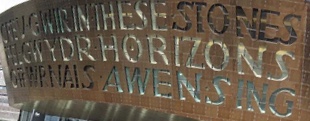
Although ‘awen’is usually translated literally from Welsh to English as ‘poetic inspiration’ or ‘muse’, its resonance in Welsh is both broader and much deeper. In his poem ‘Mewn Dau Gae’ , the twentieth century Welsh poet Waldo Williams uses the phrase “awen yn codi o’r cudd …” (awen arising from the deep, or from what is hidden). In a commentary on his translation of this poem (1), Rowan Williams says that he didn’t feel able to translate the word ‘awen’ literally here because it would not adequately convey the sense in context, as it is “not just a matter of one poet’s imagination at work”. I would endorse that comment and add that it is just as much a matter of communal inspiration and a shared sense of something arising from the landscape and the ‘Deep’ from which the spirit of the landscape arises.
Rowan Williams further develops his discussion of awen in the Introduction to the translation from The Book of Taliesin which he has published together with Gwyneth Lewis(2). There it is linked both to bardic craft and to “the shamanistic gift of inhabiting a life other than the poet’s own”. Noting that the concept of awen is central to the Taliesin poems, the assertion is again made that simply translating the word as ‘inspiration’ or ‘muse’ would be misguided. Reference to the awenyddion as described by Gerald of Wales in the twelfth century is also made to reinforce the sense of “spirit possession” that the term also implies in these poems, and that this is the mark of a true poet rather than the lesser practitioners Taliesin often denigrates alongside monks and other clerics whose knowledge is seen as inferior to that of the bard.
Taliesin is seen, therefore, as a poet of “ecstatic utterance” and compared to the Greek Orpheus, defining part of the way of ‘being’ a poet. Many of the poems in The Book of Taliesin – both the so-called ‘Legendary’ poems and the ‘Prophetic’ poems – refer to the awen as the source not only of inspiration but of deep knowledge. The source of awen is also often located, both in these poems and in the poetry of other Welsh bards of the period, as coming from the Cauldron of Ceridwen. There is a sense, then, of awen as having a spiritual origin so that, in the more orthodox christian theology of the later Middle Ages, it is seen as coming from the Virgin Mary, or directly from God.
So how has that usage survived into modern Welsh where the dictionaries seem satisfied with ‘poetic inspiration’ or ‘muse’, but the example from Waldo Williams’s poem and Rowan Williams’s commentary on it suggest deeper meanings? ‘Awenydd’, in modern Welsh is often used simply as a synonym for ‘poet’, functioning in a similar way to the word ‘bard’ in English. So ‘inspired poet’ might be a good way of translating it, though it doesn’t usually imply shamanistic possession. Similarly ‘awen’ is what inspires a poet or anyone with a creative gift. It can be used simply in these terms, but the linguistic archive of Welsh still makes that deeper meaning available and the sense of it arising from the ‘Deep’ haunts its usage and implies a deeper mystery to the practice of an awenydd’s craft than simply having a way with words. So Taliesin’s strictures about the necessary qualities of a bard still stand!
1. ‘Translating Waldo Williams’ by Rowan Williams chapter in Cof ac Arwydd , Golygwyd gan Damian Walford Davies & Jason Walford Davies (Barddas, 2006)
2. The Book of Taliesin :Poems of Warfare and Praise in and Enchanted Britain, Translated by Gwyneth Lewis and Rowan Williams (Penguin Classics, 2019) * (Discussed separately HERE~>)

Many rivers and streams run into the drowned lands of Gwyddno Garanhir where Mererid’s~> cry can be heard in the sigh of the turning tides, the cries of the wading birds and the winds gusting over the waves. This is a mythic world in a place that I inhabit. To the north the wide estuary of the River Dyfi washes the salt marsh and the mire of Cors Fochno shadowed by mountains to the east. These lowland acres stretch out to meet the sea, crossed by a web of streams flowing into rivers such as the Clettwr which rushes from the high ground through a rocky cleft and down through a wooded gorge to level out across the bog and into the estuary. And Ceulan, which flows from the same high ground where the cauldron lake of Moel y Llyn, fed by a perpetual spring, drains into the capillaries, veins and arteries around Cae’r Arglwyddes, flooding into the rivers below. Ceulan meets Eleri, running down from even higher ground, and as the land begins to level out they run together through another wooded gorge towards Cors Fochno, once flowing directly into Cardigan Bay but now diverted into the estuary to drain the land between the bog and the sea(*see note). Was it here that Gwion Bach was found in the fish weir of Gwyddno Garanhir and re-born as Taliesin? And so, was the flood that drowned Gwyddno’s realm the same flood that flowed from Ceridwen’s cauldron and poisoned his horses?(Discussion on this and the lake of Moel y Llyn HERE~> )
The geography of the tale of Gwion and Taliesin is diverse. In the most well-known account Ceridwen set Gwion to tend the fire under her cauldron above the waters of Llyn Tegid. But this is too far north of Maes Gwyddno for the watersheds to bring the flood from there, though Llyn Tegid is itself said to have been formed by an inundation. Other parts of the tale of Gwion and Taliesin take it even further north to the Conwy estuary on the northern coast of Wales, where yet another inundation legend is set. Gwyddno himself may have originated in the ‘Old North’, that is the borderlands between England and Scotland.
So these ‘legendary’ events have geographical fluidity! But what of their source myth? Here, at the crucial meeting place of legend and mythic narrative – and the liminal ground of folklore through which the stories are diffused – is where historical memory, geology, and cultural ancestry come together in inherited mythos, and so cultural identity. It tells us where we belong, and who our gods are. When Gwyddno Garanhir leaves his lands to dwell with the ancestors accompanied by Gwyn ap Nudd ~> it is a mythic event represented in legend as located in a specific place, though his land could be any of many where historical inundations took place or where geological events re-shaped landscapes and seascapes as the narratives of these events themselves become ‘folklore’ and are written down as ‘literature’. They are our events when they are located in familiar landscapes or narrated in culturally specific ways. But the mythos is universal and this universality is reflected in the apparent universality of international folklore motifs, though mythic universality runs deeper; this is why Annwn is the ‘Deep’ from which our shallow world is manifest.
But it is never ‘shallow’ to us. because it is given depth by legends and mythic narratives which enliven the lands we inhabit, just as the empty winter woods take on a depth when sunlight shimmers through trees in full leaf to shadowy hollows and glades. Already, then, when Taliesin is re-born in Gwyddno’s lands, they are places of legendary history where mythic events have occurred. So when Gwyddno’ son Elffin adopts Taliesin as his bard at the court of Maelgwn Gwynedd, characters from the historical record become the stuff of legend and the carriers of mythic narrative: here the bard re-born from the waters to sing of the Deep from which he came. Here too is Mabon, freed from the dungeon below the waters of the Severn, who himself shares a story with Pryderi, stolen from his mother, Rhiannon, soon after his birth. The stories are told with many variations and inter-leavings as myth becomes legend and lore: the Harp of Maponos ~> playing to inspire multiple narratives.
And Taliesin? His historical, legendary and folkloric dispersal weaves a mythic identity as the archetypal bard. But when Gwyn ap Nudd invites him into The Deep~> he seems reluctant to leave the legendary territory of his shaping for the mythic realm he claimed to know. Such is the ambiguous fate of heroes and demi-gods of ancient story, living between worlds. It is so for us too, when The Deep reveals itself and its darkness illuminates our world.
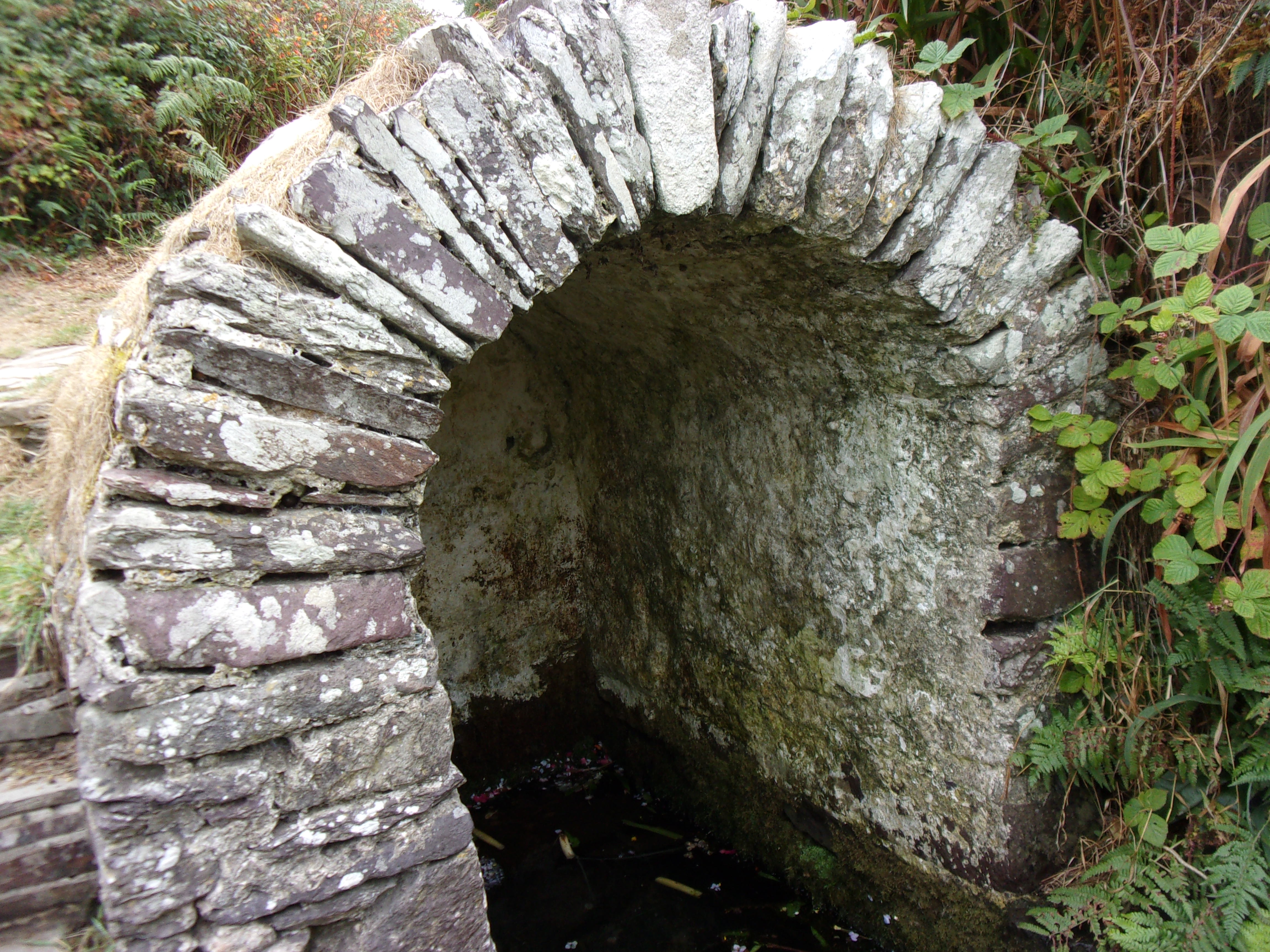
Waters broke from a rock when Non,
pregnant, gripped it in a storm. By the well
Dewi was born: such tales do legends tell.
Now the waters that sit in the bowl of the rock
are still; beyond, waves break on the beach;
far out on the sea dolphins break the swell.
The view from the headland out over Bride’s Bay
is of islands, Sgomer, Sgogwm and between
and further out, too far to see, Gwales
keeping its secrets, where Brân’s head
sojourned while time stood still, the company
enchanted by the singing of Rhiannon’s birds.
Here a light spray showers down
as clouds break for a brief asperging
of a moment, which passes like the rain
as soon as it came, bringing a blessing
as did the touch of water from the well,
shaping a story : a tale I have to tell.
Non’s Well is a mile or so outside Tyddewi (St David’s) in Pembrokeshire where the cathedral to Wales’ patron saint is located. Non was his mother as told in his biography, though whether he was born here or further north in Ceredigion, the territory of Non’s father Ceredig, is disputed, as is often the case in legendary history.
But this site was already a place of significance and the well remains mythically present.

The story of Brân’s head and Gwales is told in the second of the four Mabinogi tales.
https://www.bbc.co.uk/news/uk-wales-62605682

This BBC story about sunken islands revealed on a medieval map is interesting. (in the light of the story in the Black Book of Carmarthen)
Though I think that the quotations from Juliette Wood rather blur the distinctions between myth, legend and folklore.
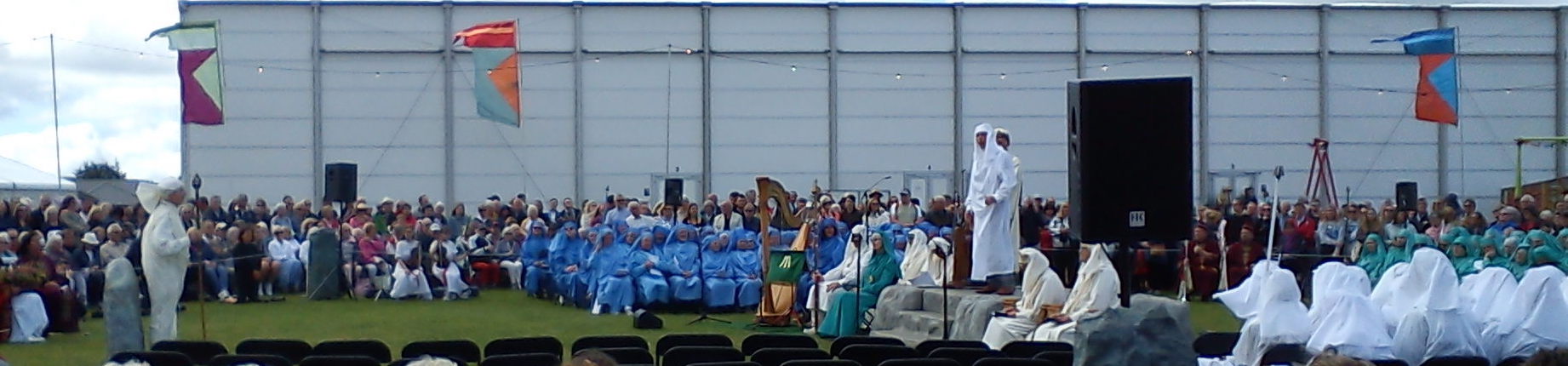
A field of gathering where folk come together
In its centre the Gorsedd circle
Bards welcome those who are worthy
Under the sign of Awen
Bring them into the bond of belonging.
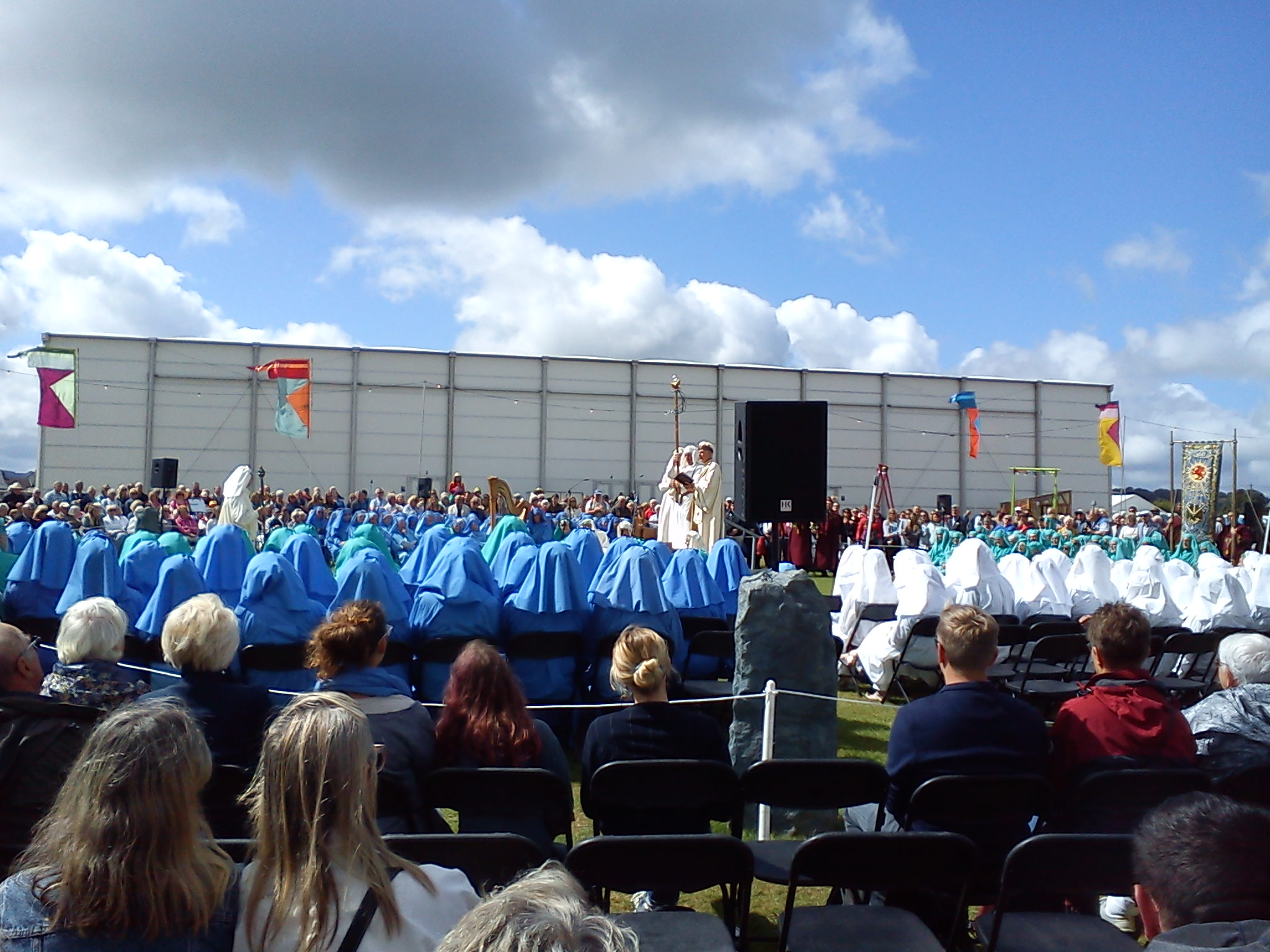

Delightful to the Dragon-Lord …
After the final lines of ‘Mydwyf Merweryd’
(‘I am the Pulse …’) from The Book of Taliesin
Delightful to the dragon-lord
are songs from Gwion’s river
Flowing through the halls,
the scent of fair weather,
A horn full of mead
fragrant with honey and clover,
Druids skilled in Awen
– nothing pleases him better!
So the bard instructs the chieftain as to what is valuable and what, therefore, should please him: Gwion’s River : the flow of inspired song, fine weather, fragrant mead and the inspired utterances of his poets.
 greghill.cymru