Memorial Stone to Waldo Williams, Preseli Hills, Pembrokeshire.
Awen yn codi o’r cudd, yn cydio’r cwbl
(Awen rising from hiding, everything binding)
The above quotation from Waldo Williams’ great mystical poem “Mewn Dau Gae’ (In Two Fields) has appeared in the masthead to this weblog and I wrote about its context in the poem elsewhere ~> . His sense of the awen arising from the deep both within the poet and from the landscape was discussed there. More recently I have come across a discussion of the poet’s work written in the mid twentieth century by Anglican priest and fellow Welsh-language poet Euros Bowen who asserts that, for Waldo Williams (in my translation) “awen is more than poetic inspiration; it is more than a divine influence on the poet. […..] It is itself a religion.”
Although Waldo Williams was a Quaker, and widely thought of as a ‘Quaker poet’, this critic asserts that “ .. it would be a grave error to call him a non-conformist Christan poet” but one who worships in an “invisible and timeless place” (to quote one of his poems) beyond the confines of any temple. He further asserts that “the basis of his faith is not a trust in Christ, or a convincement about God. Its core is a metaphysical and religious convincement that God’s Awen gives life its meaning and purpose, and that awen enables ‘recognition’ (‘adnabod’ – a key term in his poetry) of the divine. After citing a number of references to awen in the poetry to make this case, Euros Bowen then examines the awdl (a long poem in cynghanedd metres) ‘Tŷ Ddewi’ about the establishment of a centre of worship by St David in the place which now bears his name. He notes that, in spite of the Christian context of this foundation, Waldo Williams has St David replying to a passing Celtic pagan who tells him
“I will not serve Christ hanging on a cross. Give back the sun of the old shining world, bring light to the land of the heart without any pang of pain from an odious crown, O, give us the birds of Rhiannon.” (*)
David replies that there is room for “the song of that queen” in the new religion alongside “the beauty of Brân the Blessed”. The response of the critic to this is that it sounds distinctly odd coming from a Christian saint, but is entirely consistent with the poet’s view of awen.
It is enlighnening to read such a critical response from an Anglican priest with a different theological perspective but who also had great admiration and respect for the poet and was able to imaginatively inhabit his spiritual space. It was also instructive to have my own perceptions of the poet’s view of awen re-inforced and extended by the discussion. Not everyone would endorse Euros Bowen’s view of Waldo Williams, at least not as categorically as he states it. For most he will remain a Quaker poet working within the Christian tradition. But that is not, of course, incompatible with the Quaker view of experiental religion and its recognition of ‘many paths to the Spirit’ ; nor of the poet’s belief that, speaking of Catholic martyrs,
Un yw craidd cred a gwych adnabod
Eneidiau yn un a’r rhuddin yng ngwreiddyn Bod
(The core of all faiths is one, so I keenly acknowledge / Souls quickening together at the root of Being)
or of his perception of awen as a “voice clearly heard” and its presence clearly felt “yn cydio’r cwbl” – making everything whole.
(*) These lines are from the translation of Dafydd Johnston in The Peacemakers , a volume of Waldo Williams’ poems in Welsh with facing English translations, mainly by Tony Conran (Gomer, 1997)
Euros Bowen’s essay first appeared in 1957 and was re-published in Waldo Williams – Cyfres y Meistri 2 , Robert Rhys (1981)
The name CERIDWEN has had various forms and implications. Can we say which most clearly relates to its origin? The spelling with one ‘r’ given in this opening sentence is the most common in modern Welsh usage both as a given name and as a rendering of the name as used by the early Welsh bards. But CERRIDWEN is also often used by those referring to the character in the Tale of Taliesin and associated references in legendary texts. An attempt to unravel the uncertain origins of the name was made by Marged Haycock in 2003 where she also catalogued the various forms of the name in the early texts* . These mainly occur in manuscripts which have been dated to the Thirteenth Century, though they may, of course, be using earlier forms or 13th century adaptations of earlier forms. The Black Book of Carmarthen gives ‘Kyrridven’. Peniarth 3 gives ‘Kyrrytuen’, The Book of Taliesin variously gives ‘Cerituen’, ‘Kerrituen’ and ‘Kerritwen’, while the Red Book of Hergest gives ‘Kerituen’. So ‘-fen’ is the most common termination (a mutated form of archaic ‘ben’ : ‘woman’) and ‘rr’ is more common rather than the single ‘r’ of modern Welsh spelling. Whether the variations are due to different spelling patterns at different times and places, or by different scribes, or whether the different forms reflect developments in speech pronounciation is unclear. The difference between the ‘C’ and the ‘K’ initial consonant is clearly simply a matter of a different spelling convention to represent the hard ‘c’ sound. But the the following vowel, ‘y’ or ‘e’ could well represent a shift in actual pronounciation of the vowel sound.
Later examples include: ‘Cereidven’, ‘Cyridven’, ‘Caridwen’, ‘Cridwen’ and ‘Cridfen’.
Elis Gruffydd uses ‘K/Ceridwen’ in his 16th century version of the prose tale of how Gwion Bach became Taliesin, and K/Caridwen is also found in other sources of this tale. Hence Charlotte Guest’s popularisation of ‘Caridwen’ in the translation included in her Mabinogion.
What about possible meanings of the name? Ifor Williams ** asserted that ‘Cyrridfen’ is the most likely original form from ‘cwrr’ (bent, angled..?): ‘cwrr-rhid-ben’ (= woman with an angled joint, or ‘crooked back’) so fitting the stereotype of a witch; but later scholars since have thrown some doubt on this interpretation.
Marged Haycock also discusses:
-the first syllable as ‘cyr’ which could relate to ‘crynu’ so Cyridfen could be like the Gwrach Cors Fochno that makes people shake or shiver
-the first syllable as ‘crid’, judged to be “difficult” but ‘craid’ ( for ‘graid’) (passionate, fierce, powerful) is possible
-the second syllable as ‘ŷd’ (corn, relating her to a corn goddess like Ceres as some earlier antiquarians had supposed)
– her daughter Creirwy, with the first syllable a form of ‘credu’ (belief’) and so, by analogy, her mother’s name as Credidfen would mean ‘woman to be believed in’, making the mother’s and daughter’s name stems a pair.
None of this is conclusive. Nor is there any surviving early evidence of divine origin as no references to her before the 13th century manuscripts exist and all references since seem to be based either on those manuscripts or the later prose tale which itself stems from them, or is an elaboration of more detailed earlier sources which have not survived. Many have, nonetheless, experienced her as divine or chosen to characterise her a witch or powerful enchantress on the basis of interpretation of the prose tale and the reference to her later in that tale by Taliesin when he says, “I was nine months in the womb of the witch Ceridwen”.
What the earlier poems emphasise is, rather, her keeping of the cauldron of awen and so a source of poetic inspiration. In the prose tale, she gives birth to Taliesin and then ceases to be part of the tale. In the bardic tradition this giving birth to Taliesin may be seen as inspiring his presence and inspiring bards to sing in his name. Certainly, many of them asserted this. Cuhelyn Fardd (1100-1130) spoke off being inspired by “awddl Cyridfen”, while Cynddelw Prydydd Mawr (1155-1200) acknowledged “Cyridfen” as the source of his art and Prydydd y Moch at the beginning of the 13th century specifically mentions the cauldron of “Cyridfen” as the source of the gift of awen. These and other references by identified bards are of course in addition to the many references by unidentified bards in The Book of Taliesin.
References
*Marged Haycock ‘Cadair Ceridwen’ yn Cyfoeth y Testun 148-> (Gwasg Prifysgol Cymru, 2003)
**Ifor Williams Chwedl Taliesin (Gwasg Prifysgol Cymru, 1957)
‘The Last Bard’ Frontispiece to Musical and Poetical Reliques of the Welsh Bards by Edward Jones (1784)
The traditional view of the inspired bard or divine singer is of one holding a harp. This image goes back to the Greek Orpheus whose words and music could charm the gods. He was given a golden lyre – a type of small hand-held harp – by Apollo who taught him how to make music with it. In the Brythonic tradition we might think in terms of Maponos and Taliesin, although Taliesin’s most often identified source of inspiration is the Cauldron of Ceridwen and although he says “I was the string in a harp” in one of his many metamorphoses in Cad Goddeu, references to him playing a harp are few. One such is the ‘Elegy for Uthr Pendragon’ where he tells us:
I’m a bard, I’m a harpist, I make music On a pipe On a crwth;
Seven score, or more Could not match my skill, My craft, my art …
Surviving references to musical intruments used by the early Welsh bards are not common, though Gerallt Cymro in his twelfth century Description of Wales said “the Welsh use three instruments: the harp, the pipe and the crwth”; but the professional court bards tended to be contemptuous of the ‘lesser’ bards and entertainers who played such intruments. Here, though, in spite of singing his own praises as the greatest of poets, in typical boasting style, the Taliesin figure is happy to sing his praises as a musician too. As for other bards, at least one text relates the issuing of “a harp, a crwth and pipes” by a king to his poets*, and Llywarch ap Llywelyn (Prydydd y Moch) praises his prince “ â thafod a thant” (with both tongue and [harp]string).
Earlier practices in the Ancient World and in pre-medieval heroic society in different parts of Europe highlight the harp, and the lyre, and sometimes an instrument like the crwth, as an accompaniment to recitation. A 15th century Latin text on the history of the viol and similar stringed instruments comments that, before the development of a raised bridge holding the strings separately away from the body of the instrument, the flat-bridged arrangement would have produced a drone sound rather than individual notes and was used “for the recitation of epics” adding that this was common “over the greater part of the world”.** Such instruments might be played with a bow on the reciters lap or held out in front, rather than on the shoulder as with a modern violin. This suggests that bards and cyfarwyddwyr (story-tellers) had a choice of a steady drone or the sounds of single plucked strings on the lyre or the small harp when reciting, in addition to any music they might also make in the intervals to recitations or to accompany songs. In Welsh, the modern word ‘telyn’ for harp had a wider earlier usage to include the lyre and similar instruments, so the distinction may not always be clear. Similarly the crwth, often seen as an earlier form of the violin, may have overlapped in form with the lyra and the lyre before distinct forms of these intruments and the terminology used to decribe them became fixed.
Of particular interest here is the terminology used between Wales and Ireland. In Ireland one word for a small ‘harp’ was ‘croth’ which seems to indicate a crwth rather than what we would think of as a harp. But the word ‘teillin’ was also used, although it is not the current usage, which, as well as sounding like Welsh ‘telyn’ apparently, according to the Irish scholar Eugene O’Curry, could also indicate the sound of a buzzing bee***. We need to distinguish here between the small harps, or other instruments, which a bard might hold while reciting, and the larger harps used for musical recitals. The fluidity of terminology between harp, lyre and crwth probably reflected the fluidity of form of instruments so described.
Then there is the matter of strings. Traditionally the strings were made from woven horse hair. But in the later medieval period gut strings began to be used and, especially with the larger harps, strings of metal. Such strings made it easier to play individual notes, as with the strings of the viol with an arched bridge noted above, and so to perform polyphonic music. They gave a clearer sound for each note but the horse-hair strings produced a softer sound which seems to have been more to the taste of the bards. The distinction between ‘telyn lledr’ (gut strings) and the ‘telyn rhawn’ (horse-hair strings) was made in one 15th century poem by Iolo Goch, complaining that the new-fangled strings of gut (or “dead sheep”!) are inferior to those of horse-hair and make a harsher sound:
Un delyn , ddiddan angerdd Onid o rawn, gyfiawn gerdd
(‘a harp’s innate quality, its sweet tone/best from horse-hair, a well-made tune’ – ‘cerdd’ here can refer to either poetry or music).
In the same poem he reminisces about a past when there was time to ‘clera’ before the coming of the gut-stringed harp. To ‘clera’ was to go about as a minstrel, presumably singing and playing as well as reciting poetry. But as the professional bards were above such things, the clêr, or minstrels were a lesser grade of bard. But this strict grading does not seem to have survived the times of the independent Welsh princes and poetry in the later Middle Ages is more often associated with music and song as the bards travelled around the houses of the gentry to ply their craft and the difference between grades of bard disappears.
So Iolo Goch is not remembering back that far, but clearly the soft sweetness of a humming bee was more to the his taste than the sharp ringing of single notes. We might also think here of the drone sound of the flat-bridged viol used for recitation of epics noted above. Should we think also of the crwth, or croth/crotta related to the early Irish instrument so denoted? It seems anyway that there was a reversal of terminology between Wales and Ireland. What’s in a name if things so named are different? The crwth and the harp may well have developed separately from the lyre, as might the viol. Overlapping forms and names across Europe as new instruments were developed can make it difficult to pin down references to them in historical texts. But one scholar was prepared to declare that the crwth (‘crotta’) was certainly a Brythonic instrument***.
In addition to these considerations, the nature of bardic recitation and its relation to ‘song’ should be considered. The point of traditional bardic measures and verse forms is that they should be musical, and the bards were said to ‘sing’ rather than recite their verse. It is noteworthy that still today the modern Welsh word ‘canu’ can mean both ‘singing’ and ‘versifying’ and the related words ‘ynganu’ (‘recitation’) and ‘llafarganu’ (‘chant’, or literally ‘songspeech’) contain both the sense of speaking and of singing. So the voice made the music and was supported by the background sound of the strings. There could be music too, of course, as part of an evening’s entertainment. The chief bards at the courts of the Welsh princes may have thought themselves above such lighter forms of entertainment. But for Taliesin, even when his name was taken by one of these chief bards, though he thought himself seven score times their equal, the awen came through him in a multiplicity of forms in words, music and inspired song.
§
A poem containing conceits interacting with these deliberations appears on my Web Portal weblog HERE~> §
Notes: *in The Black Book of Chirk (c.1200)
** J Tinctoris , quoted in Ian Woodfield The Early History of the Viol (Cambridge, 1984)
*** A O H Jarman ‘Telyn a Chrwth’ Llên Cymru 6 (1962) Discusses O’Curry’s remarks. Jarman’s comment on the crwth: “Nid rhaid amau nad oedd y crotta yn offeryn ‘Cymreig’ neu Frytanaidd”
Opening the door from the otherworld island of Gwales Margaret Jones
Although is was said there was a gatekeper at Arthur’s court, there was not. But Glewlwyd Gafaelfawr was there ….” Owein : The Lady of the Well
A gatekeeper is an elusive character. He may not be a gatekeeper. He may only keep that gate on certain days of the year, or only on 1st January, the gateway to the year. He may deny entry to those for whom, elsewhere, he keeps their gate. Like Glewlwyd Gafaelfawr (‘Brave-grey Mighty-grip’), who is the keeper of the gate (though not the keeper of the gate) of Arthur’s hall in different tales, as when Culhwch comes calling in the tale of How Culhwch Won Olwen* and the keeper of the gate in quite another hall where he refuses admittance to Arthur in the poem ‘Pa Gur yw y Porthaur?’(Who is the Gatekeper?) unless he can prove the worth of his men. He may also be the keeper of the gate for Wrnach the giant when Cei and Bedwyr come calling seeking the things Culhwch needs to wed Olwen, a detail which may be referenced in the poem ‘Pa Gur yw y Porthaur?’ where Cei’s exploits “in Awarnach’s hall” are alluded to when Arthur tells Glewlwyd of his heroic deeds.** This would, of course, be an elaborate and circuitous joke, but it also embodies the double-sided nature of portals.
If we are puzzled, who should we ask? Manawydan fab Llyr is said to be deep in understanding and counsel when Arthur tells Glewlwyd of the qualities of his men. He, too, is a gatekeeper, remarking the door out of the otherworld fortress of Gwales which should not be opened until the occupants are ready to leave. He also watches the Portal through which both Rhiannon and Pryderi pass in the enchanted fortress which appears on Gorsedd Arberth, and keeps watch until he is able to bring them back into the world again. His representation in the Mabinogi as one who patiently bides his time and in Triad 8 as “lledyv” (humble, subdued) suggests one who waits to act at the appropriate time. Consider, too, the Irish tale of Mananaan mac Lir who meets Bran out on the sea as he is passing to the otherworld islands. Manannan says the sea is for him like a grassy plain as Bran passes in his boat through the rolling waves and Manannan sends him on his way.
*This is one if the many ‘doublets’ in the tale How Culhwch Won Olwen, mirroring a similar incident in a parallel episode elsewhere in the tale as if on the other side of a gate in another tale. ** Rachel Bromwich commented “it seems likely that the two gatekeepers have been interchanged, and that Glewlwyd Gafaelfawr originally figured as the guardian of the fortress of Wrnach” and, a little further on, suggests that the poem would therefore represent an earlier version of the episode of Cei and Wrnach. (Trioedd Ynys Prydein, revised 2006 edition, p.362)
The question is posed HERE~> in a different way, and when you have returned from THERE~>, consider these links as a mirror of a window between two worlds. Who, then, is a gatekeeper?
So Rudyard Kipling in ‘Puck’s Song’ from Puck of Pooks Hill. ‘Gramarye’ is defined in the Oxford English Dictionary as meaning both ‘grammar’ and also ‘occult learning, magic’. Another form of the word is ‘glamour’ in the sense of ‘enchantment’. Where does ‘grammar’ merge into ‘glamour’ to make magic? Consider that the earliest books of instruction for welsh bards, based on the even earlier purely oral methods of instruction, are known as ‘Gramadegau’r Penceirddiaid’ (Grammars of the Chief Bards). Grammar, in the Middle Ages, was regarded as the ‘mother of the arts’. The secrets of the bards of Ynys Prydain were revealed alongside grammatical instruction in these handbooks. Versification and the structure of language were seen as one and the same study: the keys to the mysteries.
We are talking here of a time when literacy was possessed by only a few, and fewer still who were not using it more or less exclusively for ecclesiastical purposes in Latin. These select few were the holders of a skill which enabled them to give shape to a developing tradition to which only they had access. So to manipulate its history, and the ability to pass it on to the future, was an act of power involving both ‘occult knowledge’ and the skill to use it.
But, as the bardic grammars also make clear, both cynghanedd (the music of the language) and the traditional verse forms (the artistic shape of the language) are held within language itself, part of its hidden grammar which the bards had the power to reveal. As one modern theorist of cynghanedd puts it, the bards were instructed to “dathla yr anweledig yn weledig” {*} (celebrate the invisible into visibility). The same theorist also asserts that language has developed not simply as a denotive medium for naming and describing things in the everyday world, but also carries a deeper structure of meaning which may be hidden in its everyday use but which has the power to reveal otherness and, from that revelation, to create articulations of a hidden world. The welsh bards were special in that they produced an institutionalisation of this idea in the bardic grammars.
So grammar becomes glamour or enchantment, glossed as ‘gramarye’ in English in spite of there being no tradition of arcane handbooks of bardic practice in that language. But any inspired poet, or awenydd, in any language, will wish to fulfil the instinct to carry meaning from the hidden realms into the cultural sphere of common conversation and, by doing so, to infuse the world we know with hidden meaning. This is the only grammar that counts.
{*} R. M. Jones Meddwl y Gynghanedd (Barddas, 2005)
Some have supposed that Taliesin was a god whose identity – and perhaps name – became confused with the historical bard of the 6th century Brythonic warlord Urien of Rheged.[i] Be that as it may, it is certainly the case that many of the poems in The Book of Taliesin were written by later awenyddion who adopted his mantle and sought to develop his mythos. So his place among the gods, or his relation to them, became less clear as he gained legendary significance as a bard/awenydd. In their later literary representation, the gods themselves, and their relationships to each other, became interlaced as the weavers of song wove their stories into more complex narratives. What follows is an attempt to identify a few threads stitched into the later medieval tapestry.
In the poem known as ‘Cad Goddeu’ (Battle of the Trees) in The Book of Taliesin, Gwydion conjures a host of trees to assist in the battle. The poem also asserts that Taliesin himself was created out of plants, earth and ‘water from the ninth wave’ by Math and Gwydion, in much the same way they created Blodeuedd in the Fourth Branch of The Mabinogi. No reason is given for the battle in the ‘Cad Goddeu’ poem itself, but No. 84 of Trioedd Ynys Prydein says that it was fought for ‘a bitch, a roebuck and a lapwing’. The Fourth Branch of The Mabinogi contains other examples of Gwydion’s magical abilities, including an episode where he travels from North to South Wales to trick Pryderi into giving him some pigs that were a gift from the Otherworld domain of Annwn. Gwydion later kills Pryderi when they engage in man-to-man combat as part of the war which breaks out as a result of Gwydion’s trickery. But there might be an older version of this story in which Gwydion’s brother Amaethon actually raids Annwn itself, not for pigs but for a white roebuck and a young hound. The story is contained in the Peniarth manuscripts (No. 98B) and records two englyn verses with some explanatory prose. It is thought that the englyns must be older than the prose which refers to the ‘Cad Goddeu’ by an alternative name of ‘Cad Achren’. It says that :
“This battle took place because of a white roe deer and a young hound which came from Annwn. They were taken by Amaethon fab Dôn . Because of this Arawn, King of Annwn, attacked Amaethon.” [ii]
The text goes on to say that there was a person on either side of the battle whose name was not known but if guessed it would ensure that the battle would be won by the side that guessed correctly. On one side this person was a woman called Achren. On the other a man called Brân. It is then said that Gwydion sang two englyns:
[Like this]
Steady are my horse’s hooves as I spur him on
The alder sprigs held high on the left
Brân is your name, of the shining crest.
Or like this:
Steady are my horse’s hooves on the day of battle
The alder sprigs held high in your hand
Brân in your coat of mail with [alder] sprigs on it
The good Amaethon won this battle. [ii]
This must mean that Brân was with Arawn and the woman Achren was with Amaethon. If this is the Bendigeidfran of the Second Branch of The Mabinogi then his presence with the Otherworld troops might go some way to explaining his ‘blessed’ appellation and the description of him as a giant. The ascription to him of alder sprigs fits the ‘Cad Goddeu’ where alder is said to be in the vanguard of the battle which is also a characteristic of Brân in The Mabinogi. The name-guessing game is a well-established folklore motif, most well-known in the story of Rumpelstiltskin as given by the Brothers Grimm, though I know of no other example of it in Brythonic lore. The ‘Cad Achren’ story suggests that the conflict between Gwydion and Pryderi in The Mabinogi, which takes place entirely between North and South Wales, is a re-telling of an earlier tale of a conflict between the Children of Dôn and Arawn in Annwn. Amaethon does not appear with his siblings in The Mabinogi tale so a story which includes him does suggest an earlier provenance.
Instead of pigs this story cites a white roebuck and a young hound as the cause of the battle, two of the three items cited in the Triad as the cause of the ‘Cad Goddeu’. It would be helpful to know the significance of these animals in this case but the story as it has survived appears to be an incomplete fragment preserved only to (partly) explain the verses. Amaethon is usually identified as a god of agriculture and agricultural gods do sometimes become gods of war.[iii] Gwydion is clearly portrayed as a magical adept and trickster, consonant with his appearance in The Mabinogi. Although the suggestion is that Amaethon stole the deer and hound from Arawn, this may not be a raid on Annwn from Thisworld, but a war between different groups of deities. If so the war could be within Annwn itself as with the conflict between Arawn and so Pryderi and Hafgan in the First Branch of The Mabinogi, or possibly between different otherworlds. In one of the ‘conversation’ poems in The Black Book of Carmarthen, Gwyn ap Nudd speaks of his role as a harvester of souls not just in Thisworld but in Otherworld battles too [see HERE ~>]. In another of these conversation poems Taliesin refuses the invitation of Ugnach (a probable synonym for Gwyn ap Nudd –[ see HERE~>]) and instead says he is going to the fortress of Lleu and Gwydion. ‘Caer Gwydion’ or ‘Caer Aranrhod’ (the fort of Gwydion’s sister) are names for the Milky Way. Might they also indicate an alternative Otherworld and is this where Taliesin is heading?
If we are dealing with two opposing group of deities , one linked to Annwn and led by Arawn (another probable synonym for Gwyn ap Nudd) and also including Pryderi, Brân and indeed the other chief characters of Branches 1-3 of The Mabinogi, opposed to the family of Dôn, some of whom feature in the Fourth Branch but also include Amaethon and Gofannon, then where does Taliesin fit? The author or redactor of the ‘Cad Goddeu’ poem in The Book of Taliesin (probably the 12th century awenydd Prydydd y Moch [iv]), wearing the mantle of Taliesin, clearly wants to place him as a significant presence in the battle, and to suggest a divine origin for the bard, shaped by the magic of Math and Gwydion and brought into being by the Divine mother Modron. Taliesin is a presence in other conflicts with Annwn, notably joining Arthur’s raid in the ‘Preiddeu Annwn’ poem. In ‘Cad Achren’ he appears to be on the same side as Amaethon and Gwydion if this battle is the same as the ‘Cad Goddeu’ as the prose attached to the englyns sung by Gwydion asserts. But he is said elsewhere to keep company with Brân and Pryderi. [v]. When he joins Arthur’s raid on Annwn he might have a purpose other than the desire for loot as I have intuited [HERE~>]. He is a shape-shifter, a trickster and an all-round slippery customer who makes it hard for us to pin him down. He seems closest in nature to Gwydion who is himself a shape-shifter, a master story-teller and chanter of verse for magical purposes. It may be they both originate in a trickster deity linked to the source of awen who may have been tricksy in causing conflict between the gods too.
References
[i] Ifor Williams Chwedl Taliesin (O’Donnell Lecture 1955-6)
[ii]My translation from the text as given by Ian Hughes in the introduction to his edition of Bendigeiduran Uab Llyr (Aberystwyth, 2017) . What follows is based both on his discussion in Welsh (p. xxvii), and that of Rachel Bromwich in English in Trioedd Ynys Prydein (p.p. 218-19).
[iii] The most well-known example is Mars who protected agriculture as well as being a god of war.
[iv] As suggested by Marged Haycock : Legendary Poems From The Book of Taliesin pp. 27-30
[v] e.g in The Second Branch of The Mabinogi where he is one of the seven who returned with Bendigeidfran from Ireland and sojourned with the head of Brân in Gwales.
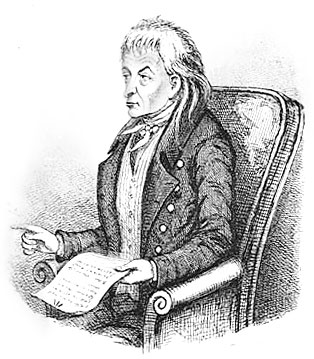
Iolo Morgannwg has a reputation as a notorious forger of Welsh literary history. But perhaps we should remember him as the first Brythonic Reconstructionist. In Wales, where scholars first unmasked his imaginative reconstructions as a misleading distraction from their attempts to produce definitive texts of medieval Welsh authors, he has more recently been re-assessed as an important literary figure in his own right.[*] He was the progenitor of the modern bardic orders, both the direct descendant of his ‘Gorsedd’ which is associated with the annual National Eisteddfod festival held at a different site in Wales each year, and those druidic orders which practice druidry as a path of pagan spirituality. Iolo did not think of himself as a pagan, though he opposed the institutional power of the Church of his day. He, at various times, associated himself with Quakers and particularly Unitarians, portraying the three rays of the Awen as emanating directly from a single God.
But he could certainly be called an Awenydd in his bardic practice, both in those poems which he acknowledged as his own and those which he attributed to others. The Gorsedd he created was not just an exercise in antiquarian speculation, it was a world he created so that he could actively inhabit it, a world in which druidic ceremonies validated in the present the lost inheritance of the past. Perhaps his most notorious forgeries were those of the poems of Dafydd ap Gwilym which he ‘discovered’ and persuaded others were genuine, plausibly enough for them to have found their place in editions of that poet’s work. Unlike some other notable forgeries of the Romantic period, and some of Iolo’s other creations, these were not of a wholly imagined poet, but one who existed and whose genuine works survive. What of those poems which did not survive? Iolo thought he knew, after all Dafydd visited him in his dreams and spoke to him. This has been attributed to the laudanum he habitually took to help him sleep. But he was also well-versed in the techniques of strict-metre poetry as written by the medieval Welsh bards and fully immersed in the ethos of Dafydd’s bardic practice and that of other bards, and so – in promoting their work as he did – he could also convincingly re-create it to fill the gaps which he perceived in the surviving record.
Although antiquarians and scholars such as Edward Lhuyd had previously begun to re-connect with the Brythonic past before Iolo, it was he who successfully re-imagined and re-constructed it as a contemporary practice based on both a well-informed and on instinctive knowledge inspired by Awen and also with the skill he asserted an Awenydd must have, such as proficiency in the traditional metres and the word-music of cynghanedd. He was, in that sense, a true inheritor of the spirit of Taliesin who himself berated other bards whom he considered not to be true awen-poets. Many of Taliesin’s poems are now known to be the work of medieval bards who placed themselves in his tradition. As such they wrote not for fame or fortune but for the Awen which held them to proclaim, in Iolo’s words “Y Gwir yn erbyn y Byd” (‘The Truth against the World’ – words which are still proclaimed today in the ceremony of the chairing of the bard at the Welsh National Eisteddfod).
Clearly that ‘truth’ was not affected in Iolo’s mind by the feigned authorship of some of the poems he wrote, any more than it was of the 12th and 13th century bards whose work was taken to be that of the 6th century Taliesin. “The truest poetry is the most feigning” says Touchstone in Shakespeare’s play As You Like It. W H Auden repeated it in the twentieth century with his own advice for lying poets. So what of the truth or otherwise of the world Iolo created? Consider these lines which he penned in English on visiting the imprisoned radical preacher William Winterbotham:
Of late, as at the close of day
To Newgate’s cell I bent my way
Where Truth is held in thrall
I wrote, that all might plainly see
My name, the Bard of Liberty
And terror seized them all.
Although this is to be seen in the context of Iolo as a political radical, he in no way separated his politics from his bardism [**]. The first five lines are an accurate account of his visit and how he identified himself in the visitor’s book. He was subsequently asked to leave without seeing the person he came to visit. We might think, therefore, that the last line is wishful thinking. Iolo was, on more than one occasion, investigated for sedition when it was feared that the Revolution in France would spread to Britain. So the authorities were certainly worried about him, if not terrified. In championing Truth, he clearly also took liberties, but it may now be time to re-assess him and celebrate all that he subsequently made possible by his activities. For us today ‘The Bard of Liberty’ and the ‘Bardd-Awenol’ might be co-identities we can comfortably inhabit.
[*] A recent academic project based at the Centre for Celtic Studies in Aberystwyth : lolo Morgannwg and the Romantic Tradition in Wales has resulted in a number of major assessments of Iolo’s life and work, establishing him as an essential figure in Welsh, and indeed British, cultural history.
[**] Iolo was in London in the 1790’s to promote his English-language collection Poems Lyrical and Pastoral and to promote himself as ‘The Bard of Liberty’. It was at this time that he held the first of his Gorsedd ceremonies on Primrose Hill and also circulated in the milieu of other radical poets and artists of the time such as the young S T Coleridge and William Blake.
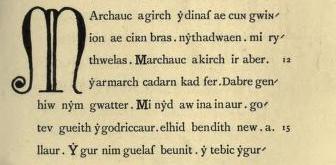
The Opening of the poem inThe Black Book of Carmarthen from the facsimile of Gwenogvryn Evans
One of the most intriguing of the ‘conversation’ poems in early Welsh is that between Taliesin and Ugnach. Two separate manuscripts of the poem have survived, one in The Black Book of Carmarthen and another in a separate manuscript also kept in The National Library of Wales. The poem has been interpreted in a number of ways and a few ambiguous words in one of its englyns have given rise to much speculation about the context for the poem. I will discuss these matters after giving my translation. I should make it clear here that I read it as a straight-forward encounter with an Otherworld character whose identity I will also suggest below. A remarkable feature of the poem, if it is viewed in this way, is that Taliesin is reluctant to accept the invitation offered to him, given the apparently fearless forays into the Otherworld which are a feature of some of the poems attributed to him.
Who is Ugnach that Taliesin should be so deferential to him and yet refuse his offer of hospitality? In the poem he says that he is ‘Ugnach, Son of Mydno’ but Taliesin claims not to know him and there are no references to this character elsewhere unless we can equate him with the ‘Mugnach’ mentioned in the Triads as the father of Fflur who is beloved of Caswallawn. There he is named with the additional appellation ‘Gorr’ which is usually presumed to be an abbreviation for ‘Corrach’ (dwarf) but it might also be a scribal mistake or variant of ‘cawr’ (giant). Names ending in ‘-ach’ tend to signify supernatural characters such as ‘Wrnach’, a giant and Diwrnach, the Irish owner of a magical cauldron, both of whom feature in Culhwch and Olwen. Attaching the suffix -‘ach’ to the Welsh word ‘gwraig’ (woman) gives ‘gwrach’ (witch). So it might be that the name’s significance is as much in its suffix as in any genealogy.
Following the conventional exchange when two horsemen meet each other, Ugnach is immediately insistent that Taliesin should accept his hospitality – ‘You cannot refuse’ – but Taliesin, as politely as possible, does refuse. He says he is on his way to the fortress of Lleu and Gwydion (presumably Dinas Dinlleu in Gwynedd, a location which is the setting for part of the Fourth Branch of the Mabinogi ?) When asked where he is coming from he says ‘Caer Seon’, a place that has a number of possible locations.
Why will Taliesin not go with Ugnach? It may be that he really is in a hurry, but there is a certain tension in the exchange between them that suggests an evasiveness on Taliesin’s part and an insistent lure on the part of Ugnach. It has something of the atmosphere of the exchanges between the boy and the crone or ‘false knight’ in the folk ballad ‘The False Knight on the Road’ and its variants. Here, though, Taliesin does not try to cleverly outwit Ugnach but, in accordance with convention, to politely but firmly decline his offer. Does Taliesin fear the consequences of going with Ugnach, perhaps thinking he may never return? This suggests a skilled mediator with Otherworld beings who is wary of what this one wants with him.
The poem is written in the form of a series of three-line englyns with each of the three lines featuring end-rhyme, something not achievable in the translation but which, along with the syllabic requirements of the englyn form, may have a bearing on the particular choice of words and therefore may be a factor in the issues discussed below.
TALIESIN:
Horseman who rides to the fortress
With white hounds and great horns
I see you but I do not know you.
UGNACH:
Horseman who rides to the estuary
On a steed strong and steadfast
Come with me, you cannot refuse.
TALIESIN:
I cannot go there now
I have no time to delay
Blessings go with you from above and below.
UGNACH:
Warrior who is not seen here often
With the look of one who is fortunate
Where do you go and from where do you come?
TALIESIN:
I come from Caer Seon,
From contesting with strangers;
I go to the fortress of Lleu and Gwydion.
UGNACH:
Come with me to my fortress
For shining mead
And fine gold for your spear-rest.
TALIESIN:
I do not know you bold warrior
Who promises mead and a bed,
Your speech honeyed and fair.
UGNACH:
Come to my domain
For wine flowing freely.
Ugnach am I, named son of Mydno.
TALIESIN:
Ugnach, blessings to your Gorsedd,
May you have favour and honour.
Taliesin am I and I’ll acknowledge your feast.
UGNACH:
Taliesin, greatest of men,
Most accomplished in bardic contest,
Stay with me until Wednesday.
TALIESIN:
Ugnach, most richly endowed,
Grace to your great land;
No censure on me that I cannot stay.
§
On the face of it this seems to be an encounter with a character from the Otherworld, a character who bears a striking resemblance to Gwyn ap Nudd with his pack of white hounds. This is how I read it so this has had a bearing on how I have translated it. But other contexts have been argued for, mainly centring on the interpretation of the fifth englyn. There Taliesin says he comes from ‘Caer Seon’ where, in the second line of the englyn, he says he has been ‘ymlit ac itewon’. On the face of it these words seem to mean ‘fighting (or disputing) with jews’. Taking the word ‘itewon’ to be the earliest example of the modern Welsh word ‘iddewon’ (jews) would certainly give such a meaning for the line. This has led to one interpretation of the poem as an account of Taliesin returning from the Crusades, making ‘Caer Seon’ Jerusalem and ‘jews’ a generic term for those being attacked there [1]. A much more likely word, in that case, would be ‘saracens’ but there are several examples in medieval literature in English as well as Welsh of such words being mixed up or having a general application to refer to ‘others’. Elsewhere, saracens were even conflated with saxons, and the precise identity of peoples from other cultures would not necessarily be distinguished and the word for one could serve as the word for others, particularly if they were all ‘enemies’ [2] For this reason I have preferred to translate ‘itewon’ (which end-rhymes with ‘seon’ and ‘gwidion’) as ‘strangers’. There is, of course, no need to opt for the ‘crusade’ theory even if ‘itewon’ is retained as ‘jews’. There are possible locations for ‘Caer Seon’ on the island of Anglesey and near Conwy on the coast of North Wales. Taliesin could have been engaging in theological disputes or bardic contests (rather than fighting) with jews in either of these places, though it seems unlikely. Or he could have been coming from Arthur’s court at Caerleon, where such a contest is a little more possible.
Some scholars have suggested that ‘itewon’ might be a mistake for ‘cerddorion’, and that Taliesin was therefore engaging in expected bardic contests with other poets, especially if Caer Seon is taken to be a court of Maelgwn Gwynedd at Deganwy near Conwy. Similarly ‘itewon’ has been taken as a developed form of the place name ‘Iudeu’ , thought to be on the Firth of Forth, which would mean that Taliesin had journeyed from the Old North, possibly to North Wales or possibly to another destination in the Old North. But all of this is a distraction from the encounter with Ugnach. It seems clear that Taliesin is being invited to an Otherworld caer and that he refuses the invitation. If we may take Ugnach to be Gwyn ap Nudd two possibilities may be considered. One is that Taliesin’s boastful expeditions to the Otherworld, such as that described in Preiddeu Annwn, are conducted as raids either for treasure or for poetic inspiration. Here he is invited to visit as a guest, or perhaps is being lured there to account for himself. Clearly he is not prepared to go on these terms. The other possibility, suggested by at least one scholar [3] is that he is dead and that Ugnach is bidding him come to the ‘great land’ as he acknowledges it, and that he is either not yet ready to go, or he is going elsewhere. If so Ugnach may well be Gwyn ap Nudd, in another guise. The fact that Taliesin says he journeys to the fortress of Lleu and Gwydion has been seen as a possible reference to the Milky Way (Caer Gwydion), that is, he has his sights on a higher destination. The possibility that this would mean ‘Heaven’ in a christian sense, or an alternative Otherworld location of which Gwydion is the ruler – imponderable though that may be – is also worth pondering.
References
Llyfr Du Caerfyrddin ed. A O H Jarman (Cardiff, 1982)
‘Rhai Cerddi Ymddidan’ Brinley F. Roberts in Astudiaethau ar Y Hengerdd ed. Rachel Bromwich & R. Brinley Jones (Cardiff 1978)
Alexander Falileyev ‘Why Jews? Why Caer Seon? Towards Interpretations of Ymddidan Taliesin ac Ugnach’ in Cambrian Medieval Celtic Studies No. 64 Winter 2012
[1] By Graham Isaac in an article discussed by Alexander Falileyev (see above).
[2] As suggested by Marged Haycock in her notes to the poem ‘Kadeir TeŸrnon’ Legendary Poems From The Book of Taliesin (CMCS, 2007) p.310
[3] Also proposed by Graham Isaac and discussed by Alexander Falileyev (see above).




 greghill.cymru