A bronze statue of the goddess Artio was exhibited as part of ‘The Celts’ at the British Museum a few years ago. It has the inscription ‘To the Goddess Artio, dedicated by Licinia Sabinilla’.(1)
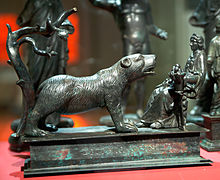
What is particularly interesting about this statue is that the exhibition catalogue notes that the human figure is a later addition and that the statue was originally just the bear figure. The assumption is that the addition occurred when the statue was acquired for use in the Romanised Gaulish villa where it was found. This suggests that the original statue reflected an earlier practice of representing the deity in animal form, but that this was unacceptable to the romanised individual who acquired it so the human figure was added. The statue was found in northern Gaul. Inscriptions to the male god Artaius are recorded mainly in the south which was romanised earlier. One reads “to Holy and August Artaius”. Was there a male and female pair of bear deities or did one develop into the other? A shift, that is, from female to male and then on from animal to humanised deity.
If so, how might a bear goddess and god, recorded in epigraphy and iconography in Gaul, as has been suggested(2), become the Arthur of British tradition? Clearly bear deities did not fit well with the tendency of the Romans to assimilate Celtic deities to their own pantheon, but these bear deities are attested and did survive Romanisation, at least for a time. So when a heroic figure resisting the Saxons is commemorated in the ninth century Welsh-Latin Historia Brittonum with the same ‘Arth-‘ (bear) stem to his name, and as such a name is not common, it is worth asking where this name might have come from. It also the case that the name Arthur is attached to a figure in early folklore in Welsh which feeds into such literary manifestations as the tale Culhwch and Olwen, an Arthurian story which predates the appearance of Geoffrey of Monmouth’s shaping of Arthur in his ‘History’. Surveying early Arthurian literature in Welsh, O J Padel has written; “the Arthur of local legends and magical animals is the dominant one until the 12th century, when the military one becomes prominent”. (3) This early Welsh Arthur was a leader of a group of rugged and often themselves magical individuals rather than a ‘king’. Padel compares them variously to Robin Hood’s band and the Fianna under Finn in Ireland. In this context it is easier to see how such a view of the emergence of Arthur from a bear deity begins to make sense.
Arthur’s continuing presence in folklore as a giant should also be borne in mind, as should the legend that his wife Gwenhwyfar was the daughter of a giant. This view of him seems to have easily survived his translation to the king of medieval romance and seems to be persistent from earlier traditions. It is reflected in many landscape features such as ‘Arthur’s Seat’, suggesting a giant-sized occupant; there are many cromlechs, other megaliths and large rocks citing Arthur in their name or with a legend connecting him to them. Other members of Arthur’s retinue such as Gawain are also credited with gigantic stature(4). In Culhwch and Olwen the ‘chief giant’ Ysbaddaden Pencawr says that Arthur is one of his men although he is helping Culhwch to fulfil the task that Ysbaddaden has set for him. It is easy to see how a folklore giant who becomes human might later be portrayed as confronting or otherwise dealing with giants. Arthur’s dog is called Cafall (horse) making it a suitable sized dog for a giant.
- Inscription from Beaucroissant CIL 12, 02199, referencing Mercury together with Artaio dedicated by Sextus Genius Cupitus
- David Jones ‘The Myth of Arthur’ in Epoch and Artist (Faber, 1959
- O J Padel Arthur in Medieval Welsh Literature (University of Wales Press, 2000)
- William of Malmesbury mentions an outsize grave of Gawain in the 1120’s. Many references to Arthur as a giant also occur in Chris Grooms The Giants of Wales/Cewri Cymru (Lampeter, 1993
 greghill.cymru