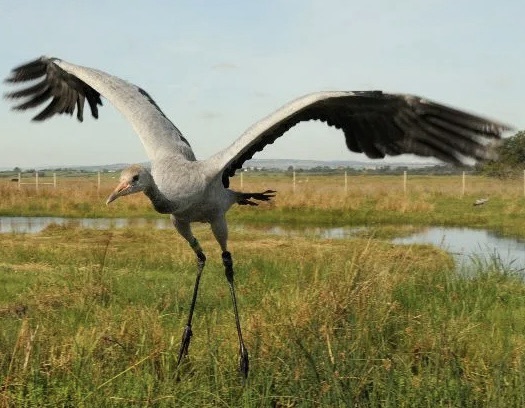
My local Welsh-language community magazine has a regular column on the origins of place names. A recent edition discussed a farmhouse located on a rocky outcrop at the edge of Borth Bog (Cors Fochno) called ‘Cerrigcaranau’ (1) which seems to mean ‘Crane Rock’. Cranes were once common in Wales and this wetland would be an appropriate place for them, although ‘garan’ was also sometimes used instead of the more usual ‘crychydd’ or ‘Crëyr’ for ‘heron’, but perhaps only after cranes were no longer present.
Another possible source of the name was also discussed by a local writer in 1910: that the reference is to Gwyddno Garanhir and that the rock’s name might have originally been ‘Cerrig Garanhir’ referring to the drowning of his lands as recounted in the legend of Cantre’r Gwaelod, indicating that Gwyddno took refuge from the flood on this piece of higher ground (2). The suggestion here is that it refers to Gwyddno’s name ‘Garanhir’ (literally ‘long crane’, though it has been interpreted as meaning he had long legs like a crane). But if Gwyddno, as a legendary character, has a crane nature, might this also have mythological origins? Cranes feature in a number of ways in mythology. The Gaulish god Tarvos is represented in images of him as a bull with three cranes. Miranda Green, in a discussion of the image, has suggested that cranes and other water birds can represent the release of the soul after death and more generally function as an image of metamorphosis or transformation into animal form. (3)
Although it is difficult to locate the origins of the Cantre’r Gwaelod legend precisely in time, in the version that we have it seems to post-date the references to Gwyddno as ruler of this land at the time of the localised Taliesin story, that is if we take it literally as the Taliesin story must be set before the inundation. The two stories may have different provenance and become entwined in local legend, just as they each have parallel versions set on the Conwy estuary in North Wales. But Gwyddno’s crane nature, if it has mythological origins, would go back even further, before the legendary events that these stories relate. To shape-shift and fly from an inundation, or to transform into a creature capable of remaining on flooded land and become one with the transformed environment, takes the story back before the legendary domain of historical or geographical events, imaginatively shaped into story, to the mythological domain which often infuses such legendary narratives with deeper significance.
What, then, of Gwyddno’s ‘conversation’ with Gwyn ap Nudd? There is no mention there of Gwyddno’s drowned lands, but he remains a legendary character encountering a mythological one who may be gathering his soul after death. This does not preclude the legendary Gwyddno himself having a mythological origin, or that his soul bird might have been a crane, released by Gwyn as the ‘Bull of Battle’ just as Tarvos may be releasing transformed souls as cranes. Such speculations are enticing and chime with my own perceptions of cranes, herons, egrets as wide-winged soul-birds traversing the spirit world whenever I encounter them in feathered flesh or in ethereal space.
—-
1 Angharad Fychan ‘Enwau Lleoedd’ Y Tincer, Mawrth 2005.
2 Richard Morgan ‘Dwy Neidr’ Cymru 38 , t.55
3 Miranda Green Dictionary of Celtic Myth and Legend, p.68 & p.208
 greghill.cymru
3 responses to “Gwyddno Garanhir as a Crane Spirit? ”
This farm (Cerrig Caranau) has a machine in Machynlleth dispensing their own organic milk. The blurb on the panel by the machine says the farm is on the site of the burial mound of Gwyddno Garanhir according to local folklore. Mythic milk!
There is a similar machine in Aberystwyth and when I checked this afternoon I found the same information panel which I’ve never read through before. So thank you for bringing it to my attention.
Funeral mound is an advance on a place of refuge, but it reinforces the local folklore of Gwyddno’s association with the site.
Interesting to hear about Cerrigcaranau / Cerrig Garanhir. I’d agree that Gwyddno’s soul-bird may have been a crane and he might have shapeshifted into crane in ritual and called upon crane in battle. A
Also very interesting to read the comment suggesting Cerrigcaranau is also where Gwyddno’s funeral mound is. That’s the first mention I’ve heard of that. It would be a fitting resting place.