Looking to put together a compilation of writings from here and elsewhere, it seemed that something on Nodens was also needed. So here is a draft of some thoughts which might make it into such a compilation. It relies less on historical attestations and academic investigation than other pieces. But there are a number of ways that data from historical sources, folklore and archaeology link into my personal insights.
There is a temple of Nodens above the River Severn at Lydney, facing across the river from the western side and the eastern edge of the Forest of Dean. The temple was constructed quite late in the Roman occupation of Britain and so would have been thoroughly Romanised in its practice though dedicated to a Brythonic god Nodens who has survived in the folklore record variously as Nudd, Lludd and Lud. There are a number of landscape features in the forest containing the element ‘Lyd-’ which I once spent some time pursuing on foot [Described HERE]. This area between the rivers Severn and Wye, and westwards into the old forest of Wentwood, was known as ‘Gwent Is-Coed’ (‘Gwent below the Forest’) and, according to the first Mabinogi story featuring Rhiannon and Pryderi, Gwent Is-Coed was the domain of Teyrnon who rescues Pryderi after he had been snatched as a baby from Rhiannon by a creature who is also intent on stealing a foal from his stable every May Eve. Teyrnon eventually returns Pryderi to Rhiannon, ending her penance at the horse block for allegedly murdering her son. He is one of four fathers for Pryderi alongside his other foster-father Pendaran Dyfed, his biological father Pwyll Pen Annwn and, when he is an adult, his virtual step-father Manawydan. Pryderi is, of course, an analogue of Mabon Son of Modron, the Divine Son Maponos of the Divine Mother Matrona, so it is appropriate for a character who is based on a god whose identified descent is matrilineal that his fatherhood should be more diversely identified. Whether we are to regard each of these fathers as aspects of one divine figure, or different expressions of male partners for the Divine Mother, it is instructive to note that the name Teyrnon as been derived from Brythonic Tigernonos (‘Divine King’), an appropriate partner for Rhiannon whose Brythonic origin in Rigantona (‘Divine Queen’) suggests that they should be placed together. Consider, too, that an early version of a triad(*) which predates the Mabinogi story claims that Pendaran Dyfed was the original owner of the Otherworld pigs that Pryderi loses to Gwydion in the fourth Mabinogi and so might be conflated with Pwyll Pen Annwn who was in later versions said to be the recipient of the pigs from Annwn. Finally consider that Manawydan has been associated with the Irish sea god Manannan, in spite of himself having no apparent maritime characteristics in the Welsh sources, but may also be conflated with Pendaran as he also becomes a lord of Dyfed when he marries Rhiannon.
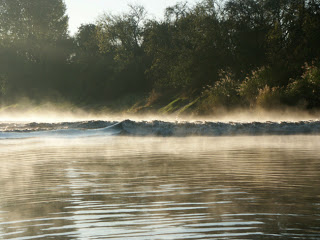
It is my intuition that we can we regard each of these characters as expressions of Nodens and that he is a sea god whose temple at Lydney overlooks the lower reaches of the River Severn where it broadens to the sea and where the phenomenon known as as the ‘Severn Bore’ causes the river to reverse its downwards flow and rush back upon itself with the incoming tide. This, it has been suggested, is an explanation for the epithet ‘Twrf Lliant’ which may mean ‘thundering waters’ and is attached to Teyrnon’s name. That is, the wooded domain of Teyrnon by the tidal Severn, where the temple of Nodens is located, the land of Dyfed much further west — the domain variously of both Pendaran and Pwyll and later of Manawydan — might all be earthly locations for characters who carry the mythology of Nodens, though not explicitly of the sea. If all of these have their origins in earlier folklore based on even earlier mythology, there is also a much later folktale in Welsh which tells of a character called ‘Nodon’ who was lord of the vast plain which now lies under the sea between Wales and Ireland. The tale tells that a healing well was kept for him by a well maiden called Merid, whose violation caused the land to be flooded. This is clearly a variant on the story of Mererid and the drowning of Cantre’r Gwaelod recorded in The Black Book of Carmarthen. But this story refers to a much larger area than the lands of Gwyddno Garanhir and is ruled by a character who is clearly Nodens.
Consider that flooded plain in the context of the words in the second Mabinogi where Bran crosses to Ireland: “… the sea was not wide then and Bran waded across the two rivers Lli and Archan. It was later that the sea flooded across the realms between.” Legends reflecting the historical raising of the sea levels in earlier times also carry mythological significance. Bran is Manawydan’s brother and is portrayed as a giant because of his characteristics in the Mabinogi, though he is never specifically referred to as a giant. The two brothers are clearly beings from the mythos as well as characters in the story, and if we can associate them with the sea, as we can their Irish counterparts, and the sea as a primordial place of origins, and Nodens as the Sea God, then those who are related to him as brother, sister, child or alter-ego — god relationships are fluid — can also be seen as having their identity not as ‘equivalents’ or syncretised deities but as springing from a source in the primordial deep, manifesting now perhaps as Annwn, or the deep place of origins, in the keeping of Gwyn ‘son’ of Nudd or Nodens; or the legendary dimensions of Gwent Is-Coed or Dyfed. When there is an enchantment on Dyfed in the third Mabinogi, and both Rhiannon and Pryderi are taken back to the Otherworld, that land becomes wild and uncultivated as it would have been before people lived in it. When Manawydan brings them back the land returns to its cultivated state and the people who live on the land have also returned. Just as the gods move between the worlds, and bring their world into our world, so they also make our world what it is, a place we can inhabit when the gods as cultural beings are with us, but we are also reminded of their primordial origins and that other place which the sea washing over the land also represents. What is given may also be taken away. A salutary reminder for our times.
* “And Pryderi son of Pwyll Pen Annwfn, who tended the pigs of Pendaran Dyfed in Glyn Cuch in Emlyn.” (TYP 26)
 greghill.cymru
One response to “NODENS”
Thanks for sharing your thoughts on Nodens and His place-names and fluid identity – very interesting.